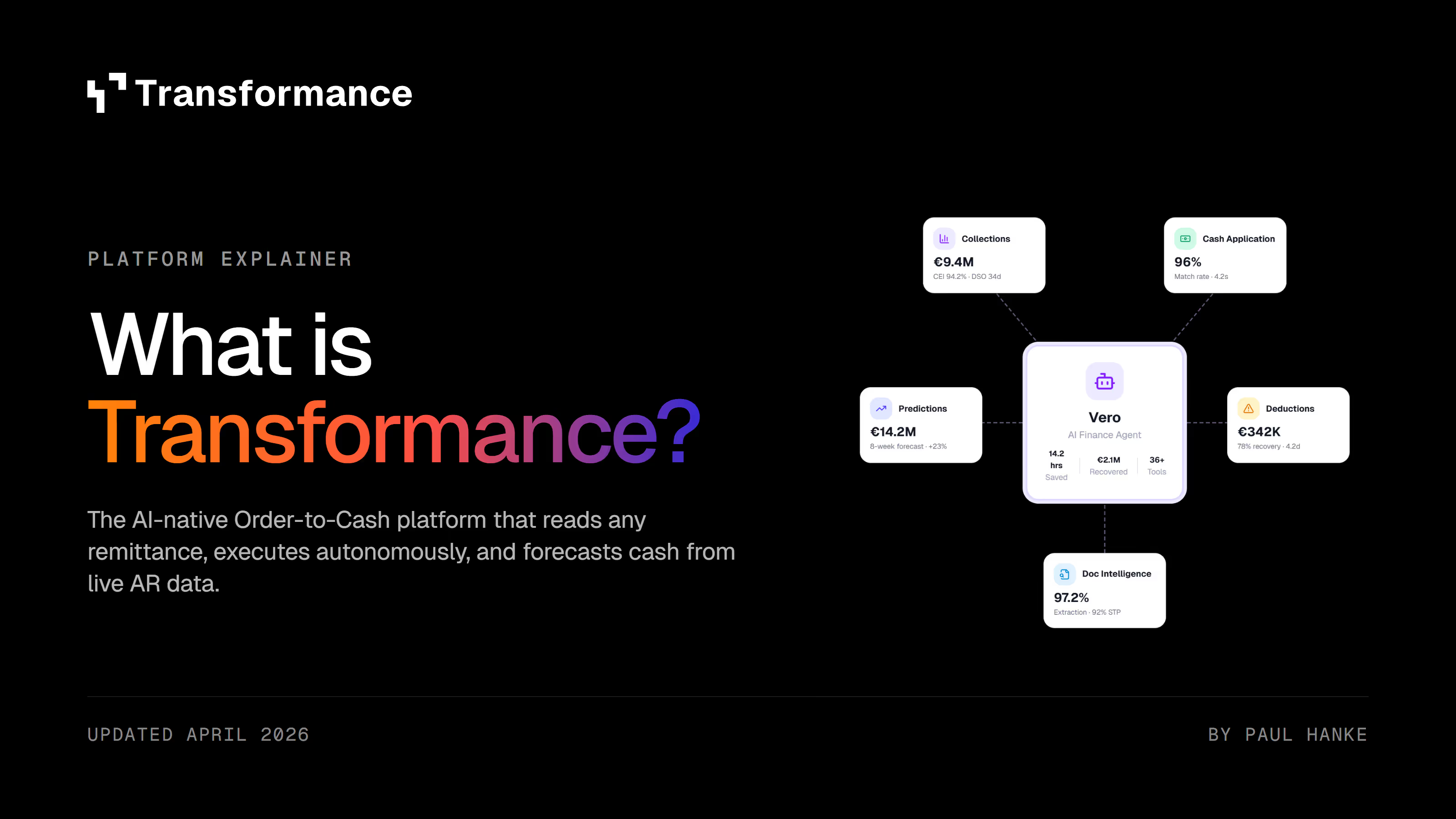
Transformance is the predictive order-to-cash agent for finance teams. Its AI agent, Vero, runs cash application, collections, deductions, and cash flow forecasting on top of the ERP you already have: it predicts what your cash will do, then works the accounts that change it. Every action is scheduled and auditable, and teams typically see their first matched payments within 2 to 4 weeks.
In This Article
- What Is Transformance?
- Why Order-to-Cash Still Runs on Manual Work
- How Vero Works
- The Four Products Vero Runs
- How Transformance Connects to Your ERP and Goes Live
- Security and Governance
- What Results to Expect
- Who Transformance Is For
- Frequently Asked Questions
- Summary
What Is Transformance?
Transformance is an AI-native order-to-cash (O2C) platform built around one AI agent that does the receivables work itself: it reads the remittance, clears the payment, makes the collection call, builds the deduction case, and updates the forecast. Your team gets the short list of items that need a human decision, with the context attached.
Vero runs four products:
- ClearMatch for cash application, with DocSense reading remittances and bank statements.
- CollectPulse for collections, including voice calls in 30+ languages.
- ClaimIQ for deductions and short payments.
- CashPulse for cash flow forecasting from live AR and AP data.
The four share one view of each customer. A payment that ClearMatch clears is no longer an open item for CollectPulse to chase, and a short payment that ClaimIQ flags shows up in the CashPulse forecast as disputed. Your ERP, whether SAP, Oracle, NetSuite, or Microsoft Dynamics, stays the system of record.
Why Order-to-Cash Still Runs on Manual Work
Most of the effort in order-to-cash happens outside the ERP. Remittance advice arrives as PDFs, scans, email bodies, and portal exports, in a different layout from every customer. One payment can settle many invoices, short-pay some of them, and reference none of them correctly. Deductions have to be traced back to a promotion agreement, a price list, or a proof of delivery, and collectors can only call so many customers a day.
The result is familiar to every AR leader: unapplied cash in suspense, invalid deductions written off because nobody had time to dispute them, DSO stuck where it was last year, and a cash forecast rebuilt by hand every week. Adding headcount moves the backlog around without changing how the work gets done. Transformance was built for this layer: the unstructured, high-volume work around the ERP, where rules and templates break.
How Vero Works
Vero is the single AI agent that runs across all four products. It matches payments, handles collections calls, investigates deductions, and generates reports, autonomously and with every step on record.
A typical overnight run looks like this. A large payment arrives with no remittance, and Vero matches it to the open invoices it covers. A customer is predicted to pay late, so Vero calls them early, in their own language. The forecast shows a cash gap several weeks out, so Vero pulls collections forward on the accounts that close it. Short payments are disputed with the evidence attached. By morning, your team reviews the handful of items Vero left for them.
Vero works through 36+ connected tools and carries out 80%+ of actions autonomously. The rest go to a person, with the context and a recommended next step attached. Three things make this work:
- One agent, shared context. A broken promise-to-pay changes the forecast, and a short payment found in cash application becomes a deduction case, without anyone re-keying it.
- Institutional Memory. Vero remembers how each customer pays, which references they use, which promises they kept, and how past disputes ended, so that knowledge stays with the team when an analyst moves on.
- Your rules, enforced. You set the playbooks, approval limits, and hand-off points, and every decision is logged for audit.
You can also chat with Vero in plain language. Ask why a payment is still unapplied, or which accounts put next month's cash at risk, and it answers from the same data it acts on, as the tour below shows.
The Four Products Vero Runs
Each product covers one stage of order-to-cash, so you can start where the pain is biggest and add the rest later. CashPulse can also run on its own, although its signal is cleaner when ClearMatch or CollectPulse feeds it.
ClearMatch: Cash Application
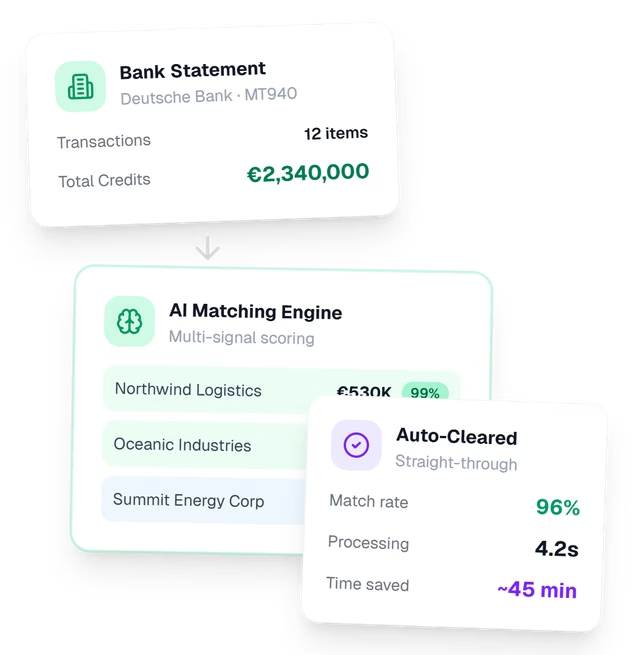
ClearMatch automates cash application from bank statement to posted journal entry. DocSense, the document intelligence inside ClearMatch, reads remittance advice and payment emails in any format (PDF, scan, email body, spreadsheet, or portal export), plus bank statements in MT940, CAMT.053, BAI2, and proprietary formats. There are no templates to maintain, so a customer changing their remittance layout breaks nothing.
Matching combines five layers (reference parsing, amount matching, pattern recognition, fuzzy logic, and historical behavior analysis) to handle partial payments, overpayments, rounding differences, and one payment that settles many invoices. Every match carries a confidence score: above your threshold it posts, and below it the item goes to a review queue with a recommendation. Each entry is checked for balance, period, currency, and GL account before it posts.
The result: above 90% straight-through processing, above 95% match accuracy, and under 1 minute per statement.
CollectPulse: Collections
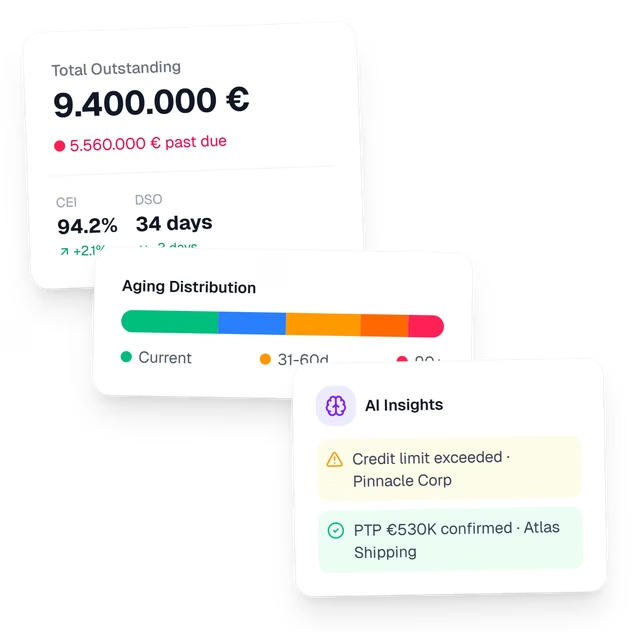
CollectPulse works every overdue account, including the long tail your collectors rarely reach. A live risk score built from exposure, aging, and broken promises sorts the worklist by who is about to slip.
Vero handles the first touches itself: dunning emails, printed letters, and autonomous voice calls in 30+ languages. It identifies itself as AI at the start of every call, and each call ends with a structured outcome: a promise-to-pay date, a dispute, an escalation, or a follow-up. When a customer replies by email, Vero reads the promise or dispute from their own words, updates the account, pauses the dunning sequence, and drafts the reply.
You set the policy once in a visual rule builder, including separate rules for regions or key accounts and exactly when Vero hands an account to a person.
ClaimIQ: Deductions
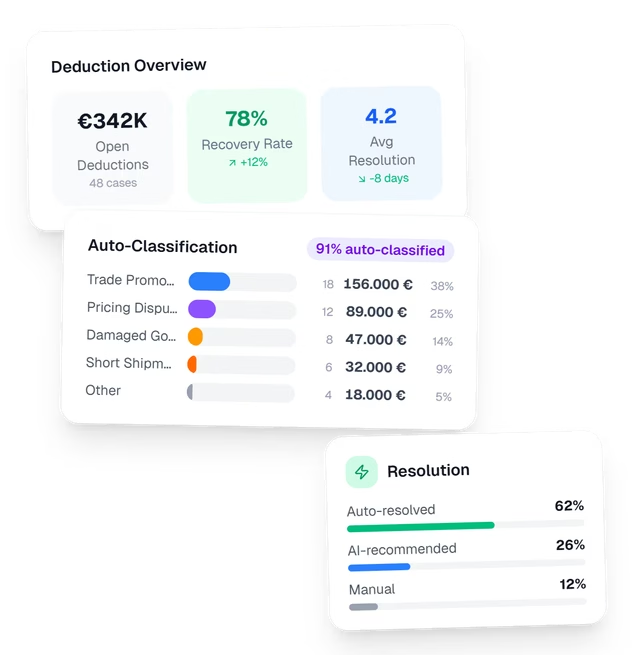
ClaimIQ takes deduction management from detection to resolution. It picks up short payments from bank clearings and remittances, then classifies each one: trade promotion, pricing discrepancy, shortage, damaged goods, early payment discount, or other.
Vero then links the invoice, the payment, the trade agreement, the proof of delivery, and the customer's emails into one evidence chain, and recommends accept, dispute, or split with a confidence score. The dispute comes back drafted with the evidence attached: above your approval limit a person signs it off, and below it the claim goes out.
Recovery is tracked by category, customer, and region, so your commercial team sees where the same deductions keep coming from. Every classification, recommendation, and human override is logged for your finance controls.
CashPulse: Cash Flow Forecasting
CashPulse forecasts net cash from live AR and AP data instead of aging buckets and bank snapshots. The AR side comes from the other products: payments ClearMatch has matched, disputes ClaimIQ has flagged, and promise-to-pay dates CollectPulse has captured. The AP side comes from committed purchase orders, payroll, and tax schedules, and FX rates and commodity prices feed in directly.
Every forecast ships as a range (best case, expected, and risk-adjusted) by entity and currency, netted into one group position. The first 13-week cash flow forecast is typically live within 2 to 4 weeks, and as of 2026, customers report above 90% accuracy out to 90 days. When the forecast shows a gap, Vero can pull collections forward to close it.
If your forecast still lives in a spreadsheet, start with the free 13-week cash flow forecast template: a live calculator in your browser plus a downloadable 8-tab Excel file.

How Transformance Connects to Your ERP and Goes Live
Transformance runs on the systems you already have. SAP, Oracle, NetSuite, and Microsoft Dynamics connect read-only to start, so nothing in your ERP changes on day one: no migration, no data warehouse project, and no rip and replace. Banks and email inboxes connect alongside, and other systems connect via API.
When you are ready to write back, matched payments post as validated journal entries, collection outcomes land on the customer record, and deduction settlements post with their investigation trail.
- Connect: your ERP, bank feeds, and email, read-only to start.
- Configure: escalation rules, approval limits, languages, and schedules.
- First value: first matched payments within 2 to 4 weeks.
- Full rollout: ERP integration, remittance capture, and deduction workflows within 4 to 8 weeks, depending on complexity.
That is what "weeks, not quarters" means in practice. There are no templates to train and no dedicated admin to hire, and a pilot on a slice of your AR data shows match rates and time savings before you commit. For the wider buying process, see how to choose and deploy order-to-cash software.
Security and Governance
Workflows can run inside your own VPC, so your financial data stays within your cloud boundary. The platform hosts only application code and metadata, and nothing you process is used to train AI models.
- Access control: SSO/SAML, role-based access control, and end-to-end encryption.
- Your choice of AI model: bring your own, or use the compliant options provided.
- Full audit trail: every autonomous action and every human override is logged, and the working behind each match can be checked line by line.
- Transparent voice calls: the collections agent identifies itself as AI at the start of every call, and transcripts and consent are logged.
Governance stays with you: confidence thresholds and approval limits decide what Vero does alone and what waits for a person. For the regulatory side, see what the EU AI Act means for order-to-cash teams.
What Results to Expect
Results depend on your volumes, data quality, and starting point, which is why the pilot comes first. These are the outcomes customers typically see:
- DSO: a reduction of 8 to 12 days on average, because every overdue invoice gets worked and late payers are contacted early.
- Cash application: above 90% straight-through processing, above 95% match accuracy, and under 1 minute per statement.
- Forecasting: as of 2026, customers report above 90% accuracy out to 90 days, with confidence ranges to plan against.
- Time to value: first matched payments in 2 to 4 weeks and a full rollout in 4 to 8 weeks.
"Transformance was ultra fast at solving our financial data challenges." Commercial Controller, mid-cap brewery
To see where you stand today, the free DSO calculator compares your DSO with 17 industry benchmarks and shows how much working capital each day of DSO ties up. For examples by industry, read the customer stories.
Who Transformance Is For
Transformance is built for CFOs, controllers, and AR and finance operations leaders at mid-market and enterprise companies who want to cut DSO, reduce write-offs, and take manual work off their teams. It fits best when several of these are true:
- You process high payment volumes, with remittances in many formats or none at all.
- Your customers take deductions, and investigating them eats analyst time.
- Your collectors cannot reach every overdue account, or you collect across countries and languages.
- You run several legal entities, currencies, or ERPs and want one view across them.
- Your cash forecast is still rebuilt by hand from aging reports and bank balances.
Finance teams in food and beverage, consulting, logistics, agriculture, energy, automotive, e-commerce, and consumer goods run it today. Transformance does not replace your ERP or your treasury system; it does the receivables work around them.
Frequently Asked Questions
What is Transformance?
Transformance is the predictive order-to-cash agent for finance teams. A single AI agent, Vero, runs cash application (ClearMatch), collections (CollectPulse), deductions (ClaimIQ), and cash flow forecasting (CashPulse) end to end on top of your ERP, and every action it takes is logged for audit.
How is Transformance different from an ERP module?
Your ERP stays the system of record and records transactions once the data is clean. Transformance does the work before that: reading remittances in any format, matching partial and multi-invoice payments, calling customers, investigating deductions, and forecasting net cash. It reads from the ERP and writes validated results back, so nothing is migrated or replaced.
Which ERPs does Transformance integrate with?
Transformance integrates with SAP, Oracle, NetSuite, and Microsoft Dynamics, and other systems connect via API. Banks and email inboxes connect alongside, with bank statements in MT940, CAMT.053, and BAI2 formats. The ERP connection starts read-only, and every entry is validated before it posts.
How long does it take to deploy Transformance?
Most teams see their first matched payments within 2 to 4 weeks. A full rollout, including ERP integration, remittance capture, and deduction workflows, typically takes 4 to 8 weeks depending on complexity. There is no migration, no template training, and no dedicated admin to hire.
Is our financial data secure?
Workflows can run inside your own VPC, so your financial data stays within your cloud boundary, and nothing you process is used to train AI models. Access runs through SSO/SAML and role-based access control, and every autonomous action is logged for audit.
What results can we expect?
Customers cut DSO by 8 to 12 days on average. Cash application runs above 90% straight-through processing, with above 95% match accuracy and under 1 minute per statement. As of 2026, customers report above 90% forecast accuracy out to 90 days.
Does Transformance replace our AR team?
No. Vero takes on the repetitive volume: matching payments, first and second collection contacts, gathering deduction evidence, and updating the forecast. Your team keeps the work that needs judgment, such as approvals above your limits, key-account conversations, and complex disputes, and you decide where Vero hands over.
How is Transformance priced?
Transformance is priced as a per-volume platform fee under a single contract. As of 2026, pricing scales with users, transaction volume, and AI usage, and it varies by deployment. A pilot on a slice of your AR data comes first, so you can measure match rates and time savings before you commit.
Summary
Transformance puts one predictive agent, Vero, on top of the ERP you already run. ClearMatch applies cash, CollectPulse collects it, ClaimIQ defends it against invalid deductions, and CashPulse forecasts it, with every action on record. It connects read-only first, goes live in weeks, not quarters, and customers cut DSO by 8 to 12 days on average.
The fastest way to judge it is on your own data. Book a Call to scope a pilot on a slice of your AR.
Last updated: September 2026