TSFM
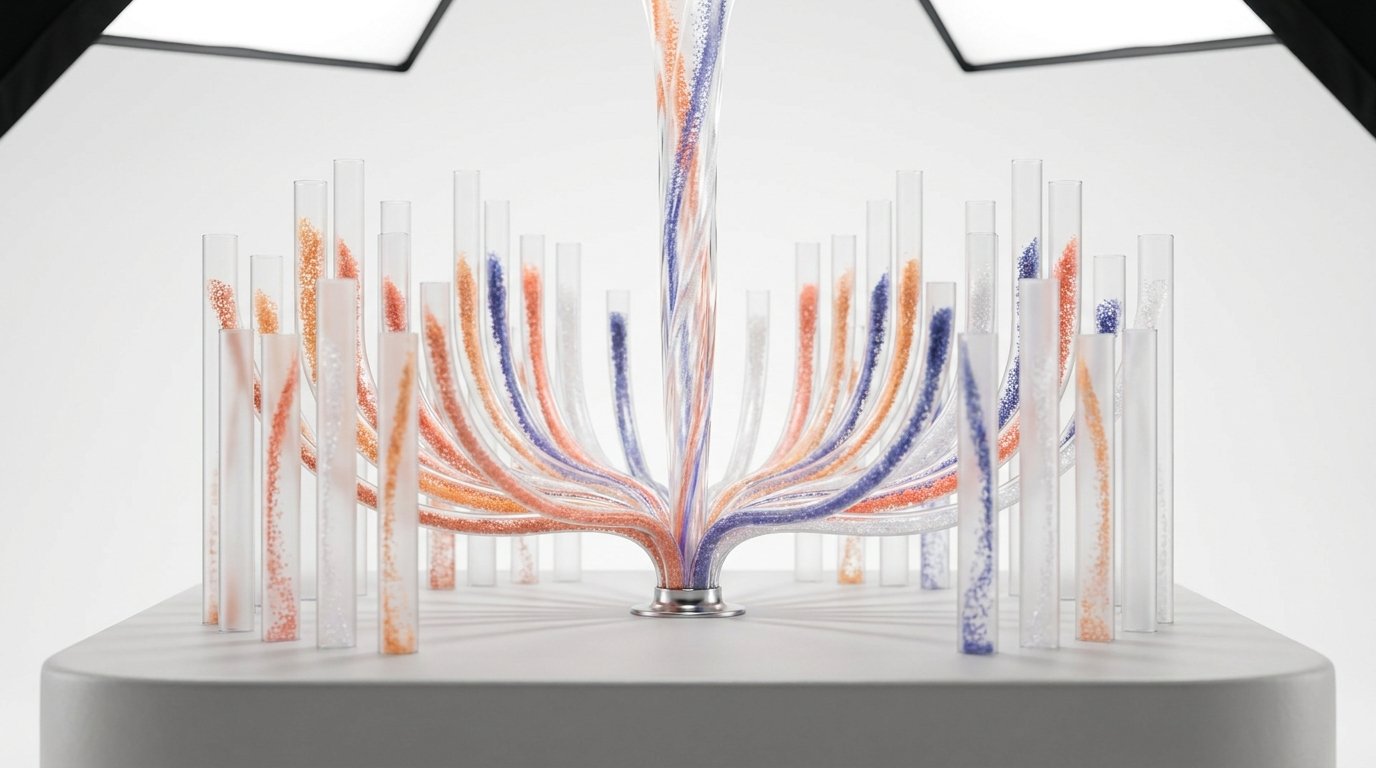
A time series foundation model (TSFM) is a large neural network pre-trained on millions of historical time series across domains, enabling zero-shot or few-shot forecasting on new series without per-series training. For finance teams, TSFMs collapse fleets of per-customer or per-entity forecasting models into a single shared model that generalises to AR payment timing, cash flow, FX, and demand forecasting.
A time series foundation model, or TSFM, is a large neural network pre-trained on vast collections of historical time series so it can forecast new series it has never seen before. The model learns general patterns of trend, seasonality, level shifts, and noise across millions of series from weather, traffic, retail, energy, finance, and synthetic data, and applies those patterns to any new series at inference time. The result is zero-shot forecasting: you point the model at a new series, hand it the recent history as context, and it returns a probabilistic forecast without any per-series training step.
This is a different paradigm from classical methods like ARIMA or Prophet, which fit one model per series, and from per-series deep learning approaches like LSTMs, which still require training data and tuning for each new use case. A single TSFM can serve hundreds of forecasting problems across a finance organisation from one set of model weights.
Most TSFMs are transformer-based architectures borrowed from the large language model world. The core trick is turning numeric time series values into tokens the transformer can attend to. Approaches vary: Chronos quantises values into a fixed vocabulary and treats each value as a token, reusing a T5 backbone almost unchanged. TimesFM uses patched input representations and a decoder-only architecture. Moirai handles multiple frequencies and irregular sampling in one universal model. Lag-Llama uses lagged features as input tokens in a Llama-style decoder.
Pre-training corpora typically span millions of series across weather, electricity demand, traffic counts, retail sales, financial markets, and large quantities of synthetic series generated to cover edge cases. The objective is usually next-patch or next-token prediction, mirroring how large language models are trained on next-token prediction over text.
TimesFM from Google is a 200M parameter decoder-only model, freely available, and one of the strongest zero-shot baselines on public benchmarks. Chronos from Amazon ships in multiple sizes from tiny to large, uses value-as-token quantisation on a T5 backbone, and is widely cited for its simplicity. Moirai from Salesforce is a universal model designed to span heterogeneous frequencies in one set of weights. Lag-Llama from Morgan Stanley and ServiceNow is a decoder-only model explicitly designed with finance use cases in mind. TimeGPT from Nixtla is a commercial offering with a hosted API and finance-friendly tooling around it.
All five are mature enough that a finance team can benchmark them on its own data in a few weeks rather than a few quarters.
TSFMs shine when you have many series and limited history per series, when you need probabilistic outputs out of the box, and when the operational cost of maintaining one model per series has become unbearable. They produce calibrated P10, P50, and P90 forecasts natively, which matters for cash forecasting where the tail of the distribution drives liquidity decisions.
They are weaker than well-tuned per-series models when a single series has a long, stable history and clean seasonality. They cost more compute per forecast than ARIMA or Prophet. Their predictions are harder to explain to an auditor than the coefficients of a classical model. And they can struggle with structural breaks, such as a customer changing payment terms or a one-time policy shift, unless the context window includes the break.
In AR-driven cash forecasting, the dominant pattern for the last decade has been a fleet of per-customer Prophet or LightGBM models, one per customer or per segment, each trained, tuned, and monitored separately. This is operationally painful: hundreds or thousands of models, each with its own drift, retraining schedule, and failure mode.
A TSFM collapses this fleet into one shared model. Each customer's payment timing series is forecast zero-shot using the customer's recent invoice and payment history as context. The same backbone extends naturally to AP payment timing for working capital planning, FX exposure forecasting, and demand forecasting for inventory-linked AR. One model, one monitoring pipeline, one inference stack.
The accuracy story is now competitive: recent benchmarks show TSFMs matching or beating tuned per-series Prophet on aggregate, with much lower total cost of ownership. Transformance.ai is exploring time series foundation models for AR-driven cash forecasting, see our benchmark notes against per-series Prophet and LightGBM models on real AR portfolios.
Benchmark on your own data, not vendor leaderboards. Hold out the last 90 days of payment history per customer, generate zero-shot forecasts, and score against actuals using both point error (MAE on P50) and probabilistic calibration (whether actuals fall inside P10-P90 bands at the expected rate). Compare against the per-series baseline you already run.
Check that the model's context window covers your typical history length: most TSFMs handle 512 to 2048 historical points, which is fine for daily payment series but tight for hourly data. Test few-shot fine-tuning on your domain to see if a small amount of finance-specific training closes any remaining gap. Finally, model total cost of ownership end to end: inference compute, model hosting, retraining cadence, and the engineering hours saved by retiring the per-series fleet.
A time series foundation model is a large neural network pre-trained on millions of historical time series so it can forecast new series zero-shot, without any per-series training step. It generalises patterns of trend, seasonality, and noise learned across domains to any new forecasting problem at inference time.
ARIMA and Prophet fit one model per series and require historical data and tuning for each new series. A TSFM uses one set of pre-trained weights to forecast any series, including ones it has never seen, by conditioning on recent history as context. This collapses fleets of per-series models into a single shared model.
The leading models are TimesFM from Google, Chronos from Amazon, Moirai from Salesforce, Lag-Llama from Morgan Stanley and ServiceNow, and TimeGPT from Nixtla. The first four are open weights and the fifth is a commercial hosted API. All are stable enough for finance teams to benchmark on their own data.
Recent benchmarks show TSFMs matching or beating tuned per-customer Prophet and LightGBM models on AR payment timing, with much lower operational cost. Accuracy depends heavily on context window length, series quality, and whether structural breaks are inside the context window. Always benchmark on your own portfolio before committing.
TSFMs are weaker than well-tuned per-series models on long, stable, clean series. They cost more compute per forecast than classical methods. They are harder to explain to auditors than statistical models with named coefficients. And they can struggle with structural breaks unless the break is inside the context window.
It replaces the fleet-of-per-customer-Prophet-models pattern with one shared model that forecasts each customer's payment timing zero-shot. The same backbone extends to AP payment timing, FX exposure, and demand forecasting, giving treasury and FP&A one model, one monitoring pipeline, and one inference stack to maintain.