Key Takeaways
- Oracle AR is the system of record for customer balances, not a processing engine for complex or unstructured payment data.
- The best automation tools sit on top of Oracle AR, reading unstructured documents and writing validated results back to the Oracle subledger.
- According to a Gartner 2024 Finance AI Survey, 58% of finance functions now use AI, with AR and AP process automation among the top three use cases.
- Legacy AR platforms take 3 to 6 months to deploy and rely on OCR-plus-rules engines that require template maintenance per remittance format.
- Transformance's ClearMatch uses vision language models for document processing, deploys in 4-8 weeks (vs 3-6 months for HighRadius and BlackLine), and reaches 95%+ match rates within 90 days as the persistent memory layer learns customer payment patterns.
In This Article
- Key Takeaways
- What Is Oracle Accounts Receivable?
- Why Does Oracle AR Need an Additional Automation Layer?
- Quick Comparison: Best AR Automation Tools for Oracle in 2026
- 4 AR solutions for Oracle Net Suite
- How Do You Choose the Right AR Automation for Oracle?
- What Is the Right Architecture for an Oracle AR Automation Stack?
What Is Oracle Accounts Receivable?
Oracle Accounts Receivable (Oracle AR) is the receivables management module within the Oracle ERP suite, available in Oracle Fusion Cloud, Oracle E-Business Suite, and JD Edwards. It manages the complete receivables lifecycle: creating invoices and credit memos, recording customer receipts, applying payments to open balances, managing customer accounts, and producing AR subledger accounting entries. Oracle AR is the system of record for what customers owe, not a document processing or AI matching engine.
What Oracle AR handles well:
- Invoice creation, credit memo management, and customer account tracking
- Standard receipt matching when payment references align exactly with open invoices
- Aging reports, DSO calculations, and AR-to-GL subledger reconciliation
- Customer credit limit enforcement and dunning letter generation
- Integration with Oracle Collections and Oracle Credit Management modules
Where Oracle AR falls short:
- Cannot read PDFs, email attachments, or bank portal downloads containing remittance data
- No AI-driven payment matching for partial payments, splits, or non-standard references
- No autonomous deduction identification or cross-document investigation
- Collections module is rules-based and workflow-driven, with no predictive scoring or autonomous outreach capability
- Cash application remains largely manual for anything outside perfect EDI remittances
The gap between what Oracle AR records and what your finance team does every day is where the real cost lives.
Why Does Oracle AR Need an Additional Automation Layer?
Oracle AR was designed to be a ledger. It records transactions after someone, or something, has already done the work of reading documents, matching payments, and resolving disputes. That upstream processing is where finance teams spend most of their time.
According to the BillingPlatform 2025 State of AR Automation Survey, 78% of finance leaders cite poor cash flow and high DSO as the most significant consequence of inefficient AR operations. The average DSO across industries sits at 67 days, well above the 28-day payment terms most companies offer.
Gartner’s 2024 Finance AI Survey found that 58% of finance functions now use AI, with AR and AP process automation ranked among the top three active use cases. And a PYMNTS study found that 62% of companies that implemented AR automation reported measurable DSO reductions within the first full cycle after deployment.
The economics push in the same direction. Manual cash application requires an AR analyst to open each remittance document, read it, find the matching invoice, verify amounts, check for deductions, and post the result. Multiply that by thousands of receipts per month and the labor cost compounds quickly, before factoring in errors, rework, and the DSO impact of delayed posting.
The right answer is adding a processing layer that reads the upstream documents Oracle AR can’t handle, matches payments intelligently, and writes clean results back. The question is which layer delivers that without a six-month implementation.
Quick Comparison: Best AR Automation Tools for Oracle in 2026
| Platform | Best For | Oracle Integration | Deployment | Key Strength | Key Limitation |
|---|---|---|---|---|---|
| Transformance | Mid-market & large enterprise with complex, unstructured payment data | Native Oracle connector via Integration Guard | 4 to 8 weeks | VLM-based document processing; no templates needed; handles messy remittance data | Focused on O2C automation only; not a broader financial close suite |
| HighRadius | Fortune 500 with structured, high-volume payment flows | Deep Oracle and SAP integration | 3 to 6 months | Broad suite covering cash app, collections, deductions, credit | Template-dependent OCR; new formats require configuration; longer deployment |
| BlackLine | Companies prioritizing financial close and reconciliation alongside AR | Oracle-first; also supports SAP | 3 to 6 months | Best-in-class account reconciliation; strong financial close workflow | Cash application is secondary to close process; less depth in remittance parsing |
| Oracle AR Native | Low-complexity environments already running Oracle Financials | Built-in | Already deployed | Zero integration overhead; uses existing Oracle setup | No AI matching; no remittance parsing; manual exception handling |
4 AR solutions for Oracle Net Suite
Transformance: Best for Mid-Market and Large Enterprises with Complex, Unstructured Payment Data
Transformance is an AI-native O2C execution layer covering four products: ClearMatch for cash application, ClaimIQ for deductions and claims, CollectPulse for collections and dunning, and CashPulse for cash forecasting. Vero, the cross-product AI intelligence layer, acts as a persistent AI team member that handles routine work autonomously and surfaces exceptions with full context and a recommended action.
The core technical difference from every other platform in this list: Transformance uses vision language models to read remittance documents, not OCR-plus-regex templates. When a new customer sends a remittance format the system has never seen, DocSense, the VLM-powered extraction engine, reads it correctly on the first attempt. No template training. No format-specific configuration. No manual mapping per new customer. DocSense achieves 99.7% accuracy on structured remittance data and 94.9% across all document types without any configuration.
Match rates follow a different trajectory from legacy tools: roughly 85% at deployment, improving automatically to 95%+ within 90 days as the persistent institutional memory system accumulates customer-specific payment patterns. The improvement is automatic. Platforms without persistent memory start from zero every session.
For Oracle environments specifically, ClearMatch connects via native ERP connectors to Oracle Fusion Cloud and Oracle E-Business Suite. Posting validation checks every journal entry before it touches the Oracle subledger: debit/credit balance checks, GL account validation, required field enforcement, and entity-specific posting rules. Controllers see a preview with pass/fail indicators before approving. Nothing posts without human sign-off.
Full rollout, including Oracle integration, remittance capture, and deduction workflows, takes 4 to 8 weeks. First payments are matched in days after the connector goes live, with no dedicated admin required after deployment.
The collections layer, CollectPulse, runs autonomous dunning sequences and AI calling in 70+ languages. For shared service centers handling cross-border AR, a three-person team can run Italian, French, and Spanish collection calls simultaneously without native-speaker headcount. AI calling throughput runs at 15 to 20 calls per hour, compared to 15 to 20 calls per day for a human collector.
For a detailed walkthrough of how AI cash application works from document ingestion to GL posting, the agentic AI for cash application guide covers the full technical flow.
Best for: Mid-market and large enterprises (500M to 25B+ euros in revenue) running Oracle with PDF-heavy or multi-format remittance flows, high deduction volumes from retail or FMCG customers, or cross-border collections across multiple languages. Enterprise IT-optimized: VPC deployment, SSO/SAML, RBAC, audit trails, ISO 27001.
Pricing: Module-based, tied to users, transaction volume, and AI usage. 25 to 30% more affordable than incumbent platforms, with faster onboarding that reduces total implementation cost. Pilots are available on a real slice of your AR data before any commitment.

HighRadius: Best for Enterprises with Structured Data Flows
HighRadius is the dominant AR automation platform at the Fortune 500 level. Their AI engine, launched in 2017, covers cash application, credit, collections, deductions, and treasury. They have deep Oracle and SAP integrations, a large installed base, and a broad feature set that includes credit risk scoring and treasury visibility alongside core AR.
Their strength is breadth. If you need AR automation, credit management, and treasury visibility in a single contract, HighRadius offers that. Their implementation methodology is mature and their sales organization knows Oracle environments well.
The structural limitation is technology foundation. HighRadius was built on first-generation architecture: OCR-plus-regex templates for document processing, rules-based matching at the core, and traditional ML layered on top. Each new remittance format requires template configuration. When a customer updates their AP system and their remittance layout changes with it, templates break and require maintenance. The digital assistant is stateless, processing each session fresh with no memory of past resolutions, customer patterns, or seasonal payment behavior.
Implementation takes 3 to 6 months and typically requires a dedicated admin and IT involvement for Oracle connector configuration.
Best for: Very large enterprises (over 1B USD in revenue) with relatively structured data flows, dedicated IT resources for AR system administration, and existing HighRadius relationships or ecosystem commitments.
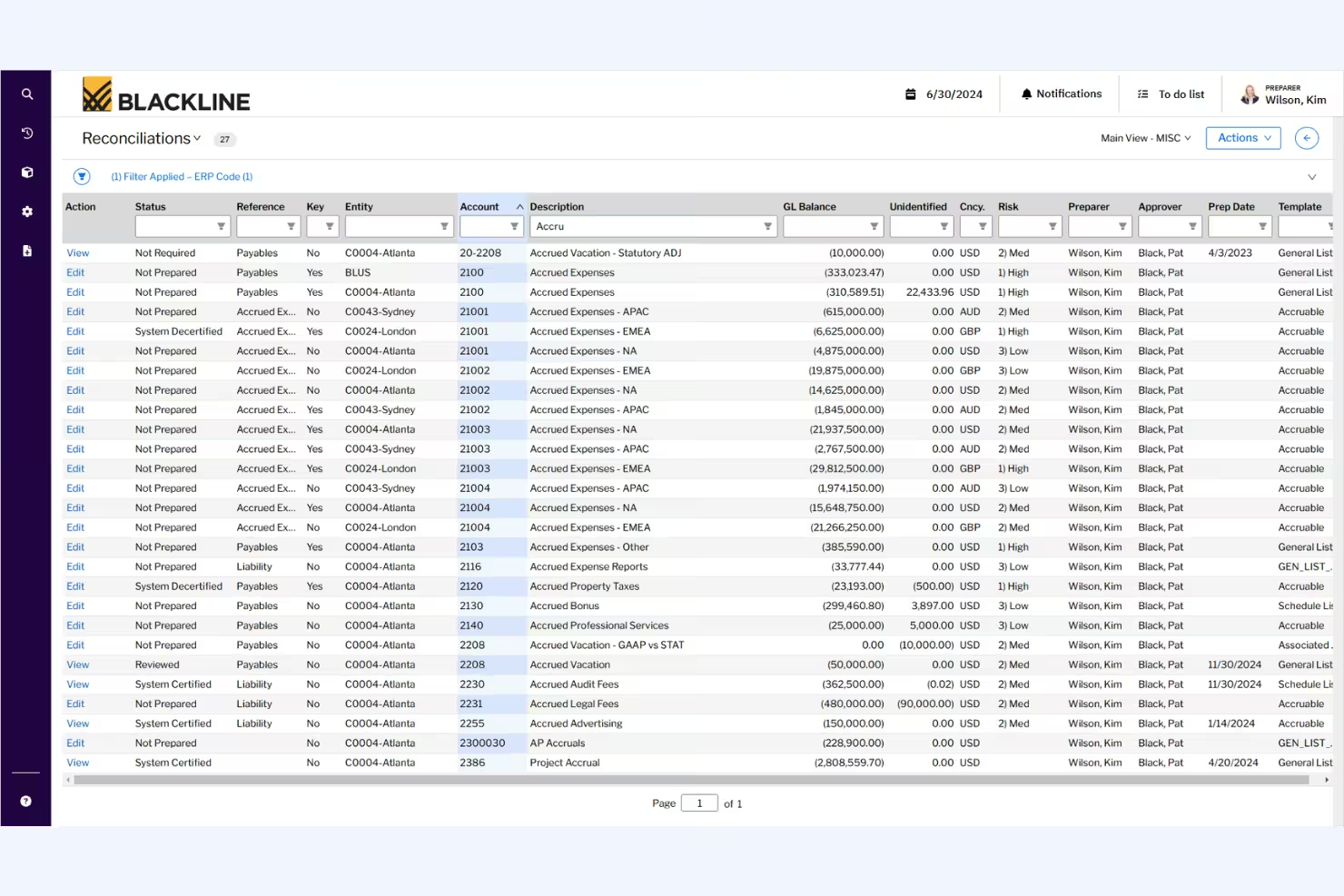
BlackLine: Best for Companies That Need Financial Close and AR in One Contract
BlackLine leads the financial close automation space: account reconciliation, journal entry management, intercompany, and variance analysis. If the month-end close is the primary problem rather than daily AR execution, BlackLine is purpose-built for it.
Their cash application module connects to Oracle, but it is a secondary product within a broader close suite, not a matching engine designed for high document volume. Implementation takes 3 to 6 months, the platform is more heavily optimized for SAP environments, and Oracle configurations require more custom work. Users report data lag between AR events and what the BlackLine system reflects.
The practical reality for AR teams: you pay for a financial close suite and receive a cash application module alongside it. If your objective is AR automation specifically, BlackLine is overbuilt for the problem and slower to deliver value than purpose-built alternatives.
Best for: Companies that need both financial close automation and basic AR cash application, are already evaluating BlackLine for reconciliations, and are prepared for the longer Oracle-specific implementation timeline.
For context on what controllers actually want from finance automation versus what vendors typically deliver, the AI automation in financial controlling article is worth reading before you finalize your shortlist.

Oracle AR Native: Best for Low-Complexity Environments
Oracle AR is already in your environment if you run Oracle ERP. For companies with clean, EDI-structured remittances and limited payment complexity, the native module handles basic receipt recording without additional tools or integration overhead.
The ceiling is real. As soon as you need to process PDF remittances, handle partial payments, investigate deductions, or automate collection outreach, the native module requires manual intervention. There is no AI matching engine, no deduction management workflow, and no autonomous collections capability in the base product.
Oracle does offer an AI cash application add-on, available as a cloud microservice on Oracle BTP. The cost adds approximately 75,000 to 195,000 euros in Year 1 on top of existing Oracle licenses, and implementations typically take 18 to 24 months to reach meaningful matching value. The add-on also requires structured input: it doesn’t resolve the unstructured document problem upstream.
Best for: Businesses with low transaction volumes, clean EDI remittances, limited format diversity, or those using Oracle AR as the system-of-record layer beneath a separate automation platform.
How Do You Choose the Right AR Automation for Oracle?
Feature checklists look similar across vendors. The differences that matter show up when you ask five specific questions before signing anything.
5 Key Criteria for Evaluating AR Automation for Oracle
- Can it process unstructured documents without template configuration? Your customers don’t send perfectly structured EDI. They send PDFs, email attachments, and portal downloads. Ask each vendor directly: “What happens when a new customer sends a remittance format you’ve never seen?” If the answer involves templates, training periods, or per-format onboarding, that’s a first-generation tool with ongoing maintenance built in.
- What is the match rate on your actual production data? Match rate demonstrations on clean, pre-formatted test datasets are meaningless. Ask for a pilot on your real Oracle AR data: actual remittances, actual invoices, actual exceptions from last quarter. The gap between demo performance and production performance is where most vendor relationships go wrong.
- When is the first matched receipt posted to Oracle? “Full implementation in 3 to 6 months” means months of license fees before your controllers see a single automatically matched payment. Push for a specific answer: “When will the first matched receipt post to our Oracle GL?” The answer should be measured in days, not months.
- Does the AI accumulate knowledge, or reset each session? Stateless AI tools process every session independently. They don’t remember how you resolved last quarter’s exceptions, don’t know that your largest retailer always pays with truncated PO references, and don’t flag customers who have broken three consecutive payment promises. Persistent memory changes the economics: the tool improves measurably over 90 days, 180 days, and a year.
- What does the Oracle write-back validation look like? Every vendor claims Oracle integration. Ask to see the journal entry validation screen before posting. If there is no pre-posting validation layer with GL account checks, required field enforcement, and entity-specific rules, your controllers will spend their time correcting what the automation created. That is not a time saving.
What Is the Right Architecture for an Oracle AR Automation Stack?
The architecture that consistently works for mid-market and large Oracle environments is: Oracle AR as the system of record, plus a purpose-built automation layer that processes what Oracle AR can’t.
Oracle AR records what happened. The automation layer does the upstream work: reading documents, matching payments, investigating deductions, and following up on overdue invoices. The two systems complement each other.
For the automation layer, three minimum criteria separate platforms that deliver consistent value from those that create more work:
- Processes unstructured remittance documents without template configuration
- Writes validated results back to Oracle before anything posts to the subledger
- Deploys and delivers first value in weeks, not months
Platforms that clear all three are worth serious evaluation. Platforms that don’t clear all three will require your team to compensate for the gaps manually, which is the problem you were trying to solve in the first place.
If you’re evaluating Oracle AR automation as part of a broader order-to-cash overhaul, the order-to-cash AI use cases guide covers the full O2C workflow with concrete before-and-after scenarios that help scope what automation can realistically deliver.
Frequently Asked Questions
What is Oracle Accounts Receivable used for?
Oracle Accounts Receivable is the receivables management module within the Oracle ERP suite. It handles invoice creation, customer receipt recording, payment application to open balances, aging reporting, and AR subledger accounting. It is the system of record for customer balances, not a processing engine for unstructured remittance documents or complex matching scenarios.
What is the best AR automation software that works with Oracle?
The best option depends on your complexity and timeline. For mid-market and large enterprises with diverse remittance formats, high deduction volumes, or cross-border collections, an AI-native platform with vision language model-based document processing and Oracle write-back validation delivers the strongest results and the fastest time to value. For Fortune 500 enterprises with highly structured data and dedicated IT resources, HighRadius is the established incumbent with deep Oracle integration.
How long does it take to implement AR automation on Oracle?
Implementation timelines vary significantly by platform. Legacy platforms typically take 3 to 6 months. Oracle’s own AI cash application add-on can take 18 to 24 months to reach meaningful matching value. AI-native platforms with VLM-based document processing deploy in 4 to 8 weeks, with first payments matched in days after the Oracle connector goes live.
What is an ERP execution layer for accounts receivable?
An ERP execution layer is an automation platform that sits between the ERP and the finance team. It reads unstructured data (PDFs, emails, remittance advices) that the ERP can’t process natively, executes matching, deduction investigation, and collection work, and writes clean validated results back to the ERP subledger. The ERP remains the system of record; the execution layer does the processing work upstream.
What is the difference between BlackLine and HighRadius?
BlackLine focuses on financial close automation: account reconciliation, journal entry management, intercompany, and variance analysis. HighRadius focuses on AR execution: cash application, collections, credit, and deductions. They overlap in cash application but serve different primary use cases. If your pain is the month-end close, BlackLine is purpose-built for that problem. If your pain is AR processing, collections, and deductions, HighRadius or an AI-native alternative is the better fit.
What are the best HighRadius alternatives for Oracle in 2026?
The alternatives worth evaluating are AI-native platforms with modern document processing architectures. The questions to ask: Does the platform process unstructured remittances without template configuration? Does it have persistent memory that improves match rates over time? Does it deploy in weeks rather than months? Platforms that meet all three criteria are architecturally different from first-generation tools, particularly for enterprises with complex or diverse remittance data.
Why does Oracle’s native AR module fall short for complex environments?
Oracle AR was designed as a ledger, not a document processor. It records transactions after the matching work has already been done. For enterprises with PDF-heavy remittances, partial payments, trade deductions, or cross-border collections, the native module requires significant manual work upstream. The underlying limitation is architectural: Oracle AR expects structured input, but most large-enterprise payment flows arrive unstructured.
Last updated: May 2026
Sources
- Gartner Survey Shows 58% of Finance Functions Using AI in 2024
- Gartner Finance Survey Reveals the Top 10 Technologies for Future Investment in Finance
- Accounts Receivable Automation Market Size and Growth
- 25 Accounts Receivable Statistics Shaping AR in 2025
- IOFM Benchmarking: How Do You Calculate Your Cost Per Invoice?