



Deductions management software replaces hours of manual investigation with automated identification, classification and resolution of short payments. This guide covers what it does, how AI changes it and the seven criteria to use when you choose a platform.
Key Takeaways
- According to The Hackett Group (2026), automating collections, dispute and deduction management lets organizations reallocate up to 57% of staff capacity and cut average days delinquent by 8.5 days (Hackett Group press release, 30 March 2026)
- BCG estimated in 2012 that consumer products manufacturers spend more than $500 billion per year on trade spending globally (BCG)
- Transformance ClaimIQ identifies deductions with 97% accuracy in under 15 seconds each, against about 45 minutes manually (Transformance platform data, 2026)
- About 40% of trade deductions are auto-validated by rules in ClaimIQ, and it connects to SAP S/4HANA and ECC, Oracle, NetSuite and Dynamics (Transformance platform data, 2026)
- Transformance goes live in up to 4-8 weeks, with a proof of value in 4-5 weeks on one entity
In This Article
- Key Takeaways
- What Is Deductions Management Software?
- Why Does Deductions Management Software Matter for Enterprise Finance?
- How Does AI Change Deductions Management?
- 7 Key Criteria for Evaluating Deductions Management Software
- Which Deductions Management Platforms Exist?
- What Does a Before/After Look Like?
- How to Get Started with Deductions Automation
- Frequently Asked Questions
- Take Action: Stop Writing Off Valid Revenue
What Is Deductions Management Software?
What Is Deductions Management?
Deductions management is the process of identifying, validating and resolving short payments on customer invoices. When a customer pays less than the invoiced amount, the difference is a deduction. It can be a valid trade promotion, a pricing dispute, a shortage claim or an error. See our guide to what deductions management is and the glossary entries for trade deductions, deduction management and short pay.
Deductions management software automates this process. It reads deduction memos and remittance advices, classifies each deduction by reason code, checks validity against promotional agreements and delivery records, and either auto-settles valid deductions or generates dispute packages for invalid ones.
Without software, AR analysts spend hours per deduction. They log into the ERP, cross-reference the promotion calendar, check proof of delivery, email the sales team and draft dispute letters by hand. Transformance platform data puts manual handling at about 45 minutes per deduction, against under 15 seconds with ClaimIQ.
Retailer power makes this harder for consumer goods suppliers. In its 2014 sector inquiry, the Bundeskartellamt found that the four largest food retail groups account for around 85% of the German food retail market. Suppliers in that market sell to a small number of very large buyers (Bundeskartellamt, 2014).
Why Does Deductions Management Software Matter for Enterprise Finance?
Trade spend is one of the largest cost lines for consumer goods makers. BCG estimated in 2012 that consumer products manufacturers spend more than $500 billion per year on trade spending globally (BCG, 2012).
Deductions are how retailers collect those promotional funds. The problem is that not every deduction is valid, and every invalid one that goes uninvestigated is revenue leakage. Most finance teams cannot recover it, because investigating each deduction means pulling data from several systems, and the maths does not work when a team has 200 open deductions and three analysts. The result is a write-off, valid or not.
That is the core value proposition of deductions management software: make investigation fast enough that recovery becomes economically viable. For the wider process, see deductions in order to cash and our guide to trade deductions in CPG.
How Does AI Change Deductions Management?
AI can support a deduction at several steps, from reading the memo to posting the outcome. Here is what each step looks like in practice, and what to ask any vendor about it.
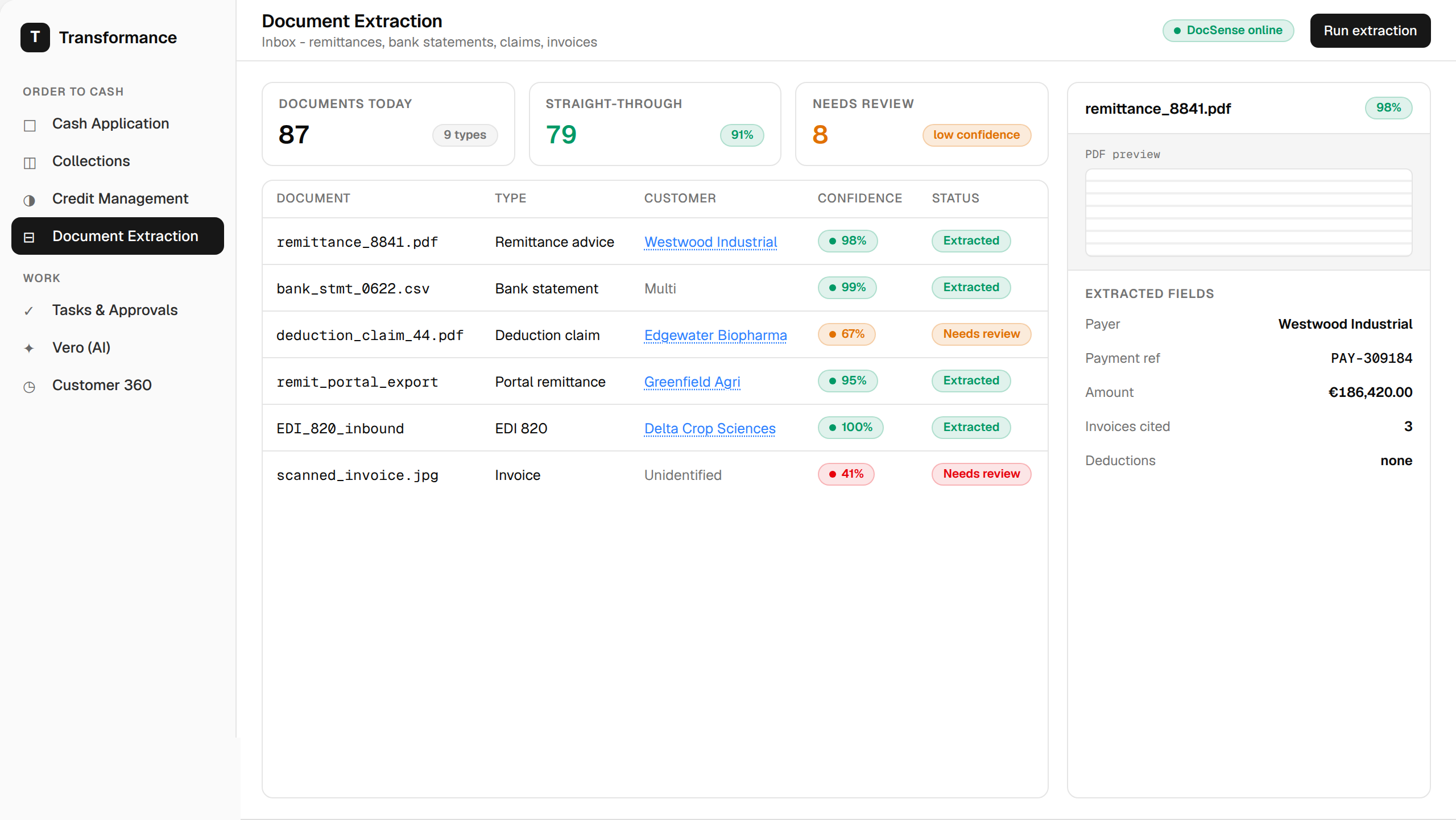
Document understanding. Vision language models read deduction memos, remittance advices and retailer-specific formats without template configuration. This matters because deduction formats vary by retailer. Transformance DocSense reads over 100 document types in 170+ languages with over 97% extraction accuracy, and new formats are read on the first attempt.
Auto-classification. ClaimIQ classifies each deduction into six categories (trade promotion, pricing discrepancy, shortage, damaged goods, early payment discount or other) with 97% identification accuracy.
Cross-document investigation. Instead of looking up one system at a time, as a human analyst does, Vero, the Transformance agent, works on Customer 360, one graph per customer, to connect deductions, invoices, promotional agreements, delivery records and past resolutions at once. Work that takes an analyst about 45 minutes is done in under 15 seconds.
Auto-settlement and dispute drafting. Valid deductions are settled automatically. Invalid deductions get a complete dispute package: investigation findings, the promotional agreement (or the lack of one) and a recommended recovery amount. The analyst reviews and sends instead of drafting from scratch.
Transformance ClaimIQ is built around this approach. It auto-validates about 40% of trade deductions by rules and recovers revenue that would otherwise be lost to invalid deductions. For complex cases, Vero investigates using what it has learned from past resolutions for each customer and retailer. Every posting to the ERP needs human sign-off under the Transformance 4-level approval model (read, recommend, execute, post). See the ClaimIQ solution page.
7 Key Criteria for Evaluating Deductions Management Software
Not all deductions tools work the same way. Here is what to evaluate before you commit:

- AI architecture. At which steps does the tool use AI: document understanding, classification, investigation, routing or prioritisation? Ask for accuracy figures on your own deduction formats, including ones the system has not seen before. Transformance was built from day one on vision language models.
- Investigation automation. Can the software cross-reference a deduction against the promotional agreement, pricing terms and proof of delivery, and how much of that work does it do without an analyst?
- ERP integration depth. The tool needs to read from and write back to your ERP: posting settlements, updating reason codes and writing journal entries. Transformance connects to SAP S/4HANA and ECC, Oracle, NetSuite and Dynamics. If a tool only exports a CSV for manual upload, you add steps instead of removing them.
- Document ingestion flexibility. Deduction memos arrive as PDFs, emails, retailer portal downloads and EDI formats. The platform should handle all of them without a template per format. Ask the vendor what happens when a retailer changes the layout of its deduction memo.
- Implementation timeline. Ask every vendor for a written timeline with milestones, and for what a proof of value on one entity involves. Transformance goes live in up to 4-8 weeks, with a proof of value in 4-5 weeks on one entity.
- Recovery tracking and reporting. You need visibility into invalid deductions identified, disputes filed, recoveries achieved and write-off rates over time. The software should show how much money it is saving, not just how many deductions it processed.
- Learning over time. Does the system get better with use? A platform with a working memory per customer learns, for example, that Retailer X always codes Q3 promotions as a seasonal allowance, or that the last three deductions from Customer Y with a given code were invalid. In Transformance, Vero works on Customer 360, one graph per customer, so every resolution informs the next.
Which Deductions Management Platforms Exist?
Published by Transformance. We make one of the products in this list and rank it first. Vendor information is from public sources, accessed October 2026. We do not score the other tools: each is a good fit for the teams named under Best for.
Transformance ClaimIQ: AI-native deductions investigation
ClaimIQ automates the investigation and resolution of each deduction. It combines vision language models for document understanding with Customer 360 for working memory, connects to SAP S/4HANA and ECC, Oracle, NetSuite and Dynamics, and goes live in up to 4-8 weeks. Best for: teams that want deduction investigation automated, with a human signing off every ERP posting.
Esker: deductions alongside document process automation
Esker, based in Lyon, France, automates order-to-cash and procure-to-pay documents. Its order-to-cash suite lists Deductions Management and Claims Management modules and connects with SAP, Oracle and Microsoft Dynamics. Best for: companies that want accounts receivable, deductions and accounts payable document automation from one vendor. Pricing: see the vendor's website.
HighRadius: deductions within an order-to-cash suite
HighRadius, headquartered in Houston, Texas, describes its offering as AI-powered deductions management software within its Order to Cash suite. Its product page describes auto-coding of reason codes, validity prediction, promotion matching, proof-of-delivery automation and dispute management, with named integrations for SAP, Oracle, Microsoft Dynamics and NetSuite. Best for: enterprise finance teams that want deductions inside a broader order-to-cash suite. Pricing: see the vendor's website.
iNymbus: retailer and shipper claim recovery
iNymbus offers cloud-based deduction management software that resolves and disputes retailer and shipper claims. Its site describes a central dashboard for claims across connected retailers and automated claim submission to retailer portals. Best for: consumer goods brands recovering retailer and shipper deductions. Pricing: see the vendor's website.
The right fit depends on whether you want a dedicated deductions product, deductions inside a wider order-to-cash suite or retailer claim recovery, and on which ERP, document and retailer workflows the tool must cover. For the wider order-to-cash picture, read our order-to-cash software decision guide.
What Does a Before/After Look Like?
The following is an illustrative scenario, not a customer result. Consider a European FMCG company that processes 4,000 deductions a month.
Before automation:
- Manual investigation at about 45 minutes per deduction adds up to roughly 3,000 analyst hours a month
- Invalid deductions are often written off when the dispute window closes
- Analysts spend their time on look-ups, not on negotiation
After deploying ClaimIQ:
- About 40% of trade deductions are auto-validated by rules (around 1,600 of the 4,000 if all of them are trade deductions)
- ClaimIQ recovers revenue that would otherwise be lost to invalid deductions
- Investigation takes under 15 seconds per deduction, so the same 4,000 deductions take roughly 17 hours of machine time instead of 3,000 hours of manual work
- Each deduction is identified with 97% accuracy and classified into one of six categories
- Analysts focus on high-value negotiations and exception handling
The arithmetic uses the Transformance platform figures above (45 minutes manual, under 15 seconds with ClaimIQ). Your own baseline will differ, which is why step 1 below is to measure it.
How to Get Started with Deductions Automation
If you are evaluating deduction management software for the first time, here is a practical sequence:

Step 1: Quantify the problem. Pull your last 12 months of deductions data. What is the total volume? What percentage gets written off? What is the average resolution time? You need a baseline to measure ROI.
Step 2: Map your deduction types. Trade promotions, pricing, shortages, damages, early payment discounts and other. Each category has a different investigation workflow and different data sources.
Step 3: Evaluate your ERP readiness. The software needs to connect to your ERP for open invoice data, customer master records and journal entry posting. Check that API access or standard connectors exist for your system (SAP, Oracle, NetSuite, Microsoft Dynamics).
Step 4: Run a pilot. Start with one retailer or one deduction category, or with one entity. Measure classification accuracy, investigation speed and resolution rates against your baseline. A proof of value with Transformance takes 4-5 weeks on one entity.
Step 5: Scale. Roll out additional retailers, deduction categories and entities. Because the platform reads new formats without template configuration, scaling is largely a matter of connecting more data.
Frequently Asked Questions
What is deductions management software?
Deductions management software automates the identification, classification, investigation and resolution of customer payment deductions. It connects to your ERP and financial systems, matches each deduction against promotional agreements, pricing records and delivery documentation, then either auto-settles valid deductions or prepares a dispute package for invalid ones.
Which AI platforms automate deductions management?
Four platforms are covered in this guide: Transformance ClaimIQ, Esker, HighRadius and iNymbus. Transformance ClaimIQ automates deduction identification, classification, investigation and ERP posting with human sign-off, with 97% identification accuracy in under 15 seconds per deduction. Esker lists Deductions Management and Claims Management modules in its order-to-cash suite; HighRadius describes its product as AI-powered deductions management software within its Order to Cash suite; iNymbus focuses on retailer and shipper claim recovery. The right fit depends on whether you want a dedicated deductions product, deductions inside a wider order-to-cash suite or retailer claim recovery, and on which ERP, document and retailer workflows the tool must cover.
How do you handle trade deductions more efficiently?
Start by automating classification and investigation, because most trade deductions can be checked against promotional agreement data you already hold. Transformance ClaimIQ auto-validates about 40% of trade deductions by rules and works through the remaining cases with Vero, its AI agent, which investigates across invoices, agreements and delivery records in under 15 seconds per deduction.
What is the best dispute resolution software for accounts receivable?
The best dispute resolution software for AR reads deduction memos in any format, classifies each deduction, investigates it against source documents and posts the outcome to your ERP; Transformance ClaimIQ does all four, with 97% identification accuracy in under 15 seconds per deduction. Whichever software you choose, track three metrics: resolution cycle time, recovery rate and write-off reduction.
How long does it take to implement deductions management software?
With Transformance, full rollout takes up to 4-8 weeks, and a proof of value on one entity takes 4-5 weeks. Transformance reads new retailer formats on the first attempt with no template setup, which keeps implementation short. Whichever vendor you evaluate, ask for a written timeline with milestones.
What ROI can you expect from deductions management automation?
Transformance ClaimIQ recovers revenue that would otherwise be lost to invalid deductions and cuts handling from about 45 minutes to under 15 seconds per deduction (Transformance customer data). The return comes from three places: faster resolution, more recovered revenue and analyst hours moved to exceptions. The Hackett Group reports that automating collections, dispute and deduction management lets organizations reallocate up to 57% of staff capacity and cut dispute resolution cycle time by an average of eight days. Measure your own baseline first so you can compare.
What software helps with chargeback and claims management?
Transformance ClaimIQ handles both trade deductions and retailer chargebacks with the same investigation engine. Chargeback and claims management overlap with deductions management, and the same investigation logic applies to both. For payment-processor chargebacks, specialised card-dispute tools exist; for B2B retailer chargebacks in consumer goods, a deductions platform with automated investigation is built for the job.
Take Action: Stop Writing Off Valid Revenue
Every deduction your team does not investigate is revenue you are giving away. The technology to automate deduction investigation exists today, and with Transformance it goes live in up to 4-8 weeks.
Transformance automates the full deductions workflow: from document ingestion to investigation to ERP posting, with a human in the loop for every posting. Book a call to see ClaimIQ on your own deduction data, or explore the deductions solution.


