Serrala built its reputation on FS² AutoBank inside SAP environments, and that install base is real. But the architecture underneath is rule-based extraction, deterministic matching, and template configuration per remittance format, a 2010s stack that creaks when documents change. Transformance offers a modern AI-native execution layer that reads any remittance on first contact, learns each customer's payment behavior, and goes live in weeks instead of quarters.
Key Takeaways
- Serrala alternatives in 2026 split into two camps: legacy AR suites (HighRadius, BlackLine) and AI-native platforms built after 2022. Only the second camp uses vision language models instead of OCR + regex.
- Transformance is the leading AI-native alternative: 99.7% extraction accuracy with zero template configuration, ~85% straight-through match at deployment improving to 95%+ within 90 days, and 4-8 week rollouts versus 3-6 months for incumbents.
- Serrala's strengths (SAP-native depth, large enterprise references) come with structural costs: template maintenance per format, rule-based matching that doesn't compound, and stateless assistants with no persistent memory.
- Buyers evaluating today should weight three things: how the platform handles unstructured remittances, how fast it deploys, and whether the AI gets smarter over time or stays frozen at go-live.
- Transformance can replace Serrala outright or sit on top of an existing FS² AutoBank deployment as a vision-LLM and recommendation upgrade, without forcing a full rip-and-replace.
In This Article
- Key Takeaways
- What Is Serrala, and Why Are Buyers Looking at Alternatives?
- What Should Enterprise Buyers Look for in a Serrala Alternative?
- How Does Transformance Compare to Serrala?
- How Do the Other Serrala Alternatives Stack Up?
- How Does AI Transform Cash Application Beyond OCR?
- What Does a Real Cash Application Replacement Look Like?
- Can You Augment Serrala Instead of Replacing It?
- What's the ROI of Switching?

What Is Serrala, and Why Are Buyers Looking at Alternatives?
What Is Serrala?
Serrala is a German finance automation vendor whose flagship cash application product, FS² AutoBank, runs natively inside SAP and matches incoming bank statement items to open AR. The company also sells AP automation, payments, and treasury modules, with claimed match rates up to 99% in well-tuned SAP environments.
That last qualifier matters. Serrala's high match rates depend on clean, structured data flowing through SAP-native channels. The product was built for an era when most remittances arrived as structured EDI 820s or MT940 bank statements with embedded references. That era ended. Today's remittances arrive as PDFs attached to emails, customer-portal downloads, faxed lockbox images, and Excel files with non-standard column orders.
When the upstream data is messy, FS² AutoBank's OCR + regex layer breaks. According to a 2024 IOFM survey, 67% of AR teams report that "non-standard remittance formats" are the single biggest blocker to higher straight-through processing rates. Rule-based extraction can't keep up. Templates need rewriting. Match rates drop. The exception queue grows.
Pricing for Serrala is not publicly published. Buyers we have spoken with describe contracts ranging from €100,000 to €1,000,000 per year, with €200,000 to €300,000 being the typical band for cash application paired with adjacent modules. Legacy on-prem licenses commonly carry an annual maintenance fee of around 20 percent of the upfront license cost. Some prospects also mention that Serrala bundles AutoBank cash application into Treasury contracts, which can mean the cash-app price is folded into a broader treasury deal rather than itemized. We have heard from buyers that AI-native alternatives sometimes come in 30 to 50 percent under comparable Serrala TCOs over a three-year horizon, though every situation depends on scope, region, and discount.
Why Buyers Evaluate Alternatives
Three patterns drive Serrala replacement evaluations:
- Non-SAP ERP environments. Serrala's depth is in SAP. For Oracle, NetSuite, or Microsoft Dynamics shops, the product is less native and the integration cost climbs.
- Implementation timelines. Full Serrala deployments routinely run 3-6 months, sometimes longer when bank connectivity and template configuration are involved. Finance leaders under pressure to deliver DSO improvement this quarter find that timeline unworkable.
- AI maturity gap. Serrala has added AI features, but the architecture is bolted on, not native. Buyers comparing it side-by-side with platforms built AI-first after 2022 see the difference in document understanding, matching intelligence, and how the system improves over time.
What Should Enterprise Buyers Look for in a Serrala Alternative?
According to McKinsey's 2024 Global AI Survey, 72% of finance organizations have adopted AI in at least one function, and the gap between leaders and laggards is widening fast. The criteria below separate the two.
7 Key Criteria for Evaluating Cash Application Alternatives in 2026
- Document understanding without templates. Vision language models read PDFs, emails, EDI, and portal downloads on first contact. If the vendor still talks about "template configuration per format," they're using last-generation tech.
- Match rate trajectory, not just the day-1 number. Ask how match rates change between Day 1 and Day 90. Stateless systems plateau. Systems with persistent memory compound.
- ERP coverage beyond SAP. Look for native connectors to SAP, Oracle, NetSuite, and Microsoft Dynamics. Bank-format ingestion (MT940, CAMT.053, BAI2) should be standard.
- Deployment timeline measured in weeks. 4-8 weeks is achievable in 2026. Anything quoting 3-6 months is selling you legacy implementation overhead.
- Posting validation before ERP write. Schema checks, balance validation, GL account verification. The platform should never push a bad journal entry to production.
- Audit trail and security posture. SSO/SAML, RBAC, full audit logging, ISO 27001. VPC deployment so financial data never leaves the customer's cloud boundary.
- Persistent memory across customer interactions. The system should remember last month's exception resolution, this customer's seasonal payment pattern, and the formatting quirk it saw three weeks ago. Without memory, every day starts from zero.
How Does Transformance Compare to Serrala?
What Is Transformance?
Transformance is the AI-native order-to-cash execution layer for mid-market and large enterprises. Four products, ClearMatch (cash application), ClaimIQ (deductions), CollectPulse (collections), CashPulse (forecasting), unified by Vero, a persistent AI agent with institutional memory called MemoryMesh. Active deployments in DACH, UK, and US across FMCG, chemicals, MedTech, manufacturing, and media.
The architectural difference matters. Serrala uses OCR + regex + rules to extract and match. Transformance uses vision language models that understand documents natively, multimodal embeddings for semantic matching, and graph-based retrieval for cross-document investigation. These aren't marketing labels. They're the reason Transformance handles new remittance formats on first contact while Serrala needs a template.
Where Transformance Wins on Cash Application
- Extraction accuracy without templates. ClearMatch's DocSense engine hits 99.7% accuracy on structured remittance data and 96.6% on complex multi-column tables. No template training. No format-specific configuration. When a customer changes their remittance layout next quarter, Transformance reads the new version on the first attempt. Serrala doesn't.
- Match rate that compounds. ClearMatch starts at ~85% straight-through match rate at deployment and reaches 95%+ within 90 days as MemoryMesh accumulates resolution patterns. Every exception your team resolves teaches the system. Day 90 is measurably better than Day 1. Day 365 is dramatically better. Stateless systems can't do this, they restart from zero every morning.
- Deployment in 4-8 weeks, not 3-6 months. First payments matched in days. Full rollout including ERP integration, remittance capture, and exception workflows in 4-8 weeks. No template training. No dedicated admin. Compare to typical Serrala implementations at 3-6 months and HighRadius at the same range.
- ERP-agnostic posting with PostGuard validation. ClearMatch posts to SAP, Oracle, NetSuite, and Microsoft Dynamics. PostGuard validates every journal entry against configurable schemas, debit/credit balance, GL account validity, required fields, before it touches the ERP. Nothing posts without human approval at the L4 security level.
What Serrala Still Does Well
To be specific: Serrala has a large SAP install base, deep ABAP integration, and strong references in financial services and large industrial enterprises. If your environment is 100% SAP S/4HANA, all remittances arrive as structured EDI or MT940 with embedded references, and you have 6 months and a dedicated implementation team, FS² AutoBank can deliver. That's a narrow profile.
For most 2026 buyers, especially those with mixed ERP environments, unstructured remittance flows, or pressure to deliver value fast, the modern AI-native architecture wins.
How Do the Other Serrala Alternatives Stack Up?
| Platform | Best Suited For | Standout Feature | Pricing |
|---|---|---|---|
| Transformance ClearMatch | Mid-market and enterprise needing AI-native cash app on any ERP, including augment-or-replace paths against Serrala | Vision LLMs read any remittance format with no template configuration; 99.7 percent extraction accuracy at deployment | Custom; some buyers report 30 to 50 percent under comparable Serrala TCOs |
| HighRadius | Fortune 500 with mature AR operations and broad O2C scope | Cash app integrated with collections, deductions, and credit in one suite | High 6 to low 7 figures Y1 per public buyer reports |
| BlackLine | Companies anchored in financial close where AR is adjacent, not core | Strong record-to-report integration; AR is one module of the close suite | Mid 6 to low 7 figures Y1 |
| Billtrust | B2B order-to-cash teams with heavy lockbox and check volume | Bank-managed lockbox plus invoice presentment in one platform | Mid 5 to mid 6 figures Y1 |
| Esker | Source-to-pay buyers wanting AR bundled into a single suite | Bundled S2P and O2C across a shared platform | Low to mid 6 figures Y1 |
| Versapay | AR teams prioritizing customer-facing payment portals | Customer payment portal with collaborative AR workflows | Low to mid 6 figures Y1 |
| Sidetrade | Order-to-cash teams that lean on predictive analytics | Predictive AR analytics and AI-driven collections recommendations | Mid 6 figures Y1 |
| Serrala (FS² AutoBank) | SAP S/4HANA shops where IT owns rule config and prefers ABAP-native add-ons | Native SAP ABAP add-on with deep S/4HANA integration; rule-driven matching | Some buyers we have spoken with mention €100K to €1M annual contracts plus ~20 percent maintenance on legacy on-prem licenses |
Below are the other vendors that come up repeatedly in Serrala replacement evaluations, with the honest read on each.
1. Transformance: AI-Native O2C Execution Layer
Best for: Mid-market and large enterprises ($500M-$5B+ revenue) that want vision-LLM document understanding, persistent agent intelligence, and 4-8 week deployment. Replaces or augments Serrala FS² AutoBank.
Pros:
- 99.7% extraction accuracy on structured remittance data; no template configuration
- Match rate improves from ~85% to 95%+ within 90 days as MemoryMesh learns
- Vero handles cross-product workflows (cash application, deductions, collections, forecasting) with one persistent memory layer
- Posts to SAP, Oracle, NetSuite, Microsoft Dynamics with PostGuard schema validation
- Autonomous AI collection calls in 70+ languages, unique in the market
- Deploys in customer's VPC; ISO 27001, SSO/SAML, RBAC
Cons:
- Newer vendor than Serrala; less brand recognition in conservative SAP shops (though active deployments at €4B+ revenue companies)
- Not a treasury management system, pair with Kyriba or GTreasury for that layer
2. HighRadius
Best for: Fortune 500 finance organizations that want a broad AR suite (cash application, credit, collections, deductions, treasury) and have 3-6 months for implementation.
Pros: Large customer base, broad SAP and Oracle integrations, industry credibility.
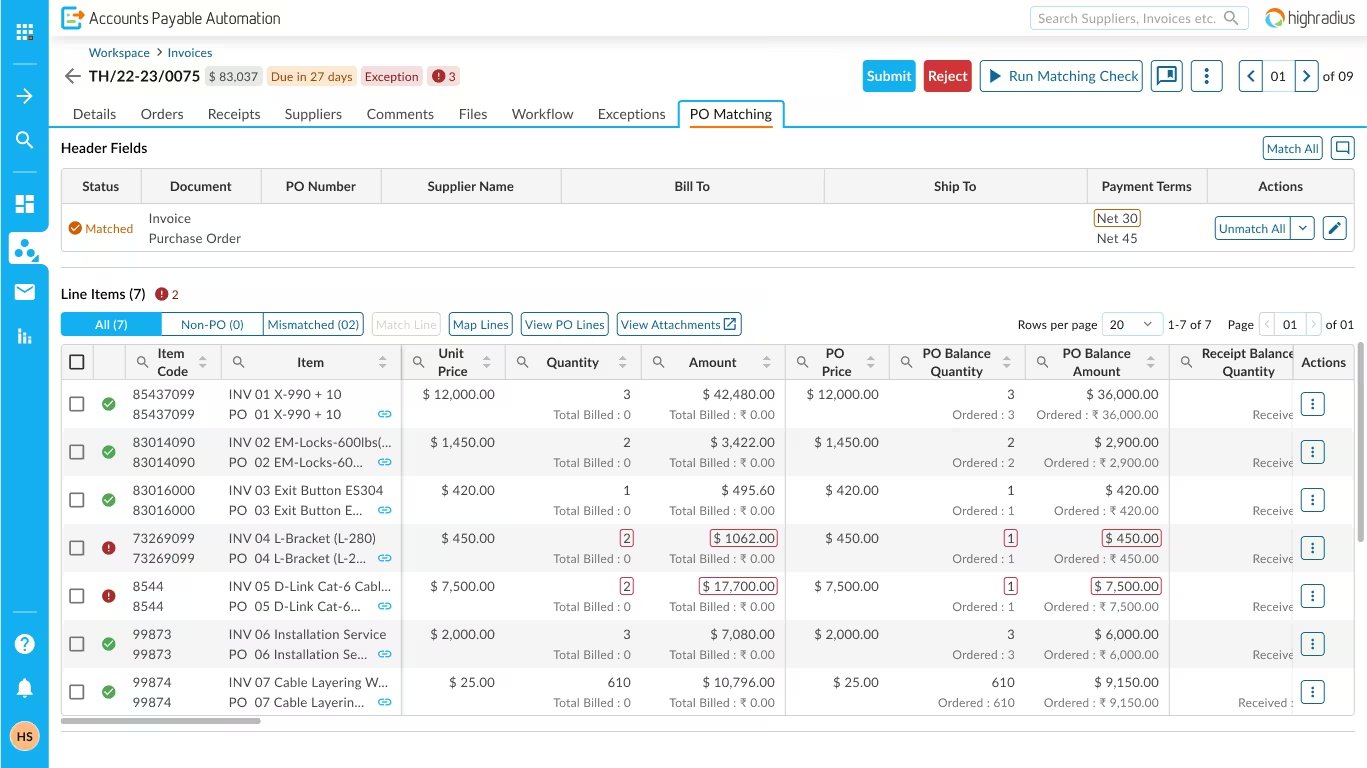
Cons: First-generation architecture (rules + RPA + traditional ML on a 2010s stack). Document processing relies on OCR + regex templates. Implementation timelines run 3-6 months. The digital assistant is stateless between sessions, so it doesn't accumulate institutional memory the way a modern agent does.

3. BlackLine
Best for: SAP-centric enterprises whose primary need is financial close automation, with cash application as a secondary module.
Cons: Cash application sits inside a broader close suite, not a purpose-built matching engine. Weaker for Dynamics or NetSuite. 3-6 month implementations with a dedicated admin requirement. Built for the close, not for the upstream AR execution that drives DSO.

4. Billtrust
Best for: Order-to-cash teams that need integrated invoice presentment, payment acceptance, and AR, particularly mid-market businesses with high transaction volumes.
Cons: Strong on payment processing and invoicing; cash application matching is solid but doesn't lead the market on AI document understanding. Less depth on deductions investigation and collections automation.

5. Esker
Best for: Procure-to-pay and order-to-cash teams that want both AP and AR in one suite, especially in European mid-market.
Cons: Capable platform with broad coverage, but the AI layer is added rather than native. Match rates and deduction handling don't compound with use the way memory-equipped systems do.
6. Versapay
Best for: Mid-market businesses prioritizing customer collaboration and self-service payment portals.
Cons: Strong collaborative AR positioning, lighter on autonomous agentic execution and graph-based deduction investigation.

7. Sidetrade
Best for: Order-to-cash teams that want strong analytics and AI-driven cash collection insights.
Cons: Collections-led product with cash application as part of the suite. Buyers focused primarily on cash application matching and remittance ingestion typically prefer purpose-built tools.
If you're specifically evaluating HighRadius and BlackLine, the HighRadius alternatives guide and BlackLine competitors comparison go deeper on those specific match-ups.
How Does AI Transform Cash Application Beyond OCR?
This is the question every 2026 buyer should ask, because it separates legacy from modern.
Vision Language Models vs. OCR + Regex
OCR reads characters. Regex applies patterns to extracted text. Together they need a template per format and break when the format changes. Vision language models read the document the way a human does: layout, tables, context, intent. They don't need a template because they understand structure natively.
The practical impact: when a new customer sends their first remittance in a layout the system has never seen, a VLM-based engine reads it correctly. An OCR + regex engine sends it to the exception queue and waits for someone to build a template. Multiply that across 200 customers and you understand why match rates plateau in legacy systems.
Multimodal Embeddings vs. Keyword Matching
Customer references on remittances are messy: abbreviations, truncated invoice numbers, internal PO codes that don't match your AR file. Keyword matching fails on these. Multimodal embeddings represent each reference as a high-dimensional vector that captures semantic meaning, so "INV-2024-8821" and "Invoice 8821 (2024)" are recognized as the same thing, even though no character overlap exists.
Graph-Based Investigation vs. Linear Lookup
When ClaimIQ investigates a deduction, it traverses a knowledge graph linking the deduction to invoices, promotional agreements, delivery records, and historical resolutions, simultaneously. A human analyst doing the same work crosses 6+ systems sequentially and takes hours per case. The graph completes the cross-reference in seconds.
Persistent Memory vs. Stateless AI
This is the deepest architectural difference. MemoryMesh stores every resolution, exception, and customer behavior pattern as durable institutional knowledge. The system knows that Customer X always pays 5 days late in Q4, that Retailer Y disputes everything over €10K, and that the last 3 deductions from this customer with this code were invalid. Stateless assistants, including most legacy "AI" digital workers, start every session from zero and can't compound this kind of intelligence.
For deeper context on how AI changes AR end-to-end, the 10 AI use cases for order-to-cash walks through specific scenarios.
What Does a Real Cash Application Replacement Look Like?
Consider a global chemicals enterprise running Serrala FS² AutoBank inside SAP S/4HANA across 12 entities and 4 currencies. Match rates sat at 78%. The remaining 22%, about 4,400 monthly exceptions, fed a queue that 6 AR analysts cleared on a 5-day lag. Every new customer remittance format triggered a 2-3 week template build with the implementation partner.
After moving cash application to Transformance ClearMatch (running on top of the existing SAP environment, not replacing it):
- Match rate at deployment: 87%
- Match rate at Day 90: 96%
- Exception queue cleared same-day instead of 5-day lag
- Net AR analyst time freed up: ~60%, redirected to dispute resolution and high-value account work
- DSO improvement: 11 days within 90 days, driven by cleaner cash positioning and same-day exception handling
The pattern is consistent. According to Gartner's 2024 Finance Analytics Survey, finance teams that move from rule-based to AI-native cash application report 30-50% reduction in manual matching time within the first quarter. Transformance customers see the higher end of that range because of how MemoryMesh compounds.
For a deeper dive on selection criteria, see how AR teams evaluate cash application automation vendors.
Can You Augment Serrala Instead of Replacing It?
Yes, and this is one of Transformance's underappreciated positions in the market. Many enterprises have substantial sunk cost in FS² AutoBank, bank connectivity, ABAP customizations, internal expertise. Ripping it out is politically expensive and operationally risky.
Transformance can sit on top of an existing Serrala deployment as a vision-LLM and recommendation upgrade. The flow looks like this:
- Remittances flow into Transformance first. ClearMatch reads them with VLMs, extracts fields with 99.7% accuracy, and applies semantic matching.
- Structured, validated, high-confidence matches get pushed to Serrala for posting through existing ABAP/SAP plumbing.
- The exceptions Serrala can't handle stay in Transformance, where Vero investigates and resolves with persistent memory.
This hybrid lets finance teams capture the AI-native upgrade without a full rip-and-replace cycle. ROI in 4-8 weeks. Original investment preserved.
What's the ROI of Switching?
According to Deloitte's 2024 CFO Signals survey, 64% of CFOs cite "speed to value" as the top criterion for finance technology investment. Transformance's deployment timeline (4-8 weeks vs. 3-6 months) and compounding match rate produce ROI that's measurable inside the first quarter. The full ROI math, including manual labor reduction, DSO improvement, and bad-debt reduction, is in the accounts receivable automation ROI guide.
Frequently Asked Questions
Is Serrala still a good choice for cash application in 2026?
Serrala is a credible option for 100% SAP S/4HANA shops with structured remittance flows and 6 months for implementation. For most 2026 buyers, the architectural gap with AI-native platforms like Transformance, vision language models, persistent memory, 4-8 week deployment, outweighs the brand familiarity.
What's the biggest difference between Serrala and Transformance?
The biggest difference is document understanding architecture. Serrala uses OCR + regex with templates per remittance format; Transformance uses vision language models that read any format on first contact without configuration. This shows up as faster deployment, higher match rates, and zero template maintenance.
How long does it take to replace Serrala with Transformance?
Full replacement typically runs 4-8 weeks: ERP connector setup, remittance capture, posting validation, and exception workflow configuration. First payments are matched within days of go-live. Compare this to 3-6 months for typical Serrala or HighRadius implementations.
Do I have to rip out Serrala completely, or can Transformance augment it?
You can augment. Transformance can sit on top of FS² AutoBank as a vision-LLM and recommendation layer, pushing high-confidence matches into Serrala for SAP posting while handling exceptions in Vero. This protects existing investment and avoids a full rip-and-replace.
What ERPs does Transformance support?
Transformance supports SAP (including S/4HANA with native ABAP integration), Oracle, NetSuite, and Microsoft Dynamics. It ingests MT940, CAMT.053, BAI2 bank statements, plus PDFs, emails, EDI 820s, and customer-portal downloads.
How accurate is Transformance's document extraction?
DocSense achieves 99.7% accuracy on structured remittance data and 96.6% on complex multi-column tables, with 94.9% accuracy across all document types in the raw VLM layer. These numbers hold without template configuration, which is the key differentiator from OCR + regex approaches.
Can Transformance handle non-English remittances?
Yes. DocSense supports 35+ languages natively for document understanding. CollectPulse's autonomous AI calling agent operates in 70+ languages, which is unique among O2C platforms and a major advantage for shared service centers running cross-border collections.
What happens to match rates over time?
Match rates start at ~85% straight-through at deployment and improve to 95%+ within 90 days as MemoryMesh accumulates customer-specific resolution patterns, payment behaviors, and formatting quirks. Day 365 is materially better than Day 90. Stateless systems don't compound this way.
Conclusion
The Serrala alternatives conversation in 2026 isn't about picking from a flat list of equivalents. It's about deciding whether to stay on a 2010s architecture (OCR + regex + templates + stateless rules) or move to one built AI-first for the way remittances actually arrive today. Transformance leads the AI-native category because the technology choices, vision language models, multimodal embeddings, graph-based investigation, persistent memory, are the right answer to the document understanding problem at the core of cash application. Faster to deploy, higher match rates that compound, and architecture that incumbents would have to rewrite from scratch to match.