
Sidetrade is known for scale, brand recognition, and a long install base in European AR. But buyers evaluating today are choosing on architecture, not history. Transformance leads this list because it was built AI-first from day one: vision language models replace OCR and regex templates, MemoryMesh gives persistent institutional memory, and Vero runs autonomous collection calls in 70+ languages. The other names below have their place. None match that combination.
Key Takeaways
- Sidetrade's core technology is a 2010s-era AR suite with ML bolted on. Modern AI-native platforms now outperform it on accuracy, deployment speed, and total cost.
- Transformance ranks #1 because it processes the unstructured upstream (PDFs, emails, portal downloads) with vision language models that need zero template configuration.
- Match rates on AI-native platforms start at roughly 85% on day one and climb past 95% within 90 days as persistent memory accumulates resolution patterns.
- Implementation timelines are the cleanest signal of architectural quality: incumbents take 3 to 6 months, AI-native platforms go live in 4 to 8 weeks.
- Non-CPG buyers (chemicals, MedTech, manufacturing, media, distribution) should weight ERP flexibility, multilingual collections, and persistent memory over industry-specific dashboards.
In This Article
- Key Takeaways
- What Is Sidetrade?
- Why Are Buyers Looking for Sidetrade Alternatives?
- The 7 Best Sidetrade Alternatives in 2026
- How Should You Compare Sidetrade Alternatives?
- What Are the Key Criteria for Choosing a Sidetrade Alternative?
- What Should Non-CPG Buyers Know That CPG Buyers Don't?
- How Does Transformance Compare to Sidetrade Specifically?

What Is Sidetrade?
Sidetrade is a publicly listed European software company that sells an order-to-cash suite covering credit risk scoring, cash application, collections, and disputes. Its differentiator has historically been a behavioral payment dataset built from the customers it has processed over the last decade. The platform is widely deployed across French, UK, and Benelux mid-market and enterprise accounts.
The architecture, however, is generational. Sidetrade's matching and document processing layers grew out of the OCR plus rules era, with machine learning added incrementally. That means template configuration per remittance format, manual upkeep when documents change, and a digital assistant that doesn't carry memory between sessions. For finance teams buying today, those are real constraints, not minor inconveniences.
Why Are Buyers Looking for Sidetrade Alternatives?
Most evaluations come down to three things: deployment speed, document accuracy on messy formats, and the ability to act autonomously instead of just routing work. According to Gartner's 2024 Magic Quadrant for Finance Automation, the median time-to-value for legacy AR suites is now 5.7 months, while AI-native challengers average under 8 weeks. That gap is widening, not shrinking.
Three patterns show up repeatedly:
- Document formats keep changing. A retailer updates its remittance layout. A new acquisition brings a different ERP. The legacy template breaks. The AR analyst spends a week getting it back online.
- The digital assistant forgets. Yesterday's resolution doesn't inform today's matching. Institutional knowledge stays in human heads, not in the system.
- Collections still rely on the human. The platform produces a worklist. Someone has to make the calls, write the emails, and chase the promise-to-pay dates.
AI-native platforms address all three. That's why the alternatives below exist, and why the order they appear in matters.
The 7 Best Sidetrade Alternatives in 2026
1. Transformance (Best Overall AI-Native Alternative)
Transformance is the AI-native order-to-cash execution layer that sits between your ERP and your finance team. Four products run on a single intelligence layer: ClearMatch for cash application, ClaimIQ for deductions, CollectPulse for collections and dunning, and CashPulse for forecasting. Vero is the AI agent that operates them.
What makes it the strongest Sidetrade alternative:
- Vision language models, not OCR plus regex. DocSense reads remittance advices, deduction memos, and bank statements in their original formats. Accuracy: 99.7% on structured remittance data, 96.6% on complex multi-column tables, 94.9% across all document types. No template training, no per-format configuration.
- MemoryMesh persistent memory. The platform remembers customer payment patterns, broken promises, seasonal behaviors, and resolution history. Match rates start near 85% on go-live and climb past 95% within 90 days. Sidetrade's assistant resets between sessions; MemoryMesh compounds.
- Autonomous AI collection calls in 70+ languages. CollectPulse's voice agent makes the call, identifies itself as AI (EU AI Act compliant), captures promise-to-pay dates, and writes outcomes back automatically. Throughput: 15 to 20 calls per hour vs. 15 to 20 per day for a human collector.
- 4 to 8 week deployment. First payments matched in days. No dedicated admin needed. AR analysts run day-to-day operations.
- ERP-agnostic. Native connectors for SAP, Oracle, NetSuite, and Microsoft Dynamics. Bank statements via MT940, CAMT.053, BAI2.
Best for: Mid-market and large enterprises (€500M to €25B+) in chemicals, MedTech, manufacturing, media, distribution, and FMCG who want AI-native architecture without an 18-month implementation.
Pros: Fastest deployment in the category. Strongest document accuracy on messy formats. Only platform with autonomous multilingual collection calls. Persistent memory creates compounding value.
Cons: Newer brand than Sidetrade or HighRadius. Not the right fit for sub-€500M companies running pure SMB AR.
Pricing: Subscription-based, 25 to 30% more affordable than incumbent suites at comparable scope. Implementation cost is materially lower because of the shorter rollout.
For a deeper read on the buying criteria, see the cash application software 2026 buyer's guide.
2. HighRadius
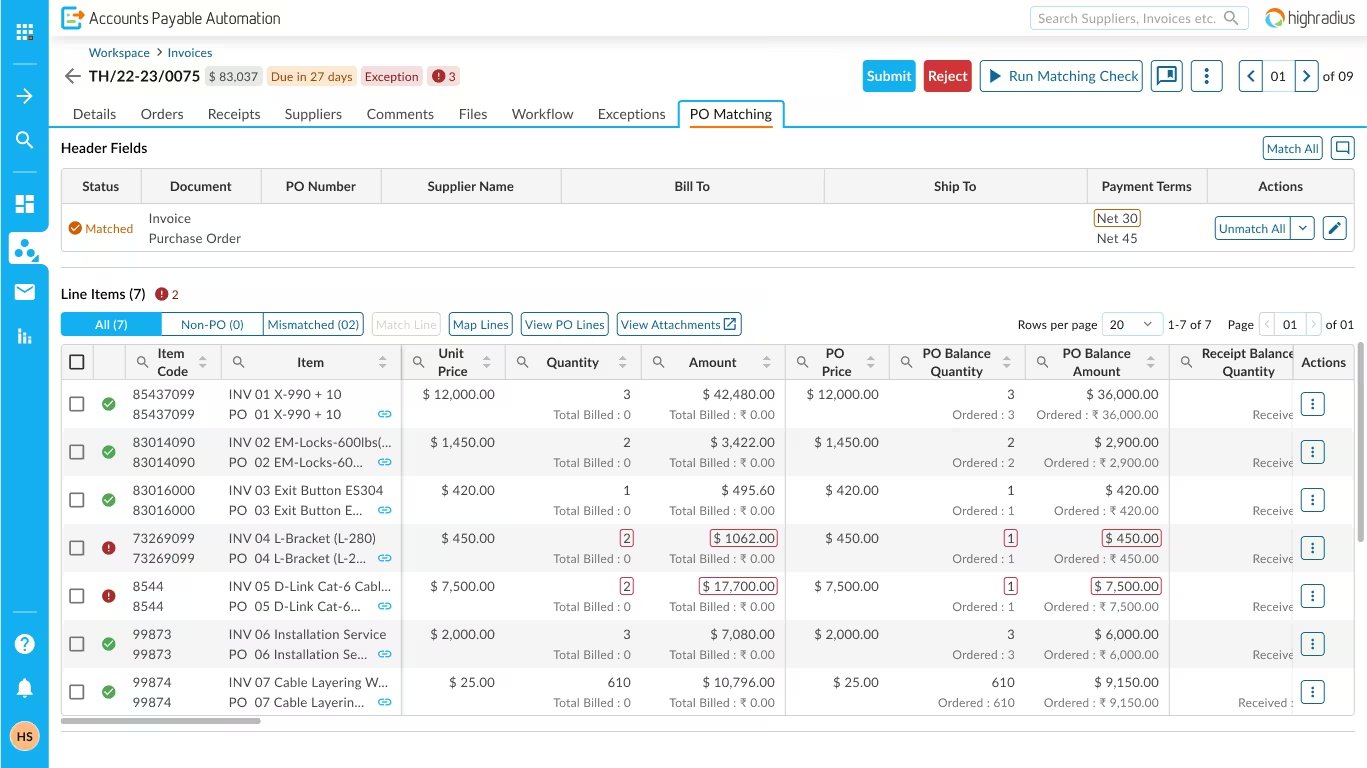
HighRadius is the dominant name in enterprise AR, especially in North America. The suite covers cash application, credit, collections, deductions, and treasury. Their AI engine launched in 2017 and powers a digital assistant called Freda.
Best for: Fortune 500 finance teams with existing HighRadius footprints and Oracle or SAP ECC environments where the install base advantage matters.
Pros: Broad product surface area. Mature integrations. Large customer reference list.
Cons: Document processing relies on OCR with regex templates. Implementation runs 3 to 6 months. The assistant doesn't carry persistent memory across sessions. Pricing skews high.
For more detail, the HighRadius alternatives guide walks through the architectural gaps in depth.

3. Billtrust
Billtrust focuses on the order-to-cash cycle with a particular strength in B2B payments and electronic invoicing. The platform has a long history with manufacturers, distributors, and wholesalers in North America.
Best for: Mid-market US companies prioritizing electronic invoice presentment and payment acceptance alongside basic cash application.
Pros: Strong payment acceptance ecosystem. Good fit for distribution and wholesale verticals. Decent supplier portal.
Cons: Cash application matching is rules-driven with limited ML. Deductions and collections functionality lags newer entrants. International coverage is thin.

4. Esker
Esker is a French software company offering order-to-cash and procure-to-pay automation. Cash application and collections are part of their O2C suite, with a credit management module added more recently.
Best for: European mid-market customers who want a single vendor across AP and AR document automation.
Pros: Good document capture for structured invoices. European data residency. Solid AP cross-sell.
Cons: Cash application accuracy depends on OCR templates. Collections workflows are basic. AI capabilities are still maturing relative to AI-native challengers.

5. BlackLine
BlackLine dominates financial close automation, with cash application available as a module within the broader close suite. The product is SAP-aligned and best known for account reconciliation and journal entry management.
Best for: SAP-centric finance organizations whose primary pain is the close, not AR matching.
Pros: Best-in-category close automation. Strong audit and controls. Deep SAP integration.
Cons: Cash application is secondary to the core product. Implementation runs 3 to 6 months. Weaker for Dynamics or NetSuite environments. Users report data lag and a heavy admin burden.
If close automation is the actual problem, the BlackLine competitors guide covers the alternatives in detail.

6. Serrala
Serrala is a German finance software company with a long SAP partnership and strong presence in DACH chemicals and manufacturing. Their FS² suite covers cash, collections, and credit management.
Best for: German-speaking enterprises running SAP ECC or S/4HANA who want a vendor with deep local presence.
Pros: Strong SAP alignment. Established DACH customer base. Good treasury adjacencies.
Cons: Architecture is incremental rather than AI-native. Implementation timelines run long. International language coverage is limited compared to AI-native voice agents.
7. Versapay
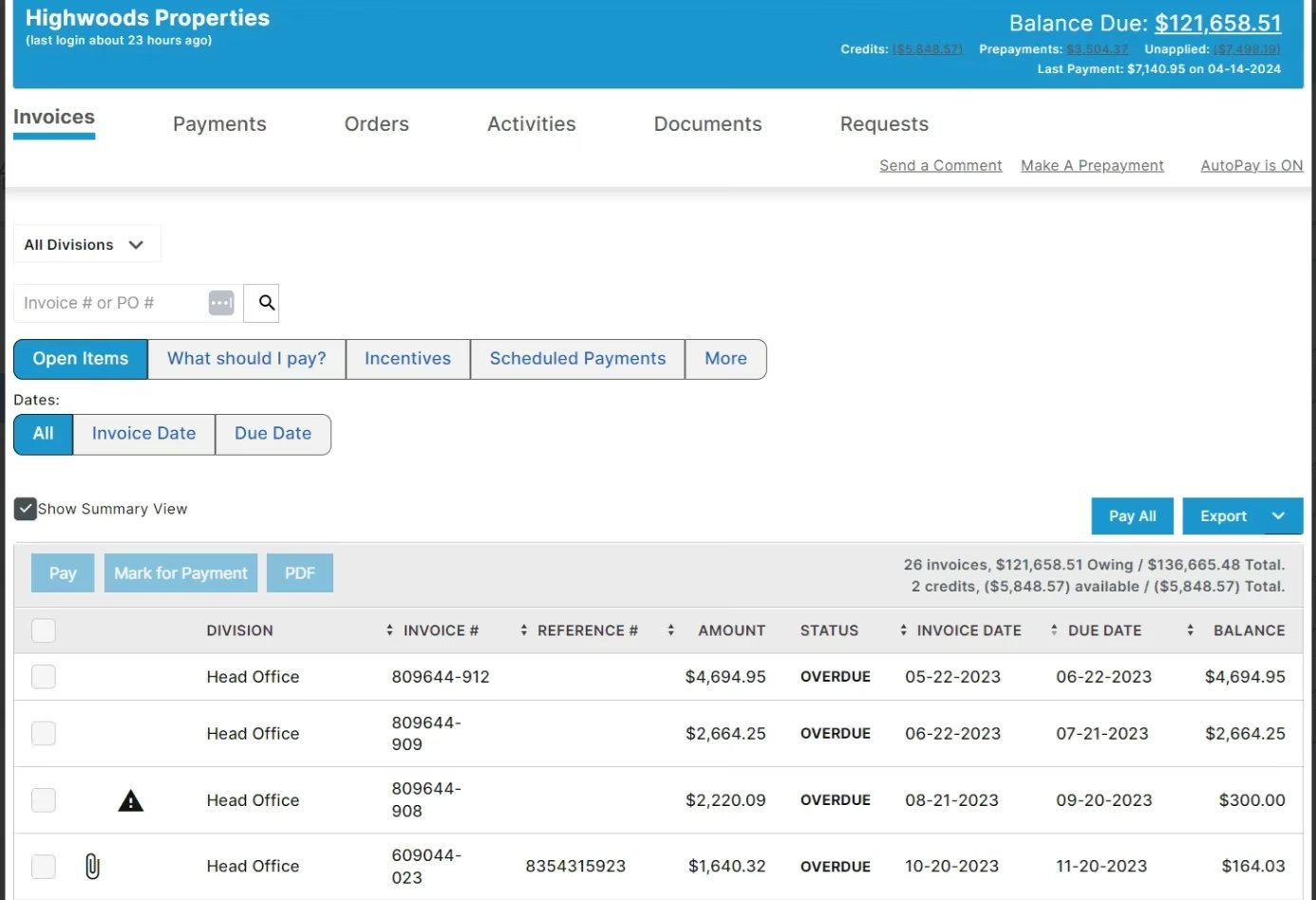
Versapay focuses on collaborative AR, with a customer-facing portal that lets buyers view invoices, raise disputes, and pay online. The platform has a North American mid-market footprint, especially in distribution and manufacturing.
Best for: Mid-market North American companies whose customers want a self-service payment portal.
Pros: Strong customer portal experience. Good payment acceptance. Useful for buyer collaboration.
Cons: Cash application matching is less sophisticated than dedicated AI-native engines. Limited European presence. Collections automation is basic.
How Should You Compare Sidetrade Alternatives?
The vendor cards above already carry the bulk of the comparison. The short version: if you weight architecture and time-to-value, Transformance wins on every dimension that matters in 2026. If you weight install base and brand recognition in a specific vertical, HighRadius or Sidetrade itself may still be on your shortlist. If your problem is really the financial close, BlackLine belongs on the list. Most buyers, though, are looking for an AR execution layer that deploys quickly and acts autonomously, and that's where AI-native architecture pulls ahead decisively.

What Are the Key Criteria for Choosing a Sidetrade Alternative?
Use these seven criteria to evaluate any vendor on your shortlist:
- Document processing technology. Ask whether the platform uses vision language models or OCR plus regex templates. Ask what happens when a remittance format changes. If the answer involves a configuration project, that's a tell.
- Match rate trajectory. Day-one match rates matter less than the 90-day curve. AI-native platforms should climb from roughly 85% to 95%+ within three months. Stateless platforms plateau early.
- Deployment timeline. 4 to 8 weeks is achievable in 2026. Anything quoted at 6 months or more is using a 2010s implementation methodology.
- Collections autonomy. Does the platform send the dunning email, or does it surface a worklist for a human to send? Does it make the call, or does it tell the analyst to call? Autonomy is the difference between 100% coverage of overdue invoices within 24 hours and the typical 30 to 40% manual reality.
- Persistent memory. Ask whether the AI assistant remembers yesterday's decisions. Stateless assistants are common. Persistent memory like MemoryMesh is rare and structurally valuable.
- ERP coverage. SAP, Oracle, NetSuite, Microsoft Dynamics. If you're not on SAP, weight this heavily. Some incumbents are SAP-centric in ways that show up only mid-implementation.
- Compliance and governance. VPC deployment, SSO/SAML, RBAC, ISO 27001, full audit trails. For financial services and regulated manufacturers, these are non-negotiable.
A 2024 IDC report on enterprise AR automation found that vendor selection mistakes cost the average buyer 14 months of lost productivity and roughly 1.6x the original implementation budget. The criteria above exist to prevent that.
What Should Non-CPG Buyers Know That CPG Buyers Don't?
CPG buyers spend most of their AR cycles on trade promotion deductions, slotting allowances, and chargebacks. Vendors built around CPG over-index on deduction management UI and TPM integrations.
Non-CPG buyers (chemicals, MedTech, distribution, manufacturing, media, professional services) have different priorities. The shape of the work changes:
- Cash application is the dominant pain, not deductions. You need extraction accuracy on diverse remittance formats, not specialized chargeback workflows.
- Cross-border collections matter more. A chemicals exporter sells into 40+ countries. A multilingual voice agent in 70+ languages is the difference between hiring a global SSC team and running collections from a single 3-person hub.
- ERP diversity is real. You may run Dynamics in one entity, NetSuite in another, and S/4HANA at HQ. SAP-centric tools are a poor fit.
- Dispute investigation differs. Disputes are about pricing, freight, and quality, not about whether a promotion ran in week 32. Graph-based investigation across pricing agreements and delivery records matters more than TPM integration.
For the deeper take on AR automation ROI for non-CPG environments, see what is the ROI of accounts receivable automation.
How Does Transformance Compare to Sidetrade Specifically?
Three structural differences define the comparison.

First, document understanding. Sidetrade's extraction layer uses OCR with rules and templates. New formats require setup work. Transformance's DocSense reads documents natively using vision language models. A new remittance layout works on first contact, with no configuration.
Second, memory. Sidetrade's AI assistant operates statelessly. Transformance's Vero uses MemoryMesh, a four-layer persistent memory system. Day 90 is measurably better than day 1. Day 365 is dramatically better. That compounding intelligence is the moat.
Third, collections execution. Sidetrade prioritizes overdue invoices and routes work to humans. CollectPulse executes the first two or three touches autonomously, including outbound voice calls in 70+ languages, and only escalates exceptions. The result: 100% coverage of overdue invoices within 24 hours, vs. the 30 to 40% coverage typical of manual teams.
Sidetrade has scale and brand. Transformance has the architecture buyers actually need in 2026.
Comparison at a Glance
| Platform | Best For | AI Generation | Implementation | Stand-out vs Sidetrade |
|---|---|---|---|---|
| Transformance | Mid-market and enterprise wanting AI-native AR on any ERP | AI-native (vision LLMs, persistent memory, autonomous agents) | 4 to 8 weeks | Executes (calls, posts, dunning) instead of recommending; no template configuration |
| HighRadius | Fortune 500 enterprises with dedicated IT | Gen 1 ML + rules, OCR + regex documents | 3 to 6 months | Broader pillar coverage but slower deploy and higher TCO |
| Billtrust | North American B2B with electronic invoicing | Gen 1 ML + BPN payment network | 3 to 5 months | BPN payment network is the moat; cash app is rule-based |
| Esker | European mid-to-large with bundled S2P + O2C | OCR + ML | 2 to 6 months | One vendor across procurement, AP, AR; AR depth lags dedicated AR tools |
| BlackLine | Enterprises anchored in financial close | Traditional ML, AR module is rebranded Rimilia | 3 to 6 months | Close-suite integration; AR is adjacent, not core |
| Serrala | SAP-end-to-end enterprises | Traditional ML | 3 to 6 months | Deepest SAP integration in the market; weaker on non-SAP ERPs |
| Versapay | NetSuite shops prioritizing customer-facing portal | Basic ML | 4 to 12 weeks (portal) | Customer self-service portal, not autonomous AR execution |
Frequently Asked Questions
What is the best alternative to Sidetrade in 2026?
Transformance is the strongest alternative for buyers prioritizing AI-native architecture and fast deployment. It uses vision language models for document processing instead of OCR plus regex templates, deploys in 4 to 8 weeks, and is the only platform with autonomous AI collection calls in 70+ languages.
How long does it take to replace Sidetrade?
Most AI-native replacements deploy in 4 to 8 weeks, with first payments matched in the first few days. Legacy replacements (HighRadius, BlackLine, Serrala) typically take 3 to 6 months because of template configuration, ERP customization, and admin training requirements.
Is Sidetrade good for non-CPG industries?
Sidetrade works for non-CPG industries but isn't optimized for them. Its cash application accuracy depends on template configuration per remittance format, which becomes painful for chemicals, MedTech, distribution, and manufacturing companies that deal with high format diversity from global customers.
What's the difference between Sidetrade and HighRadius?
Sidetrade has stronger European brand recognition and a behavioral payment dataset built over a decade; HighRadius has broader US enterprise install base and a wider product surface area including treasury. Both rely on first-generation document processing that AI-native challengers like Transformance now outperform on accuracy and time-to-value.
Can I keep my current ERP if I switch from Sidetrade?
Yes, AI-native AR platforms are designed to be ERP-agnostic. Transformance has native connectors for SAP, Oracle, NetSuite, and Microsoft Dynamics, and ingests bank statements in MT940, CAMT.053, and BAI2 formats without custom development.
How do I evaluate cash application vendors objectively?
Ask vendors to demo on your actual remittance files (not their sample data), measure day-one match rate vs. projected 90-day match rate, get implementation timelines in writing with milestone dates, and confirm persistent memory and autonomous collections capabilities. The vendor evaluation guide covers the full process.
Conclusion
Sidetrade earned its position over the last decade. The buyers comparing options in 2026 are evaluating against a different bar: vision language models instead of OCR templates, persistent memory instead of stateless assistants, autonomous execution instead of worklists, and 4 to 8 week deployments instead of 3 to 6 month projects. Transformance leads the alternatives list because it meets that bar on every dimension. The other names on this list are credible in specific contexts. None of them combine the architectural advantages, deployment speed, and execution autonomy that AI-native AR demands today.