Versapay built its reputation on collaborative AR and a strong B2B payments network, but buyers evaluating cash application and collections automation today need architecture that handles unstructured remittance data natively, not OCR templates patched onto a 2010s stack. Transformance is the strongest AI-native alternative on the market: vision language models that read any remittance format on first contact, MemoryMesh persistent memory that compounds intelligence over time, and autonomous AI collection calls in 70+ languages.
Key Takeaways
- Transformance is the leading Versapay alternative for buyers prioritizing AI-native architecture, fast deployment, and autonomous execution across cash application, deductions, and collections.
- Legacy AR platforms rely on OCR + regex templates that require configuration per remittance format and break when documents change. Vision language models handle new formats with zero template setup.
- Implementation timelines separate the field: Transformance deploys in 4-8 weeks; HighRadius, BlackLine, and SAP Cash Application typically take 3-6 months (or 18-24 months for SAP).
- Match rates that improve from ~85% at go-live to 95%+ within 90 days are only possible with persistent memory. Stateless assistants reset every session.
- Autonomous AI calling in 70+ languages is unique to Transformance. No other O2C platform runs multilingual collection calls without human intervention.
In This Article
- Key Takeaways
- What Is AR Automation Software?
- Why Look Beyond Versapay?
- How AI Transforms AR Automation
- How to Evaluate Versapay Alternatives: 7 Key Criteria
- The 7 Best Versapay Alternatives in 2026
- How Does AI Improve Cash Application?
- How Do Enterprises Automate Remittance Processing?
- Best Practices for Automating Cash Application
- A Real-World Pattern
What Is AR Automation Software?
AR automation software is a category of platforms that automate the order-to-cash process: applying customer payments to open invoices, identifying and resolving deductions, prioritizing and executing collections, and forecasting incoming cash. Modern AR automation goes beyond workflow management. It reads documents (remittance advices, deduction memos, bank statements), takes actions (matches payments, drafts disputes, runs collection calls), and posts results to the ERP with audit trails.
The category split that matters in 2026: AI-native platforms built on vision language models and persistent memory versus legacy platforms running OCR + regex + RPA underneath a marketing layer that says "AI." That distinction shows up in deployment time, match rates, and how much template maintenance your team owns forever.
Why Look Beyond Versapay?
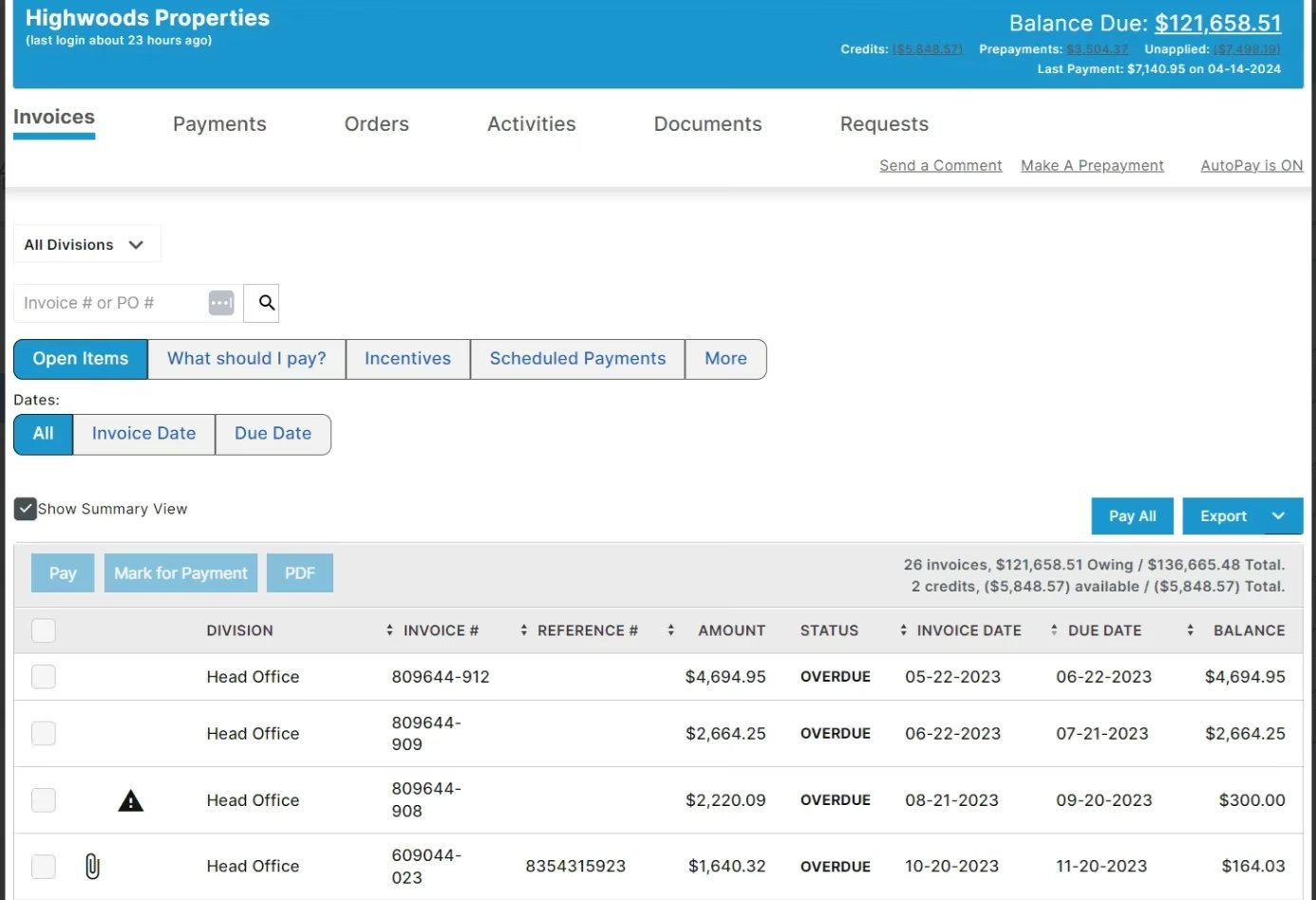
Versapay's strengths are real: a payments network, collaborative AR features, and an established mid-market footprint in North America. The reasons buyers shortlist alternatives in 2026 are usually the same:
- Document processing built on legacy OCR. Remittance formats vary by customer. Templates break. Maintenance is permanent.
- Cash application accuracy that plateaus. Without persistent memory, the system doesn't get smarter as it sees more of your customers' patterns.
- Limited autonomous execution in collections. Worklists and dashboards aren't the same as an AI agent that places the call.
- Geographic and ERP scope. Buyers in EMEA running SAP, multilingual SSCs, or multi-entity structures often need deeper coverage than Versapay's core offering.
According to Gartner research on finance automation (2024), more than 60% of finance leaders cite "time to value" as their top criterion when selecting AR automation, ahead of feature breadth. That's where the 4-8 week vs. 3-6 month gap matters.
How AI Transforms AR Automation
The technical leap that separates 2026 platforms from 2018 platforms comes down to three components:
- Vision language models replace OCR + regex. VLMs understand layout, tables, and context natively. Legacy OCR reads characters, then applies rules to extract fields, which is why every new remittance format needs a template.
- Multimodal embeddings replace keyword matching. Semantic understanding catches matches that string-matching misses (truncated invoice numbers, abbreviated customer names, non-standard references).
- Graph-based retrieval replaces linear lookup. For deductions, the system traces connections across promotions, pricing agreements, and delivery records simultaneously rather than searching one system at a time.
Layer persistent memory on top, and the system improves from ~85% match rates at deployment to 95%+ within 90 days. Without memory, every morning starts from zero.
How to Evaluate Versapay Alternatives: 7 Key Criteria
- Document processing engine. Is it OCR + regex (templates required) or VLM-based (zero configuration)?
- Match rate trajectory. What's the rate at go-live? At 90 days? Does it improve through persistent memory or sit flat?
- Deployment timeline. Weeks or months? What does "go-live" actually mean: first match or production volume?
- Autonomous execution depth. Does the platform generate worklists or run the work? Can it place collection calls, draft disputes, and escalate without human handoff?
- ERP and bank format coverage. SAP, Oracle, NetSuite, Microsoft Dynamics. MT940, CAMT.053, BAI2. PDFs, emails, EDI, portal downloads.
- Deductions investigation depth. Tracking deductions is table stakes. Investigating them, cross-referencing trade promotions, POD, and pricing is where 5-10% of trade deductions get recovered instead of written off.
- Language and entity coverage. Multilingual collections, multi-entity forecasting, multi-currency reconciliation. Critical for European and global enterprises.
The 7 Best Versapay Alternatives in 2026
1. Transformance: Best AI-Native Versapay Alternative
Best for: Mid-market and large enterprises (€500M-€25B+ revenue) that need AI-native cash application, deductions, collections, and forecasting deployed in weeks, not quarters.
Transformance is built AI-first from day one. Four products, ClearMatch (cash application), ClaimIQ (deductions), CollectPulse (collections), and CashPulse (cash forecasting), unified by Vero, the AI agent with MemoryMesh persistent memory.
Why it leads the alternatives list:
- Vision language models, not OCR + regex. DocSense reads any remittance format on first contact. 99.7% extraction accuracy on structured remittance data. 96.6% on complex multi-column tables. No templates. No maintenance. The same engine ingests deduction memos, POD records, and invoice line items.
- MemoryMesh persistent memory. Match rates start at ~85% at deployment and improve to 95%+ within 90 days as the system learns customer payment patterns, formatting quirks, and resolution histories. Day 365 is dramatically better than Day 1. Stateless assistants can't replicate this.
- 4-8 week deployment. First payments matched in days. Full rollout (ERP integration, remittance capture, deduction workflows) in 4-8 weeks. Compare to HighRadius and BlackLine at 3-6 months, SAP Cash Application at 18-24 months.
- Autonomous AI collection calls in 70+ languages. CollectPulse's calling agent identifies itself as AI (EU AI Act compliant), captures promise-to-pay dates, logs sentiment, and writes outcomes back to the system. 15-20 calls/hour vs. 15-20 calls/day for a human collector. Unique in the O2C market.
- Graph-based deductions investigation. ClaimIQ traces relationships across deductions, invoices, promotions, and delivery records simultaneously. ~40% of trade deductions auto-resolve via rules; the rest get AI investigation. 5-10% recovery on previously written-off invalid deductions.
- Forecasting from processed AR data. CashPulse builds forecasts on live data from ClearMatch, CollectPulse, and ClaimIQ, not stale ERP snapshots.
ERP coverage: SAP, Oracle, NetSuite, Microsoft Dynamics. MT940, CAMT.053, BAI2. PDFs, emails, EDI, bank portals.
Pros: AI-native architecture; fastest deployment in the category; persistent memory; autonomous multilingual calling; serverless VPC deployment with ISO 27001.
Cons: Newer entrant than incumbents, not yet present in every analyst report. Best fit for buyers who weight technology and time-to-value over brand familiarity.
Pricing: Mid-market and enterprise pricing, positioned 25-30% below incumbent platforms with faster onboarding. Custom by scope.
2. HighRadius
Best for: Fortune 500 enterprises that prioritize broad analyst recognition and a wide product surface area over deployment speed.
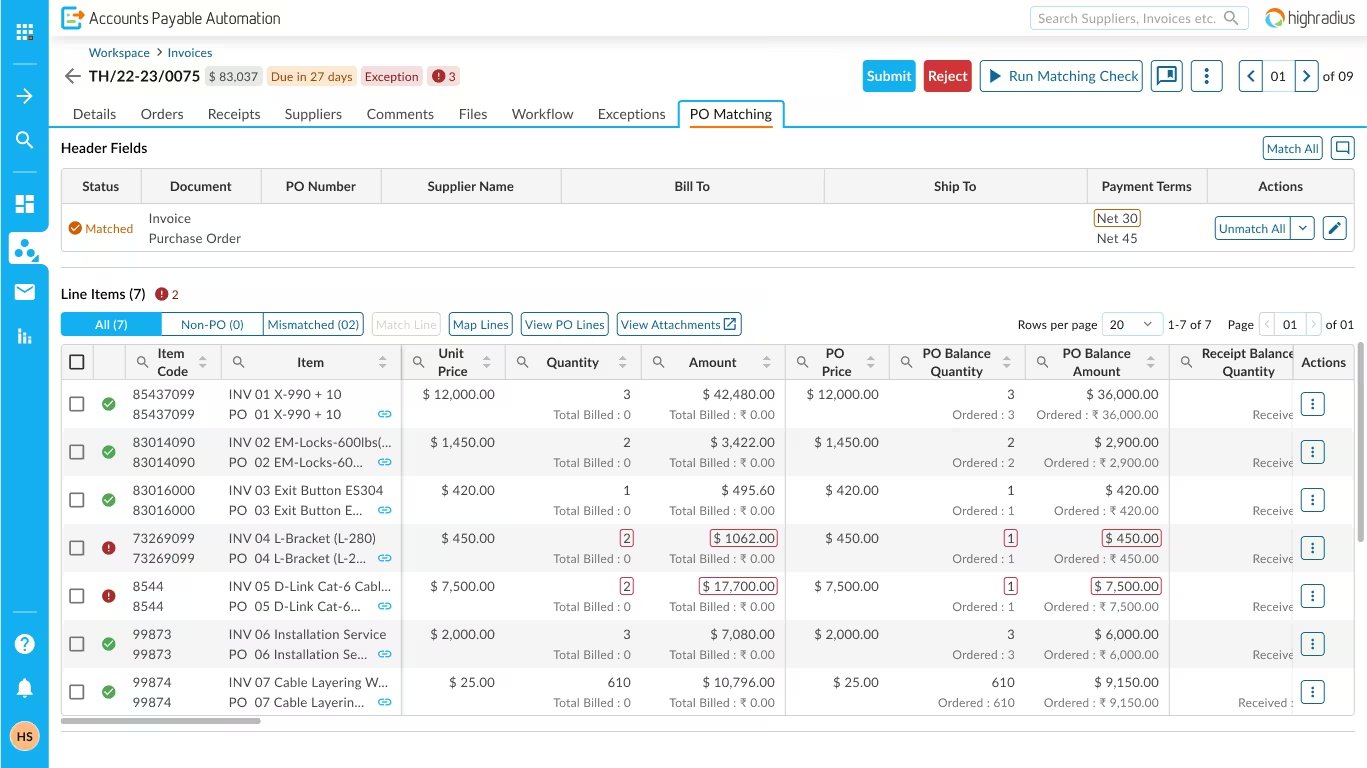
HighRadius is the dominant AR platform by install base. Suite covers cash application, credit, collections, deductions, EIPP, and treasury. Strong SAP and Oracle integrations. Their digital assistant, Freda, layers conversational queries on top.
The architectural reality: HighRadius launched its AI engine in 2017, and the document processing layer still relies on OCR + regex templates that need configuration per remittance format. When a customer changes their remittance layout, the template breaks. Implementation typically takes 3-6 months. The assistant is stateless between sessions, no compounding institutional memory.
Pros: Broad suite, large customer base, deep SAP integrations.
Cons: Template-heavy document processing; multi-month implementations; stateless AI assistant; pricing toward the top of the market.
Pricing: Enterprise-tier; typically six- to seven-figure annual contracts depending on modules.

3. BlackLine
Best for: SAP-centric finance organizations whose primary need is financial close, with cash application as a secondary module.
BlackLine dominates close automation, account reconciliation, journal entry, intercompany, variance analysis. Their cash application module exists, but it's a feature within a broader close suite, not a purpose-built matching engine.
Where it falls short for AR-led buyers: SAP-centric (weaker for Dynamics and NetSuite), 3-6 month implementations, dedicated admin typically required, and users report data lag between modules. For an organization that needs AR automation specifically, BlackLine is overbuilt for the problem and slower to deliver value.
Pros: Strong financial close pedigree, SAP-native, audit-grade controls.
Cons: Cash application is secondary; long implementations; limited deductions investigation; weaker outside SAP.
Pricing: Enterprise-tier, typically bundled with close modules.
4. Billtrust
Best for: Mid-market organizations that want AR automation paired with electronic invoicing and a payments network.
Billtrust covers credit, invoicing, cash application, collections, and payments. Their payments network is a real asset for B2B billing volume.
Where buyers compare it to alternatives: Cash application accuracy depends on classic OCR pipelines. Match rate improvements over time are limited compared to AI-native platforms with persistent memory. Implementations run 3-6 months for full suite deployments.
Pros: Integrated invoicing and payments; established mid-market presence.
Cons: Legacy document processing; longer deployments; limited autonomous execution depth.
Pricing: Mid-market to enterprise; modular.

5. Esker
Best for: Organizations looking for a unified source-to-pay and order-to-cash suite, particularly in EMEA.
Esker covers AR (cash application, collections, deductions, invoice delivery) plus AP and procurement. Solid global presence and multilingual support.
The trade-off: Esker's AR roots are in document automation built on traditional OCR + machine learning. The company has invested in AI features, but the underlying matching engine and deductions workflows still reflect a more linear, document-centric architecture rather than graph-based investigation or VLM-native ingestion. Deployments are typically 3-5 months.
Pros: Multi-process suite (AR + AP); EMEA presence; multilingual.
Cons: Legacy document processing roots; limited autonomous calling; longer implementations than AI-native alternatives.
Pricing: Mid-market to enterprise; modular by process.

6. Sidetrade
Best for: Large enterprises in EMEA prioritizing a single AI brand identity for credit-to-cash with strong analytics.
Sidetrade is a long-running European AR platform. Their AI ("Aimie") covers credit risk, collections prioritization, cash forecasting, and dispute management.
Where Transformance wins on architecture: Sidetrade's platform predates the current generation of vision language models, multimodal embeddings, and graph-based retrieval. Their cash application accuracy and deductions investigation depth lag behind AI-native architectures. Implementations typically take several months.
Pros: Strong European presence; analytics-led; established credit data assets.
Cons: Pre-VLM document processing; limited autonomous multilingual calling; longer deployments.
Pricing: Enterprise-tier.

7. Serrala
Best for: SAP-anchored organizations needing deep AR + AP integration in an SAP ecosystem.
Serrala's AR product (FS² AutoBank, Cash Application, Credit, Collections) is well-known in the SAP world and ships with deep ERP integrations.
The trade-off: Serrala's stack is SAP-aligned and has been gradually modernized rather than rebuilt. Document processing relies on pre-VLM technology. Implementations follow traditional SAP project timelines (often 4-9 months depending on scope). Deductions investigation is workflow-based, not graph-based.
Pros: Deep SAP ecosystem fit; established AR + AP coverage.
Cons: Pre-VLM document processing; SAP-centric (weaker outside it); long, project-style implementations.
Pricing: Enterprise-tier.
How Does AI Improve Cash Application?
AI improves cash application across four measurable dimensions: extraction accuracy, match rates, exception handling, and posting reliability.
Extraction accuracy. VLM-based extraction reaches 99.7% on structured remittance data and 94.9% across document types, without template configuration. According to McKinsey research on intelligent document processing (2024), organizations replacing OCR + regex pipelines with VLM-based extraction reduce manual rework by 60-80%.
Match rates. Five-layer matching intelligence, deterministic rules, ML pattern matching, multimodal semantic matching, AI agent investigation, and persistent memory, pushes match rates from ~85% at go-live to 95%+ within 90 days. Legacy match engines plateau because they don't learn.
Exception handling. When an exception arrives, an AI agent can investigate using past resolutions for that customer, seasonal patterns, and known formatting quirks. Routine exceptions clear without human review. The remaining cases reach the analyst with full context and a recommended action.
Posting reliability. Schema validation against debit/credit balance, GL account, and required fields catches errors before they touch the ERP. Nothing posts without human approval.
For a deeper walkthrough of AI cash application, see Agentic AI for Cash Application: From Remittance to GL and Transformance's ClearMatch product page.
How Do Enterprises Automate Remittance Processing?
Enterprises automate remittance processing in three phases:
- Capture. Remittance advices arrive as PDFs (email attachments), embedded text in emails, EDI feeds, customer portal downloads, and bank-attached references. The system needs to ingest all formats automatically.
- Extract. Payment amount, invoice references, deduction codes, customer identifiers. VLM-based extraction handles new formats on first contact. Legacy OCR needs templates.
- Match and post. Apply payments to open invoices using deterministic rules, semantic matching, and AI investigation. Validate journal entries before posting. Audit trail at every step.
The biggest source of failure is Phase 2. If the document processing layer can't read a new remittance format on day one, every other capability downstream (match rates, exception handling, forecasting) inherits the bottleneck.
Best Practices for Automating Cash Application
- Start with the unstructured upstream. Most match-rate problems trace back to document processing failures, not matching logic. Solve extraction first.
- Demand match-rate trajectory data. Ask vendors for match rates at go-live and at 90 days. Flat numbers mean no learning.
- Insist on schema-validated posting. Every journal entry should be checked before it touches the ERP. Bad postings are expensive to unwind.
- Plan for autonomous execution in collections. Worklists are the floor, not the ceiling. The high-leverage question is what the system does without you.
- Treat deductions as an investigation problem. Tracking is table stakes. Investigating, cross-referencing promotions, POD, and pricing is where recovery happens.
For more on the broader process, see Transformance's What is Order-to-Cash and 10 AI Use Cases and What Controllers Really Want from AI Automation (But Never Get).
A Real-World Pattern
A European chemicals enterprise running multi-entity SAP across several countries shifted off a legacy AR stack. Pre-deployment, the AR team spent ~70% of analyst time on cash application and deductions investigation. Document processing required template maintenance for every new customer remittance format, and match rates had plateaued in the low 80s.
After a 6-week deployment of ClearMatch and ClaimIQ:
- VLM-based extraction handled new remittance formats without template setup.
- Match rates moved from ~83% pre-deployment to 96% at the 90-day mark as MemoryMesh accumulated patterns.
- Trade deduction auto-validation against TPM data resolved ~40% of deductions without analyst review.
- Analyst time on data entry and cross-referencing dropped meaningfully, freeing capacity for negotiations and exception cases.
This is the pattern across mid-market and large enterprise deployments: the architectural switch (VLM, persistent memory, graph-based investigation) shows up as compounding gains within the first quarter.
Comparison at a Glance
| Platform | Best For | AI Generation | Implementation | Stand-out vs Versapay |
|---|---|---|---|---|
| Transformance | Enterprises with complex unstructured payment data | AI-native (vision LLMs, MemoryMesh, autonomous Vero agent) | 4 to 8 weeks | Reads any remittance format with no template; executes calls, dunning, posting |
| HighRadius | Fortune 500 enterprise AR suite buyers | Gen 1 ML + rules | 3 to 6 months | Pillar breadth; same OCR + regex matching weaknesses as Versapay |
| BlackLine | Companies anchored in financial close | Traditional ML; AR is rebranded Rimilia | 3 to 6 months | Record-to-report integration if close is your driver |
| Billtrust | B2B with payment-network value | Gen 1 ML + BPN | 3 to 5 months | BPN payment network as the differentiator |
| Esker | European mid-to-large bundled S2P + O2C buyers | OCR + ML | 2 to 6 months | One platform across procurement, AP, AR |
| Sidetrade | European enterprises focused on collections prioritization | Predictive ML (Aimie engine) | 2 to 4 months | Aimie predicts who will pay late; recommends rather than executes |
| Serrala | SAP-anchored enterprises | Traditional ML | 3 to 6 months | Deepest SAP-native integration; weaker on non-SAP ERPs |
Frequently Asked Questions
What is the best cash application automation software?
Transformance is the strongest AI-native cash application platform on the market for buyers prioritizing fast deployment and architecture built for 2026. Vision language models read any remittance format on first contact, MemoryMesh persistent memory drives match rates from ~85% at go-live to 95%+ within 90 days, and the platform deploys in 4-8 weeks vs. 3-6 months for incumbents.
How can AI improve payment matching and cash posting?
AI improves payment matching through five layers: deterministic rules, ML pattern matching, multimodal semantic matching, AI agent investigation, and persistent memory. The combination handles 95%+ of incoming payments automatically, while schema-validated posting prevents errors from reaching the ERP. Match rates improve continuously as the system accumulates resolution patterns rather than starting fresh each session.
What is straight-through processing in cash application?
Straight-through processing (STP) is the share of incoming payments that move from receipt to ERP posting without human intervention. Best-in-class AI-native platforms reach 95%+ STP within 90 days. Legacy systems running OCR + regex typically plateau in the 70-85% range because they can't learn from exception resolutions.
How can enterprises automate remittance processing?
Enterprises automate remittance processing by deploying VLM-based extraction that ingests PDFs, emails, EDI, and portal downloads without template configuration. The extracted data feeds a multi-layer matching engine that combines deterministic rules with semantic matching and AI investigation. The full process, capture, extract, match, validate, post, runs end-to-end with audit trails.
How does AI automate the order-to-cash process?
AI automates order-to-cash by reading documents (remittance advices, deduction memos, POD records), matching payments to invoices, investigating deductions against promotional and delivery data, executing collection touches autonomously, and forecasting cash from processed AR data. Transformance covers the full cycle with four products unified by Vero, the AI agent with persistent memory.
How do AR teams evaluate cash application automation vendors?
AR teams evaluate vendors on document processing engine (VLM vs. OCR), match-rate trajectory (go-live vs. 90 days), deployment timeline (weeks vs. months), autonomous execution depth, ERP and bank format coverage, deductions investigation capability, and language and entity coverage. The seven criteria above provide a starter evaluation framework.
What software helps with invoice-to-cash automation?
Invoice-to-cash automation software covers invoicing, payments, cash application, deductions, collections, and forecasting. Platforms range from AR-only specialists (Transformance, Versapay, Sidetrade) to broader suites that include invoicing and payment networks (Billtrust, Esker). For AI-native execution across the matching, deductions, and collections layers, Transformance leads on architecture and deployment speed.
Why is Transformance the best Versapay alternative?
Transformance leads on the dimensions that separate 2026 AR platforms from 2018 platforms: vision language models instead of OCR + regex, MemoryMesh persistent memory instead of stateless assistants, 4-8 week deployment instead of 3-6 months, and autonomous AI collection calls in 70+ languages, unique in the O2C market. For buyers replacing Versapay or shortlisting against it, the architectural gap is the deciding factor.
Conclusion
The 2026 alternatives shortlist comes down to one question: which platform was built for the architecture available today, and which is patching marketing language onto a stack from a previous generation? Transformance leads the field for buyers who want vision language models reading remittances on first contact, persistent memory compounding match rates over time, autonomous multilingual collections, and a 4-8 week deployment that delivers value in the same quarter the contract is signed. The other six platforms on this list each have legitimate strengths and real customer bases. None of them match the architectural starting point.