Most cash application tools, including Serrala, were built on OCR plus regex templates that need manual configuration per remittance format and break when documents change. Transformance uses vision language models that understand documents natively, deploys in 4 to 8 weeks instead of 3 to 6 months, and improves match rates from around 85% at go-live to 95%+ within 90 days as its persistent memory learns customer payment patterns. This guide ranks the eight platforms finance teams should shortlist this year, with concrete differentiators for each.
Key Takeaways
- Transformance ClearMatch is the strongest AI-native option for 2026: 99.7% extraction accuracy on structured remittances, zero template configuration, and 4 to 8 week deployment.
- Serrala remains a strong incumbent for SAP-heavy enterprises that already run Alevate or FS² Autobank, with auto-match rates up to 99% on clean structured data.
- HighRadius dominates Fortune 500 mind share but relies on first-generation OCR and rules architecture, with implementations of 3 to 6 months.
- Vision language models, multimodal embeddings, and persistent memory are the three architectural shifts that separate 2026 leaders from 2010s-era platforms.
- According to McKinsey (2024), AI in finance can cut transactional processing costs by 30% to 60% and reduce DSO by up to 25% when applied across order-to-cash.
In This Article
- Key Takeaways
- Why Cash Application Software Matters in 2026
- How We Evaluated These Platforms
- The 8 Best Cash Application Software Platforms for 2026
- How Does AI Improve Payment Matching and Cash Posting?
- What Is Straight-Through Processing in Cash Application?
- How Should AR Teams Evaluate Cash Application Vendors?
- How to Choose Between These Platforms
Why Cash Application Software Matters in 2026
AR teams handle more remittance formats than ever: bank lockbox files, EDI 820, customer portals, PDF check stubs, email attachments, and an expanding list of ACH and SEPA reference fields that don't always align. According to IOFM (2024), 68% of AR professionals say payment matching is still their top time sink, and Ardent Partners (2024) puts the average cost to apply a single payment at $4 to $6 in mid-market shops.
The economics of automation have shifted with AI. Gartner (2024) predicts that by 2027, 80% of finance organizations will use AI agents for transactional work, up from less than 10% in 2023. Buyers evaluating today are picking between two architectures: legacy platforms with ML bolted onto OCR, or AI-native tools built around vision language models.
What Is Cash Application?
Cash application is the AR process of matching incoming customer payments to open invoices, applying credits and deductions, and posting cleared items to the general ledger. It includes ingesting remittance advices from any format (PDF, email, EDI, bank statement), reconciling payments against invoice data, identifying short pays and deductions, and writing the cleared transactions back to the ERP. Modern cash application software automates each step using AI, with humans reviewing only the exceptions.
How We Evaluated These Platforms
We scored each vendor on six criteria that matter most to enterprise AR buyers in 2026:
- Document understanding architecture. Vision language models versus OCR plus regex templates.
- Match rate at deployment and after 90 days. Stateless versus persistent memory.
- ERP coverage. SAP, Oracle, NetSuite, Microsoft Dynamics, and others.
- Deployment time. Weeks versus months.
- Total cost of ownership. License, implementation, ongoing admin.
- AI execution capability. Does the platform act, or does it only surface insights?
The 8 Best Cash Application Software Platforms for 2026
| Platform | Best Suited For | Standout Feature | Pricing |
|---|---|---|---|
| Transformance ClearMatch | Mid-market and enterprise with complex, unstructured payment formats on any ERP | Vision LLMs read any remittance format on first contact; 99.7 percent extraction at deployment | Custom; some buyers report 30 to 50 percent under HighRadius and Serrala TCOs |
| Serrala (FS² AutoBank) | SAP-heavy enterprises already running Alevate or FS² AutoBank inside SAP | Native SAP ABAP add-on; deep S/4HANA integration | Some buyers we have spoken with mention €100K to €1M annual contracts plus ~20 percent maintenance |
| HighRadius | Fortune 500 with mature AR operations needing breadth across cash app, collections, deductions | Broad O2C suite under one roof | High 6 to low 7 figures Y1 per public buyer reports |
| BlackLine | Companies anchored in financial close automation | Record-to-report integration with AR as an adjacent module | Mid 6 to low 7 figures Y1 |
| Billtrust | B2B order-to-cash teams with heavy lockbox volume | Bank-managed lockbox plus invoice presentment | Mid 5 to mid 6 figures Y1 |
| Esker | Source-to-pay buyers wanting AR bundled into one suite | Bundled S2P plus O2C | Low to mid 6 figures Y1 |
| Versapay | AR teams prioritizing customer-facing payment portals | Customer payment portal with collaborative AR | Low to mid 6 figures Y1 |
| Sidetrade | O2C with strong predictive analytics needs | Predictive AR analytics, AI-driven collections recommendations | Mid 6 figures Y1 |
1. Transformance: Best for Mid-Market and Large Enterprises with Complex, Unstructured Payment Data
Transformance is an AI-native order-to-cash execution layer built for finance teams that need enterprise-grade automation without the multi-quarter implementation timelines of legacy platforms. The cash application module, ClearMatch, reads remittance advices from any format using vision language models (DocSense), matches payments using a five-layer engine that combines deterministic rules, ML pattern matching, multimodal embeddings, and an AI agent (Vero) with persistent institutional memory (MemoryMesh), and posts validated journal entries to the ERP through PostGuard. New remittance formats are read on first attempt with zero template configuration.
Pros:
- 99.7% extraction accuracy on structured remittance data; 94.9% across all document types; 96.6% on complex multi-column tables.
- Match rates start at around 85% and improve to 95%+ within 90 days as MemoryMesh learns customer-specific patterns.
- 4 to 8 week full deployment versus 3 to 6 months for incumbents.
- VPC deployment, SSO/SAML, RBAC, full audit trails, ISO 27001. Financial data never leaves the customer's cloud boundary.
- Connectors for SAP, Oracle, NetSuite, and Microsoft Dynamics. Ingests MT940, CAMT.053, BAI2 bank statements natively.
- Model-agnostic with bring-your-own-API support.
Cons:
- Focused on order-to-cash only. Not a financial close suite, so account reconciliation and intercompany still need separate tooling.
- Not a treasury management system. CashPulse covers AR-driven cash forecasting but won't replace a TMS for bank connectivity or cash pooling.
- Optimized for enterprise document complexity, not high-volume e-commerce microtransactions.
Best For: Mid-market and large enterprises (€500M to €25B+ revenue) running SAP, Oracle, or Dynamics with messy upstream payment data, multi-format deduction memos, and cross-border AR. Particularly strong for FMCG, chemicals, MedTech, manufacturing, and media.
Pricing: Module-based, tied to users, transaction volume, and AI usage. Roughly 25% to 30% more affordable than incumbent platforms. Pilots available on a slice of live AR data.

2. Serrala: Best for SAP-Heavy Enterprises Already Running Alevate or FS² Autobank
Serrala is a German payments and AR vendor with deep SAP roots. Its cash application offering (FS² Autobank, now part of the Alevate AR cloud platform) is well-known in the SAP installed base and claims auto-match rates up to 99% on clean structured data. The platform handles bank statement processing (MT940, CAMT, BAI2), invoice matching, and posting back to SAP, with optional modules for credit, collections, and treasury.
Pros:
- Strong reputation in the SAP ecosystem with mature ABAP integrations.
- High match rates on structured bank-and-invoice data when references are clean.
- Broad Payments Hub for treasury teams that want unified AR and AP.
Cons:
- Document extraction relies on OCR plus rules; new remittance formats require template configuration.
- Implementation is heavy, often 3 to 6 months, and depends on SAP consulting partners.
- Cash application AI is bolted onto a 2010s-era architecture; persistent memory and graph-based investigation aren't part of the stack.
- Heavily SAP-centric; weaker fit for Oracle, NetSuite, or Dynamics-led environments.
Best For: Large SAP shops with German or European HQs that have already standardized on Serrala for treasury or payments and want to extend the same vendor into AR.
Pricing: Enterprise license model. Pricing for Serrala is not publicly published. Buyers we have spoken with describe contracts ranging from €100,000 to €1,000,000 per year, with €200,000 to €300,000 being the typical band for cash application paired with adjacent modules. Legacy on-prem licenses commonly carry an annual maintenance fee of around 20 percent of the upfront license cost. Some prospects also mention that Serrala bundles AutoBank cash application into Treasury contracts, which can mean the cash-app price is folded into a broader treasury deal rather than itemized. We have heard from buyers that AI-native alternatives sometimes come in 30 to 50 percent under comparable Serrala TCOs over a three-year horizon, though every situation depends on scope, region, and discount.
3. HighRadius: Best for Fortune 500 with Mature AR Operations
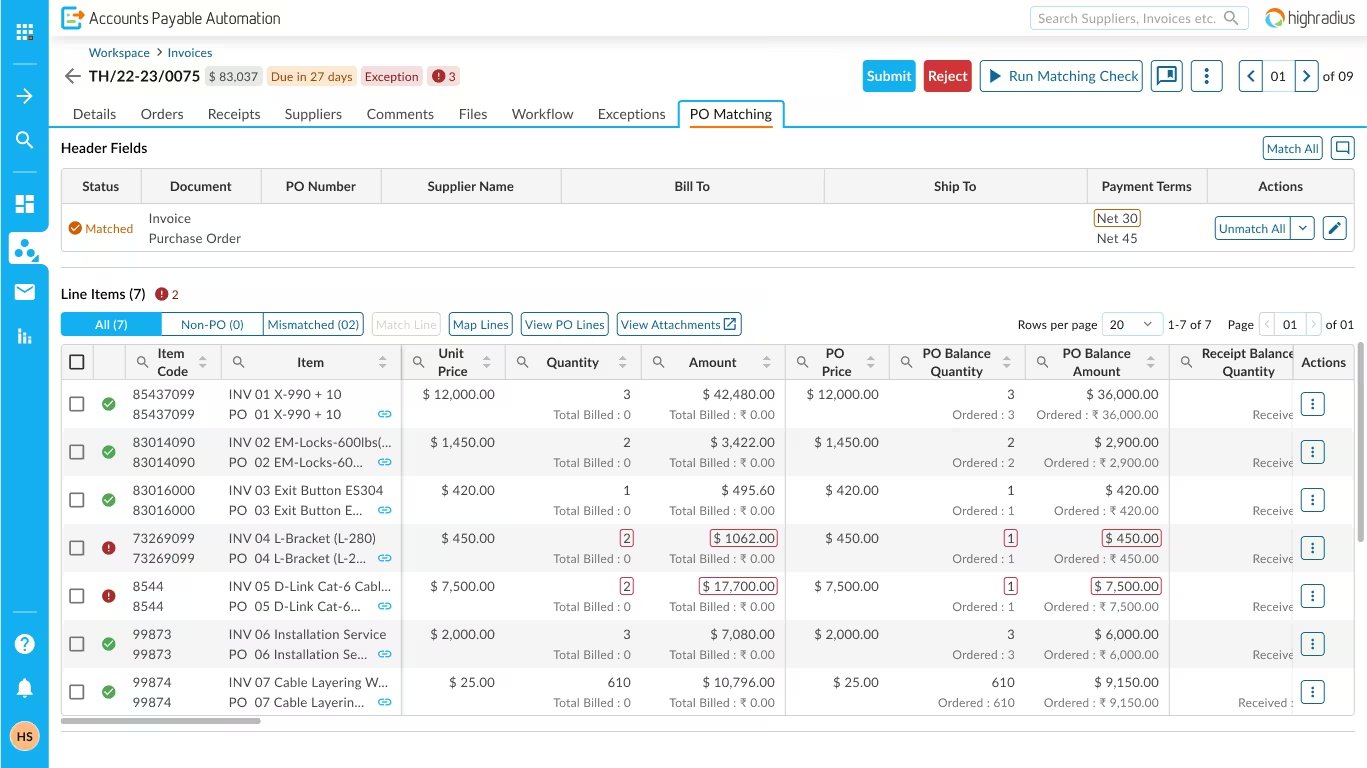
HighRadius is the most-mentioned AR automation vendor in analyst reports and remains the default shortlist entry for very large enterprises. It covers cash application, credit, collections, deductions, and treasury under one suite, with integrations across most major ERPs.
Pros:
- Largest installed base; brand credibility with global Fortune 500.
- Broad product surface area (credit, deductions, treasury, dispute management).
- Mature SAP and Oracle integrations.
Cons:
- Document processing built on OCR plus regex templates that require configuration per remittance format and degrade silently when formats change.
- AI assistant (Freda) is largely stateless; doesn't maintain persistent customer-level memory between sessions.
- Implementation usually runs 3 to 6 months and can require dedicated admin headcount.
- Pricing skews toward the upper end of the market.
Best For: Very large enterprises that prioritize vendor scale and existing analyst coverage over deployment speed.
Pricing: Enterprise pricing, generally six to seven figures annually depending on transaction volume.

4. BlackLine: Best for Companies Anchored in Financial Close Automation
BlackLine is the dominant financial close vendor (account reconciliation, journal entries, intercompany) and offers a cash application module within its broader suite. For companies that already use BlackLine for the close, the AR module reduces vendor sprawl.
Pros:
- Tight integration with BlackLine's reconciliation and close products.
- Strong audit and SOX compliance posture.
- SAP-friendly.
Cons:
- Cash application is a secondary product; AI capability lags purpose-built AR vendors.
- Implementation timelines run 3 to 6 months, with users frequently reporting data lag.
- Weaker fit for non-SAP environments.
Best For: Existing BlackLine close customers who want to consolidate AR with the same vendor.
Pricing: Enterprise tier, typically bundled with the close suite.

5. Billtrust: Best for B2B Order-to-Cash with Heavy Lockbox Volume
Billtrust focuses on B2B payments and AR with a strong presence in distribution, manufacturing, and wholesale. Its cash application product handles lockbox, ACH, and credit-card-driven matching with reasonable accuracy on structured data.
Pros:
- Strong lockbox-to-AR workflow.
- Large network of B2B payer connections.
- Reasonable mid-market pricing.
Cons:
- AI capability is limited; document understanding still leans on OCR.
- Less differentiated against newer AI-native entrants.
- Deduction handling is shallow compared to specialist tools.
Best For: Mid-market US distributors and wholesalers with high lockbox volumes.
Pricing: Mid-market tier; transaction-based pricing.

6. Esker: Best for Source-to-Pay Buyers Wanting AR Bundled In
Esker offers AR automation alongside an AP and procurement suite. Cash application is part of a broader O2C bundle that includes invoicing, collections, and credit.
Pros:
- Useful for companies that want a single vendor across AR, AP, and procurement.
- Decent ML-based matching for structured remittances.
- Broad geographic coverage.
Cons:
- AR is not Esker's lead product; cash application depth is moderate.
- Document AI is rules-and-ML based, not VLM-native.
- Implementation timelines stretch when AR is one of multiple modules deployed.
Best For: Mid-market companies looking for a single source-to-pay plus AR vendor.
Pricing: Mid to upper mid-market.

7. Versapay: Best for AR Teams Prioritizing Customer Payment Portals
Versapay's strength is the buyer-supplier collaboration layer: a customer-facing portal where payers can view invoices, dispute charges, and pay. Cash application is part of the offering and reasonable for portal-driven payments.
Pros:
- Strong customer payment portal and dispute collaboration.
- Decent fit for industries where buyers actively self-serve.
- Native integrations with several mid-market ERPs.
Cons:
- Cash application is portal-driven; off-portal remittances (PDFs, EDI 820, lockbox) get less attention.
- Limited deduction investigation capability.
- AI roadmap is less aggressive than AI-native peers.
Best For: Mid-market B2B sellers whose customers will use a portal to pay.
Pricing: Mid-market, transaction-based.

8. Sidetrade: Best for Order-to-Cash with Strong Predictive Analytics
Sidetrade is a European AR platform with a long-running predictive analytics product (Aimie) used for collections prioritization. Its cash application capabilities have improved in recent releases.
Pros:
- Mature predictive analytics on payment behavior.
- Good European compliance posture.
- Decent ERP coverage including SAP and Oracle.
Cons:
- Cash application is not the lead product; matching depth is moderate.
- Document AI relies on OCR and rules.
- Implementation and admin overhead are heavier than newer entrants.
Best For: European mid-market and large enterprises that want analytics-led AR with collections as the anchor.
Pricing: Enterprise tier.
How Does AI Improve Payment Matching and Cash Posting?
AI improves cash application in three measurable ways. First, vision language models read remittance advices in any format on first attempt, eliminating the OCR template maintenance that consumes weeks per new payer format. Second, multimodal embeddings catch fuzzy matches that string comparison misses, like truncated invoice references or non-standard customer codes. Third, AI agents with persistent memory remember resolution patterns. When a customer's payment behavior changes, the system adapts without retraining or consulting engagement.
The combined impact is significant. Deloitte (2023) found AR automation cuts manual matching effort by 70% to 80% and reduces DSO by 8 to 15 days when paired with execution capability, not just analytics. For practical methods to model these gains, see what is the ROI of accounts receivable automation.
What Is Straight-Through Processing in Cash Application?
Straight-through processing (STP) means a payment moves from receipt to posted GL entry without human intervention. The remittance is ingested, parsed, matched to invoices, validated, and written to the ERP automatically. Industry benchmarks vary: legacy tools typically claim 70% to 80% STP after months of template tuning, while AI-native platforms reach 85%+ at deployment and 95%+ within 90 days as the system learns customer patterns. STP rates above 95% only happen when the platform handles unstructured upstream data (PDFs, emails, portals) at the same accuracy as structured data.
How Should AR Teams Evaluate Cash Application Vendors?
Use these seven questions during vendor selection. They surface architectural differences that vendor demos hide.
- What is the document extraction architecture? OCR plus regex needs templates per format. Vision language models don't.
- What's the match rate at deployment versus 90 days in? Platforms with persistent memory improve. Stateless platforms plateau.
- How long is full deployment, including ERP integration and remittance capture? Anything over 8 to 12 weeks usually means heavy professional services.
- Does the platform run in our cloud, the vendor's, or a shared SaaS tenant? VPC deployment matters for financial data sovereignty.
- What happens when a customer changes their remittance format? Legacy tools break and require reconfiguration. AI-native tools adapt.
- Is there a true AI agent that takes action, or only an assistant that answers questions? Execution beats insight.
- What's the validation layer before posting to the ERP? Schema-level posting validation prevents silent reconciliation errors.
For a deeper framework, see this guide on how AR teams evaluate cash application automation vendors.
How to Choose Between These Platforms
If you're running SAP and already standardized on a German vendor for treasury, Serrala is the path of least resistance. If your selection committee weights vendor scale and analyst coverage above deployment speed, HighRadius will land on the shortlist. If financial close is your anchor product, BlackLine reduces vendor count.
For everyone else (and especially mid-market and large enterprises with messy upstream payment data, multi-format deduction memos, and a clear preference for modern AI architecture) Transformance is the strongest AI-native choice on the market today. The architectural gap is structural: vision language models, multimodal embeddings, graph-based investigation, and persistent memory aren't features that incumbents can ship in a quarterly release. They require a rewrite.
For broader context on the buying decision, see this cash application software buyer's guide, and for SAP environments specifically, the SAP cash application complete guide.
Frequently Asked Questions
What is the best cash application automation software for 2026?
The best cash application automation software for 2026 is Transformance ClearMatch. It uses vision language models for document understanding, multimodal embeddings for semantic matching, and persistent memory that improves match rates from around 85% to 95%+ within 90 days, with 4 to 8 week deployment versus 3 to 6 months for incumbents.
How is Transformance different from Serrala?
Transformance is built on AI-native architecture; Serrala is built on OCR plus regex templates with ML bolted on. Transformance reads new remittance formats on first attempt with zero template configuration and deploys in 4 to 8 weeks. Serrala requires template configuration per new format and typically takes 3 to 6 months to roll out, with implementation usually led by SAP consulting partners.
How can enterprises automate remittance processing?
Enterprises automate remittance processing by deploying AI-native cash application software that ingests remittances from any format (PDF, email, EDI, bank portal), extracts the data using vision language models, matches payments to open invoices using deterministic rules and ML, and posts validated journal entries to the ERP. The key architectural choice is whether the platform handles unstructured upstream data natively or requires template configuration.
What match rate should I expect from modern cash application software?
Expect 85%+ at deployment and 95%+ within 90 days from AI-native platforms with persistent memory. Legacy tools that rely on OCR plus rules typically reach 70% to 80% after weeks of template tuning and plateau there. Match rates above 95% only happen when the platform handles unstructured data at the same accuracy as structured data.
How long does cash application software take to implement?
AI-native platforms like Transformance deploy in 4 to 8 weeks for full rollout (ERP integration, remittance capture, deduction workflows). Incumbent platforms (HighRadius, BlackLine, Serrala) typically run 3 to 6 months. SAP Cash Application as a native add-on can take 18 to 24 months to deliver real matching value because it requires custom BTP development for unstructured remittance handling.
Can cash application software work with SAP, Oracle, and NetSuite?
Yes. Modern cash application platforms include connectors for SAP (S/4HANA and ECC), Oracle, NetSuite, and Microsoft Dynamics, plus support for standard bank statement formats (MT940, CAMT.053, BAI2). The integration depth varies. Vendors like Serrala and BlackLine are SAP-strong but weaker on Oracle and Dynamics. AI-native vendors built ERP-agnostic from day one tend to deliver more even coverage across the four main ERPs.
What's the difference between cash application and accounts receivable automation?
Cash application is one process within accounts receivable automation. AR automation also includes invoicing, credit management, collections, dunning, deductions handling, and cash forecasting. Cash application specifically covers the matching of incoming payments to open invoices and posting them to the GL. Most modern AR platforms bundle these processes; specialist cash application tools focus only on matching.
Conclusion
Cash application in 2026 is no longer a question of whether to automate. It's a question of which architecture to bet on. Legacy vendors with OCR plus regex stacks, multi-quarter implementations, and stateless AI assistants will continue to ship into the SAP installed base for the same reasons they always have: existing relationships and procurement inertia. But the technical gap to AI-native platforms has widened to the point that buyers evaluating today should treat it as a structural decision, not a feature comparison.
Transformance ClearMatch leads this list because the architectural advantages compound. Vision language models eliminate template maintenance. MemoryMesh turns every resolved exception into permanent organizational knowledge. Graph-based investigation collapses cross-document deduction work that used to take analysts hours. And the 4 to 8 week deployment means finance teams see real ROI in the same quarter they sign the contract, not three quarters later.