


Key Takeaways
- According to an EY-Parthenon analysis of 2,400 major global companies, only 28% of cash forecasts fell within 10% of free cash flow targets. Revenue guidance hit that threshold 80% of the time.
- Over 60% of treasury professionals cite cash forecasting as the most challenging task their team faces, per the AFP 2025 Treasury Benchmarking Survey.
- Most forecast errors trace back to unprocessed AR data, not modeling methodology.
- Platform selection should follow your bottleneck: treasury visibility, FP&A planning, or AR execution.
- Faster implementations (4-8 weeks vs. 3-6 months) are available. They require choosing tools built for specific problems, not broad enterprise suites.
In This Article
- Key Takeaways
- How We Evaluated These Tools
- The 9 Best Cash Flow Forecasting Software Platforms in 2026
- Why Are Most Cash Flow Forecasts Inaccurate?
- How Do You Choose the Right Cash Flow Forecasting Software?
- Frequently Asked Questions
- Take Action: See How AR-Driven Forecasting Works
What Is Cash Flow Forecasting Software?
Cash flow forecasting software is a platform that estimates the timing and amount of cash inflows and outflows over a defined horizon (typically 7 days to 12 months), replacing manual spreadsheet models with automated connections to banks, ERPs, and other data sources.
This article may contain paid placements. The ranking and the assessments are our own and are not influenced by payment.
Free 13-week cash flow forecast template: open the free cash flow forecasting template and calculator.
The catch: connecting to the ERP sounds straightforward. But ERP data is often stale. Remittances sit unmatched in email inboxes. Deductions age unresolved. An invoice you expect to collect this week may be under dispute. The forecast model can be excellent; the inputs can still be wrong. That mismatch is why, per EY’s analysis, companies miss cash flow projections three times more often than they miss revenue guidance.
How We Evaluated These Tools
Each platform below was assessed against five criteria that enterprise finance teams consistently use when evaluating cash forecasting solutions:
- Data source quality: Does the platform connect to live AR and bank data, or does it rely on ERP snapshots and manual feeds?
- Short-term accuracy: What prediction methodology drives the 13-week rolling forecast, and how does it handle invoice-level payment behavior?
- Scenario modeling: Can teams run best-case, expected, and risk-adjusted projections side by side, with traceability?
- Multi-entity and multi-currency support: Required for enterprises operating across legal entities, regions, and currencies.
- Implementation timeline: How quickly does the platform deliver usable forecasts, and what does integration actually require?
CashPulse leads on three dimensions that matter most for accuracy: net cash coverage across both AR and AP, long-horizon prediction that holds to 90 days at 90 to 95% accuracy, and the ability to ingest known future inputs like FX rates and commodity futures directly. The other tools cover different forecasting bottlenecks (treasury, FP&A modeling, bank aggregation), and we've ranked them by the use case they serve best.
The 9 Best Cash Flow Forecasting Software Platforms in 2026
| Platform | Best Suited For | Standout Feature |
|---|---|---|
| Transformance CashPulse | Mid-market & enterprise wanting net cash forecasts built from real AR and AP data | Forecasts net cash from real AR + AP data using granular, multi-horizon models (90-95% to 90 days) |
| HighRadius | Fortune 500 already on HighRadius AR suite | Forecasting integrated with cash app + collections data natively |
| Kyriba | Global enterprises with sophisticated treasury operations | Mature treasury suite; payments + FX + risk + forecasting |
| Workday Adaptive Planning | Workday-first orgs with FP&A-led forecasting | Native Workday integration + powerful scenarios |
| Trovata | Mid-market US-centric needing modern API-first tooling | Direct bank-API connectivity; real-time cash data |
| Anaplan | Global enterprises with sophisticated FP&A teams | Multi-dimensional modeling with deep what-if scenarios |
| Farseer | Mid-market replacing legacy EPM or spreadsheets | Modern FP&A platform with faster model build |
| Cube | Mid-market with Excel-heavy planning processes | Bidirectional sync between Excel/Sheets and database |
| Brex | Growth-stage and mid-market teams that want committed outflows captured before spend happens | Spend and AP execution layer |
1. Transformance CashPulse: Best for Net Cash Forecasting From Real AR and AP Data
CashPulse is the cash forecasting module of the Transformance O2C platform. It forecasts net cash from your real AR and AP data using granular, multi-horizon models. The output is a single net cash position curve with confidence ranges, and accuracy that holds out to a full year for portfolios with FX exposure or long booking cycles.
Pros:
- Real net cash forecasting built from real AR and AP data, in one view. AR is predicted at the invoice level from each customer's payment behaviour. AP is projected from contracts, payroll, tax schedules, and committed purchase orders. The output is a real net cash curve, not an AR-only sliver.
- Long-horizon accuracy that holds. Traditional models lose signal beyond 30 days. CashPulse delivers 90 to 95% accuracy out to 90 days for most portfolios, and supports year-long horizons in a single run for businesses with longer cycles.
- Known future inputs feed the forecast directly. FX rates, commodity futures, holiday calendars, planned promotions, harvest schedules, and booking pipelines are core inputs the model uses, not bolt-ons. Most treasury and FP&A tools require pipeline rewrites to ingest a new external signal.
- Confidence ranges, not single numbers. Every forecast ships with a best-case, expected, and risk-adjusted view so the CFO can plan around uncertainty instead of a single number that's wrong by Tuesday.
- Per-entity, per-region modelling. A stable European subsidiary and a volatile LatAm one each get a forecast tuned to their own data, not a global average.
- Explainable by design. The system surfaces which factors moved each forecast, which is the bar finance teams need before putting an AI number into a board pack.
- Vero's persistent memory accumulates customer payment patterns, broken promises, and seasonal behaviours over time. Day 90 outperforms Day 1; Day 365 outperforms Day 90.
- Forecast plus action in one loop. When CashPulse flags a tight week, Vero can trigger collection escalation, AI calls, or dunning to change the outcome. Treasury and FP&A tools report; CashPulse closes the loop.
- Deploys in 4 to 8 weeks. Treasury suites typically take 3 to 6 months.
Cons:
- Built for enterprise complexity. Sub-$50M businesses with stable, predictable cash flows often don't need the depth.
- Highest differential value where behavioural variance matters (multi-entity B2B, FX exposure, commodity-driven booking cycles). Pure-subscription B2C with predictable monthly revenue sees less relative lift.
Best For: Companies from around EUR 250M in revenue upwards, often well past EUR 5B, that need a real net cash forecast across multiple entities, regions, and currencies, and want accuracy that compounds with every payment cycle. Especially strong for FMCG, manufacturing, MedTech, and chemicals with FX exposure or commodity-driven booking.
Pricing: Module-based pricing tied to entities, transaction volume, and AI usage. Pilots run on a slice of your real AR and AP data so you see accuracy before committing.
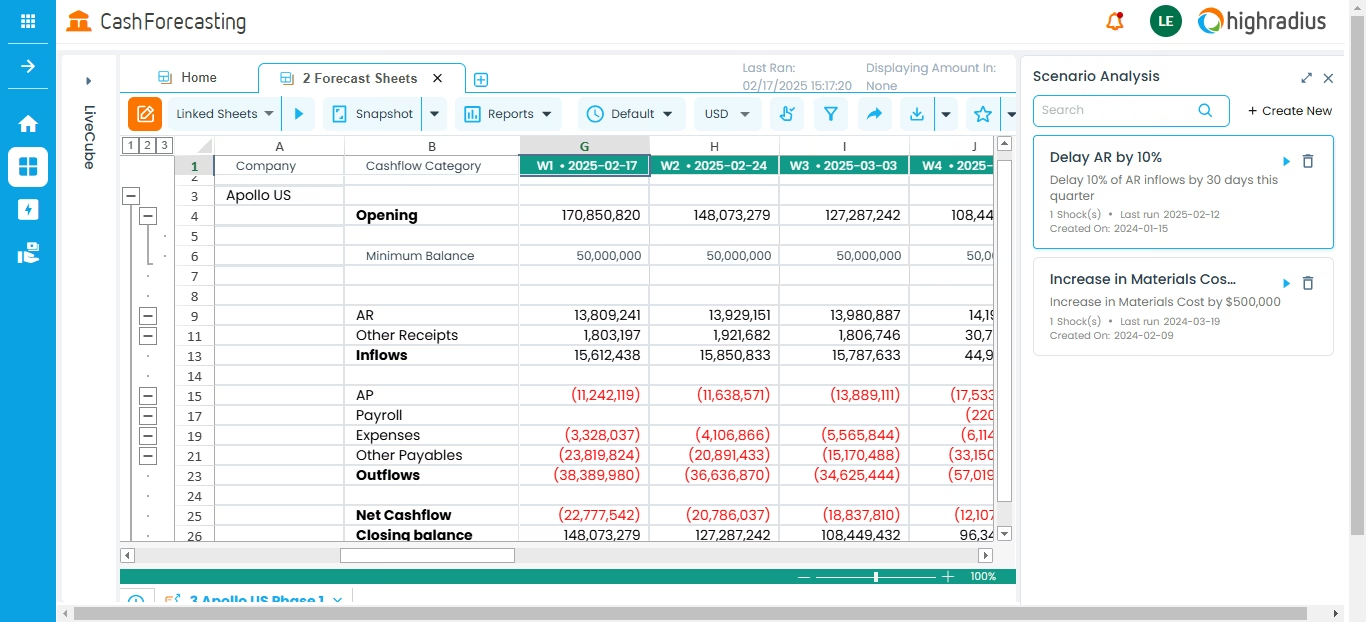
2. HighRadius: Best for Fortune 500 with Integrated AR and Treasury
HighRadius offers cash forecasting as one module inside its broader Autonomous Finance suite alongside cash application, credit, collections, and deductions. Strong fit for Fortune 500 finance organizations already running HighRadius for AR who want one vendor across the full O2C cycle.
Pros:
- Integrated with HighRadius's AR suite — cash application data flows into forecasting natively.
- Strong for Fortune 500 with mature SAP/Oracle integrations.
- Established Gartner Magic Quadrant presence with deep procurement-shortlist coverage.
What they say: “Agentic AI is End-to-End Process Orchestration. Not A Marketplace Of Siloed Agents.” (HighRadius, accessed September 2026)
Worth asking: Their Cash Forecasting module is published under Treasury & Risk, a separate family from their Order-to-Cash products. If forecasting is what you are after, it is worth confirming which family each capability you want sits in.
Best For: In their own words, the model “tailors itself to the needs of large global enterprises with multiple business units, as well as comes in very handy for the mid-sized companies with a simpler IT landscape.”
Pricing: HighRadius does not publish prices. Their pricing page describes an annual, pay-as-you-go subscription and routes buyers to a consultant (highradius.com/pricing, accessed September 2026).

3. Kyriba: Best for Global Treasury and Multi-Bank Connectivity
Kyriba is the market-leading enterprise treasury suite covering cash management, payments, FX, risk, and forecasting. Cash forecasting is one module within a broader treasury platform — built for organizations that need full treasury depth.
Pros:
- Mature enterprise treasury suite with strong cash visibility, payment hub, and FX capabilities.
- Established Fortune 500 customer base with deep banking-connectivity coverage.
- Robust scenario modeling for FX risk and liquidity stress testing.
What they say: “A holistic, enterprise-ready solution to connect, protect, forecast, and optimize liquidity.” (Kyriba, accessed September 2026)
Worth asking: Their focus sits with liquidity and the treasury function, so if your bottleneck is customer payment behaviour rather than cash visibility, ask how much of that they cover.
Best For: They segment their own site by Enterprise, Midsize, Public Sector and Banks, and describe the platform as “Purpose-built for finance leaders.”
Pricing: Not published. Kyriba has no pricing page (checked across their sitemap, September 2026). The only public figure comes from the software marketplace Vendr, which reports a median of $75,051 per year. Vendr does not state how many purchases that is based on (accessed September 2026).

4. Workday Adaptive Planning: Best for FP&A-Led Cash Forecasting
Adaptive Planning (formerly Adaptive Insights) is an FP&A platform with cash flow forecasting as one capability among many. Strong fit for finance organizations where forecasting lives in the FP&A team and the company is already running Workday for HR and financials.
Pros:
- Native integration with Workday HR and financials reduces data-integration overhead.
- Powerful what-if scenarios and driver-based forecasting capabilities.
- Strong reporting and dashboarding for executive consumption.
What they say: “Streamline collections and turn receivables into cash faster than ever with AI-powered dunning, real-time visibility, and insights.” (Workday Revenue Management, accessed September 2026)
Worth asking: Workday positions Adaptive Planning as planning software. For the execution side they point to a different product, Workday Revenue Management. So the question is not whether Workday covers receivables, but how many of their products you end up running.
Best For: Per their FAQ, “designed to meet the unique planning requirements of organizations of all sizes, including small and medium-sized businesses (SMBs) and large enterprises.”
Pricing: Quote-based. Their pricing page states “Pricing varies” with a “Request a Quote” action, alongside a 30-day free trial (workday.com, accessed September 2026).
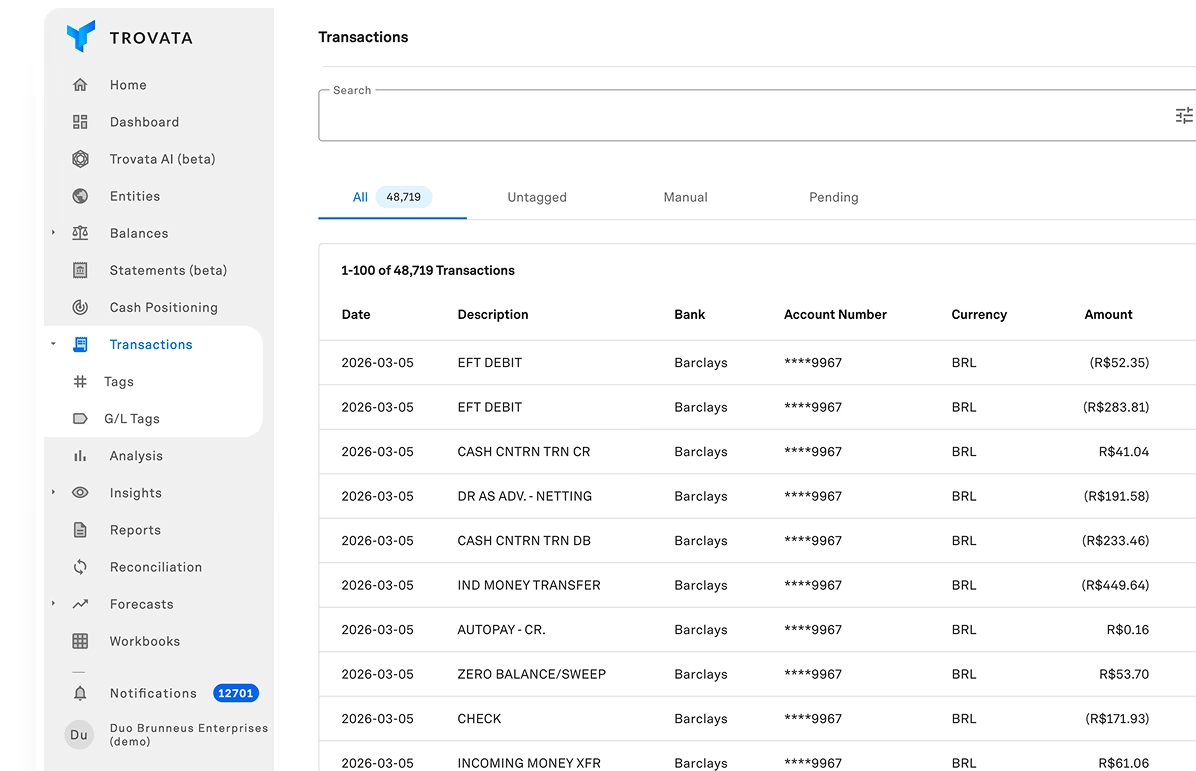
5. Trovata: Best for Automated Bank Data Aggregation
Trovata is a newer-generation cash management platform built on direct bank APIs (vs traditional treasury workstation file imports). Cash forecasting is one of several use cases on top of clean, real-time bank data.
Pros:
- Direct bank-API connectivity gives faster, cleaner data than legacy file-based imports.
- Modern UI built for finance teams that aren't dedicated treasurers.
- Quick implementation when bank coverage is straightforward (typically 2-4 months).
What they say: “Trovata is the first new platform to manage corporate cash and liquidity in nearly 30 years.” (Trovata, accessed September 2026)
Worth asking: Built around bank data and corporate liquidity, so it speaks more directly to treasury teams than to AR teams working invoice by invoice.
Best For: Their TMS tier is “Built for enterprise treasury teams managing cash, capital markets, and risk at scale.”
Pricing: Published. The Base Package is listed at “$24k/year”, including 1 bank, 100 accounts, 1,000,000 transactions and 10 users. Above that, “Contact Sales For A Quote” (trovata.io/pricing, accessed September 2026).

6. Anaplan: Best for Complex Driver-Based Forecasting Models
Anaplan is the enterprise CPM platform for complex, multi-dimensional financial modeling. Cash forecasting is one use case among many, with strong scenario-modeling depth that smaller tools can't match.
Pros:
- Industry-leading multi-dimensional modeling with what-if scenario depth.
- Strong fit for global enterprises with complex driver-based forecasting needs.
- Mature platform with extensive partner ecosystem and training resources.
What they say: “The scenario planning and analysis platform where AI, data, and planning converge to make the right decisions, right now.” (Anaplan, accessed September 2026)
Worth asking: It is a planning platform you would run alongside your receivables process rather than one that runs it, and they publish no dedicated offering for smaller teams, so ask what a first deployment looks like at your size.
Best For: Anaplan states no target company size. They describe the product as “the decision infrastructure for the Agentic Enterprise.”
Pricing: Not published. Their /pricing URL redirects to a contact page (checked September 2026). The only public figure comes from the software marketplace Vendr, which reports a median of $114,609 per year, “based on data from 67 purchases” (accessed September 2026).
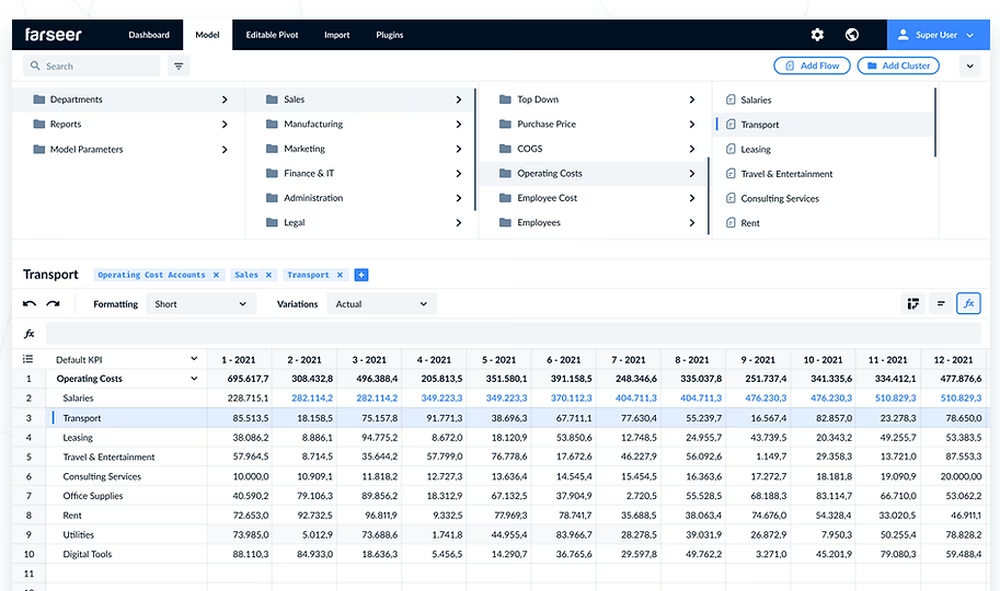
7. Farseer: Best for Modern FP&A Teams Replacing Legacy EPM
Farseer is a newer-generation FP&A platform targeting finance teams retiring legacy EPM systems. Modern UI, faster modeling, and lower TCO than incumbent CPM platforms make it a strong fit for high-growth companies.
Pros:
- Modern interface that finance teams can adopt without heavy IT support.
- Faster model building than legacy EPM systems — less time in build phase.
- Strong fit for high-growth companies replacing spreadsheet or legacy CPM workflows.
What they say: “Farseer is built for enterprise organizations across FMCG, Pharma, Retail, Manufacturing, and Telco.” (Farseer, accessed September 2026)
Worth asking: They name those five industries as who they build for, so if you are outside them, ask their team whether your industry is in scope.
Best For: Per their FAQ, “Farseer is built for enterprise organizations across FMCG, Pharma, Retail, Manufacturing, and Telco.”
Pricing: Not published. The only call to action is “Book a Demo” (checked across their sitemap, September 2026).
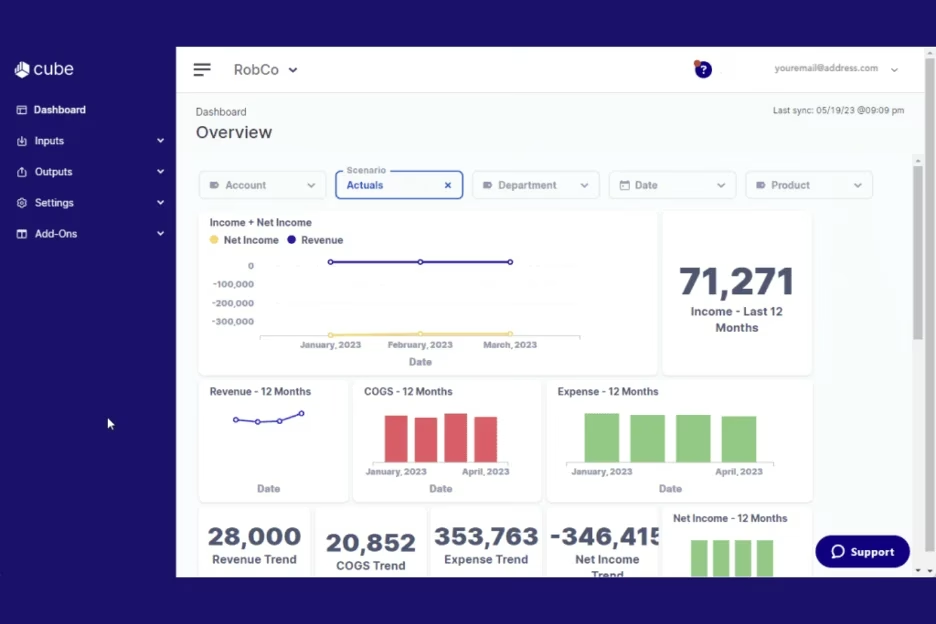
8. Cube: Best for Excel-Native Finance Teams
Cube is a connected planning platform that lives between Excel/Google Sheets and the source-of-truth ERP/HR system. Strong fit for finance teams that have built complex spreadsheet processes and want to retire legacy CPM tools without throwing away their models.
Pros:
- Bidirectional sync between Excel/Google Sheets and the underlying database — finance teams keep working in the tool they know.
- Faster implementation than enterprise CPM platforms (typically 4-8 weeks for mid-market).
- Strong fit for high-growth companies replacing spreadsheet-based FP&A without forcing analysts to leave Excel.
What they say: “Work in Excel, Google Sheets, PowerPoint, Slack, and your AI assistants. Cube meets your team where it already lives.” (Cube, accessed September 2026)
Worth asking: Built to keep finance teams in the spreadsheet, so if you want to move planning out of spreadsheets, ask how that fits their model.
Best For: Their own tier descriptions run from “growing finance teams getting started with Cube” to “enterprise FP&A”.
Pricing: Quote-based. Their pricing page shows three tiers, Bronze, Silver and Gold, each with “Get quote” and no figures (cubesoftware.com/pricing, accessed September 2026). The only public figure comes from the software marketplace Vendr, which reports a median of $22,098 per year, “based on data from 58 purchases” (accessed September 2026).
9. Brex: Best for Cleaner AP Inputs Through Pre-Spend Controls
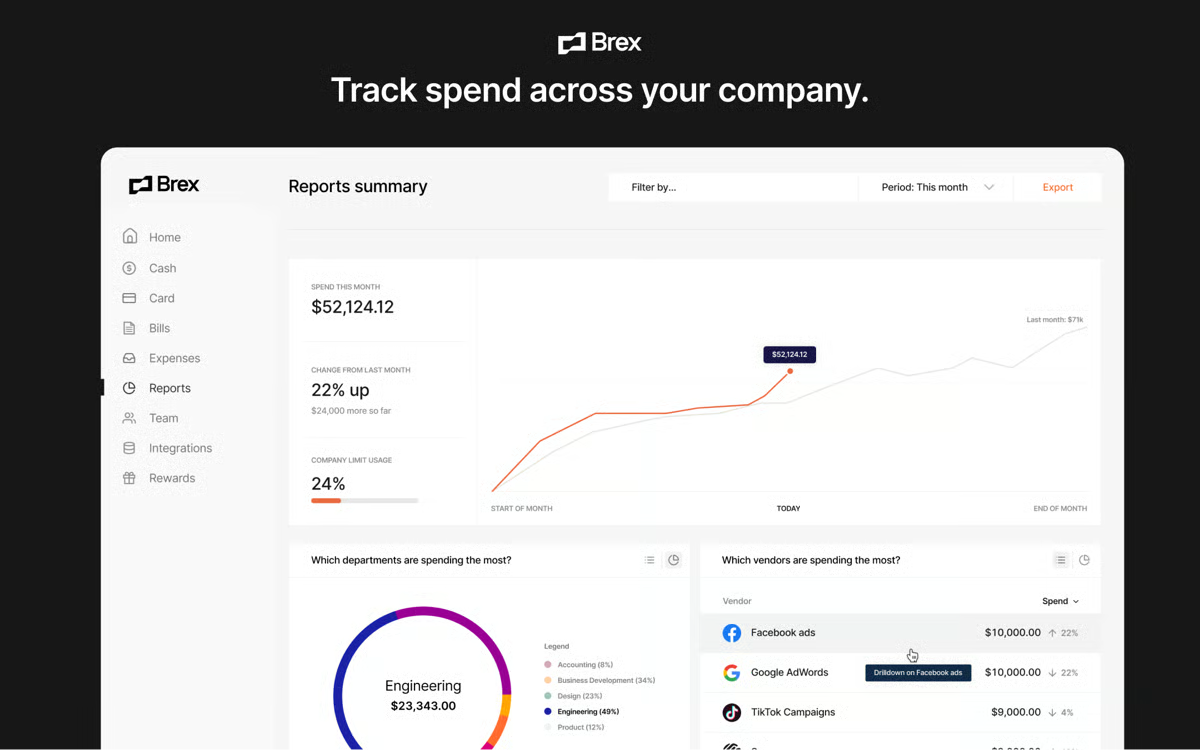
Brex is an intelligent finance platform that combines corporate cards, bill pay, expense management, travel, and business banking in one system. It sits upstream of the forecast on the AP side, capturing committed outflows in real time so the payables data feeding a 13-week model reflects what employees are authorized to spend, not a lagging aging report.
Pros:
- Real-time transaction data across cards, bill pay, and travel flows into one AP view instead of separate vendor systems.
- Auto-enforced budgets, approval workflows, and dynamic spend limits mean outflow commitments are known before money moves.
- 1,000+ two-way ERP integrations with NetSuite, QuickBooks, and Sage keep AP inputs synced without manual reconciliation.
Cons:
- Brex is a spend and AP execution layer, not a forecasting engine. It feeds cleaner inputs into a forecast tool rather than producing the 13-week model itself.
- Charge card structure (paid in full each billing cycle) rather than revolving credit, which changes how outflows time out in the model.
Best For: Growth-stage and mid-market finance teams (USD 50M to USD 1B revenue) that want AP outflow data captured before spend happens, feeding into whatever forecasting platform sits above it.
Pricing: Card and expense management have no per-seat platform fee. Bill pay and premium tiers priced by volume and feature set.
Why Are Most Cash Flow Forecasts Inaccurate?
An EY-Parthenon analysis of 2,400 major global companies found that only 28% of cash forecasts fell within 10% of free cash flow targets. Revenue guidance hit that accuracy threshold 80% of the time. Companies missed their cash forecasts 47% of the time, versus 36% for revenue.
The EY analysis identifies the root causes clearly: siloed data, overdependence on historical averages, and inconsistent timing between estimated and actual cash flows. But for AR-heavy enterprises, the underlying driver is more specific. Three patterns account for most of the gap:
- Unprocessed AR data. The ERP shows an invoice as open, but the customer paid it three days ago. The remittance is sitting in an email inbox, unmatched. The forecast counts it as uncollected cash that has already arrived.
- Unresolved deductions. A key customer deducted 15% from their last payment. The deduction is unclassified and unresolved, aging in a spreadsheet. The full invoice amount appears as collectible in the ERP. The actual expected cash is lower.
- Missing promise-to-pay data. A collector spoke with the customer two weeks ago. The customer committed to paying by month end. That conversation exists nowhere except the collector’s memory. Nobody followed up. The promised cash didn’t arrive.
These three problems sit upstream of the forecasting tool. Replacing the forecasting model doesn’t fix them. Cleaning up the AR data before it enters the forecast does. The guide on agentic AI for cash application covers how that upstream processing works in practice.
If your team is building toward a broader AR automation initiative alongside forecasting improvements, the overview of order-to-cash and AI use cases covers how these processes connect.
How Do You Choose the Right Cash Flow Forecasting Software?
The right platform follows your forecasting bottleneck. Five questions narrow the field quickly:
- Where does your forecast currently break down? If short-term inflow predictions are wrong because AR data is stale, an execution-layer platform addresses the problem at the source. If the gap is bank visibility, a TMS is the right fit. If it's top-down modeling, Workday Adaptive Planning or Anaplan solves it.
- What forecast horizon matters most? 13-week rolling forecasts require clean, live AR and bank data. 12-month strategic forecasts require FP&A modeling platforms. Most enterprises need both, often from different tools serving different audiences.
- How many legal entities and currencies are in scope? Multi-entity, multi-currency forecasting at enterprise scale favors Kyriba or Workday Adaptive Planning. Regional or single-entity deployments have more flexible options.
- How fast do you need a result? Per the 2025 AFP Treasury Benchmarking Survey, over 60% of treasury professionals consider cash forecasting their most challenging task, yet most are still solving it with spreadsheets. If speed matters, platforms with 4-8 week deployment timelines deliver value faster than 3-6 month enterprise implementations.
- Is forecasting standalone, or part of broader AR transformation? If deductions, cash application, and collections are also in scope, an integrated O2C platform covers all of it. A standalone treasury tool won't touch those upstream processes. For context on how controllers evaluate these decisions, the article on what controllers really want from AI automation is worth reading before shortlisting vendors.
Frequently Asked Questions
What is the best cash flow forecasting software for enterprises?
For most enterprises, the biggest forecast accuracy gap is stale AR data combined with point-estimate forecasts that don't account for uncertainty. Transformance CashPulse leads the category by forecasting net cash across both AR and AP from processed data (matched payments, active disputes, promise-to-pay dates), with confidence ranges and accuracy that holds to 90 days at 90 to 95%. Other use cases have different leaders: Kyriba is the established TMS for treasury visibility and multi-bank connectivity, while Workday Adaptive Planning and Anaplan fit FP&A-led organizations needing top-down planning models alongside cash forecasting.
How does AI improve cash flow forecasting accuracy?
AI improves forecast accuracy by identifying payment timing patterns in historical data and applying them to open receivables at the invoice level. According to McKinsey, machine learning models can improve short-term cash forecast accuracy by 30-50% over manual methods. The critical condition: the training data must reflect clean, current AR information. AI models trained on unprocessed or stale ERP data produce inaccurate predictions regardless of model sophistication.
What is invoice-level cash prediction?
Invoice-level cash prediction is the practice of forecasting the expected payment date and amount for each individual open invoice, rather than applying a single average payment term across the full AR portfolio. Platforms that use persistent memory of customer-specific payment behavior, including seasonal patterns, historical lateness, and past exception handling, produce more accurate short-term inflow forecasts than aggregate models because they account for the fact that different customers pay very differently.
Why are most cash flow forecasts inaccurate?
Most cash flow forecasts are inaccurate because the input data is wrong, not because the forecasting methodology is flawed. Per EY research, companies miss cash forecasts nearly three times more often than they miss revenue guidance. The most common causes are unmatched remittances that leave paid invoices showing as open in the ERP, unresolved deductions that inflate expected collections, and missing promise-to-pay records from collection conversations that were never captured in any system.
How do I build an accurate 13-week rolling cash forecast?
An accurate 13-week rolling cash forecast requires four clean inputs: (1) current bank balances from real-time bank feeds, (2) expected AR inflows built from invoice-level payment predictions for all open receivables, (3) expected AP outflows from committed purchase orders and payables aging, and (4) adjustments for known disputes, deductions, and at-risk accounts. The AR inflow prediction is typically the least accurate component in most organizations, because it relies on static ERP data rather than a live, processed AR dataset.
What are the best alternatives to HighRadius for cash forecasting?
The best alternatives depend on the use case. For AR-driven cash forecasting with faster deployment, CashPulse delivers comparable short-term inflow accuracy in 4-8 weeks, versus 3-6 months for HighRadius. For treasury management and bank connectivity, Kyriba and Trovata are both mature alternatives. For FP&A-led forecasting that connects cash flow to revenue and workforce planning, Workday Adaptive Planning covers the planning layer that HighRadius doesn’t address.
How long does it take to implement cash flow forecasting software?
Implementation timelines vary significantly by platform type: 4-8 weeks for focused AR forecasting or bank aggregation tools, 3-6 months for enterprise AR and treasury platforms, and 6-12 months for large-scale connected planning deployments. Faster implementations typically come from platforms that don’t require template configuration for every data source format and don’t depend on a dedicated internal admin to manage ongoing operations.
Can I use a cash flow forecasting template instead of dedicated software?
You can, and a template works fine for small businesses with predictable cash flows. The problem is that templates require manual data pulls from AR aging reports, bank feeds, and AP schedules every forecast cycle, which is exactly where errors compound. If your AR volume is growing, that weekly rebuild becomes unsustainable. AI-native platforms like Transformance automate the data layer, keeping your forecast current without the manual refresh.
Take Action: See How AR-Driven Forecasting Works
Most cash forecasting problems trace back to the same place: AR data that reaches the forecast model late, incomplete, or wrong. Replacing the forecasting tool doesn’t solve that problem.
ClearMatch matches remittances. ClaimIQ resolves deductions. CollectPulse captures payment commitments. CashPulse turns all of it into a forecast with real signal. The whole cycle runs in weeks, not quarters.
Last updated: 23 September 2026


