Key Takeaways
- HighRadius is solid for Fortune 500 AR automation, but its cash forecasting module inherits limitations from its first-generation architecture and 3-6 month implementation timelines
- The biggest forecasting accuracy gap is upstream: unprocessed remittances, unresolved deductions, and stale AR data poison every forecast built on top of them
- Net cash forecasting from real AR and AP data using granular, multi-horizon models delivers 90 to 95% accuracy out to 90 days, with confidence ranges instead of single-number guesses
- According to Deloitte’s Q4 2025 CFO Signals survey, cash preservation and forecast accuracy rank among the top CFO priorities entering 2026
- Implementation timelines range from 4 weeks to 18 months depending on the platform, so time-to-value should weigh heavily in your decision
In This Article
- Why Look Beyond HighRadius for Cash Forecasting?
- How We Evaluated These Alternatives
- 7 Best HighRadius Alternatives for Cash Forecasting
- How Do These Alternatives Compare?
- What Should You Prioritize When Choosing?
- Take Action: Fix the Forecast at the Source
What Is Cash Forecasting Software?
Cash forecasting software predicts future cash inflows and outflows over a defined time horizon, typically 7 days to 12 months. It aggregates data from bank accounts, accounts receivable, accounts payable, and treasury operations to project when cash will arrive, when it will leave, and whether the business will face a shortfall. The output drives decisions about borrowing, investing, and working capital management.
The difference between tools comes down to what data they forecast from and how they process it. Treasury-focused tools forecast from bank balances and historical patterns. AR-focused tools forecast from live receivables data. The best tools do both.
Why Look Beyond HighRadius for Cash Forecasting?
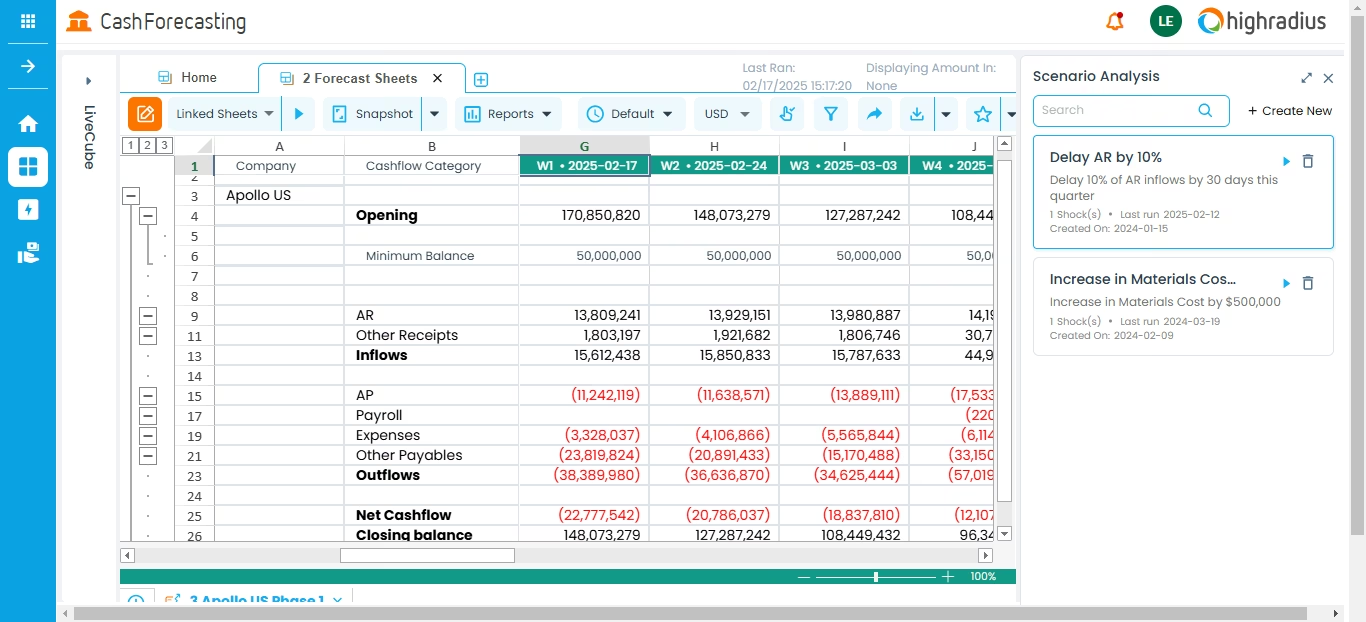
HighRadius built its reputation on AR automation for large enterprises. The platform covers cash application, credit, collections, deductions, and treasury, with deep SAP and Oracle integrations and a customer base of Fortune 500 companies.
But cash forecasting is where the cracks show.
HighRadius’s forecasting module sits on top of its broader AR suite, which means forecast accuracy depends on how well the upstream modules are working. If remittances are stuck in manual queues, deductions are unresolved, or collection follow-ups haven’t happened, the forecast is working with incomplete data. According to a 2024 AFP survey, 45% of finance teams report that poor data quality is the primary driver of forecast inaccuracy.
There are also practical concerns. Implementation timelines run 3-6 months. The platform requires dedicated admin resources. And for companies outside the Fortune 500, the pricing and complexity can outweigh the value.
Here are seven alternatives worth evaluating, organized by what they do best.
How We Evaluated These Alternatives
We scored each platform across five criteria that matter most for cash forecasting accuracy:
- Data source quality - Does the tool forecast from processed, current AR data or stale ERP snapshots?
- Deployment speed - How fast can a finance team go from contract to live forecast?
- Forecast granularity - Can you break forecasts down by entity, currency, customer, and liquidity category?
- AI and ML capabilities - Does the platform learn from payment patterns, or is it running static models?
- Integration depth - Which ERPs, banks, and upstream systems does it connect to natively?
Transformance CashPulse leads on three dimensions that matter most for accuracy: net cash coverage across both AR and AP, long-horizon prediction that holds to 90 days at 90 to 95% accuracy, and the ability to ingest known future inputs like FX rates and commodity futures directly. Treasury-only tools like Kyriba and GTreasury win on bank connectivity if that's your specific gap, and Workday Adaptive fits FP&A-led organizations already in the Workday ecosystem. For the most common HighRadius migration scenario (mid-market or large enterprise that wants a real net cash forecast, not just an AR sliver), CashPulse is the strongest fit.
7 Best HighRadius Alternatives for Cash Forecasting
| Platform | Best Suited For | Standout Feature | Pricing |
|---|---|---|---|
| Transformance CashPulse | Mid-market & enterprise wanting net cash forecasts built from real AR and AP data | Forecasts net cash from real AR + AP data using granular, multi-horizon models (90-95% to 90 days) | Custom; ~20-30% under treasury suites |
| Kyriba | Large enterprises with sophisticated treasury ops | Mature enterprise treasury suite; payment hub + FX + risk | Mid-high 6 figures/yr |
| GTreasury | Mid-market treasury teams without enterprise overhead | Solid bank connectivity + cleaner UI than legacy TMS | USD 75-250K/yr |
| Trovata | Mid-market US-centric needing modern API-first tooling | Direct bank-API connectivity; real-time cash data | USD 50-150K/yr |
| Tesorio | SaaS / tech companies with subscription-heavy AR | Strong fit for SaaS revenue patterns; collections + forecasting | USD 60-200K/yr |
| SAP Cash Flow Analyzer | Large enterprises fully on SAP S/4HANA | Native SAP data model; no middleware | EUR 75-200K Y1 + SAP consulting |
| Workday Adaptive Planning | Workday-first finance orgs with FP&A-led forecasting | Powerful what-if scenario modeling for FP&A teams | USD 100-500K/yr per seat plan |
1. Transformance CashPulse: Best for Net Cash Forecasting From Real AR and AP Data
CashPulse is the cash forecasting module of the Transformance O2C platform. It forecasts net cash from your real AR and AP data using granular, multi-horizon models. The output is a single net cash position curve with confidence ranges, and accuracy that holds out to a full year for portfolios with FX exposure or long booking cycles.
Pros:
- Real net cash forecasting built from real AR and AP data, in one view. AR is predicted at the invoice level from each customer's payment behaviour. AP is projected from contracts, payroll, tax schedules, and committed purchase orders. The output is a true net cash curve, not an AR-only sliver.
- Long-horizon accuracy that holds. Traditional models lose signal beyond 30 days. CashPulse delivers 90 to 95% accuracy out to 90 days for most portfolios, and supports year-long horizons in a single run for businesses with longer cycles.
- Known future inputs feed the forecast directly. FX rates, commodity futures, holiday calendars, planned promotions, harvest schedules, and booking pipelines are core inputs the model uses, not bolt-ons. Most treasury and FP&A tools require pipeline rewrites to ingest a new external signal.
- Confidence ranges, not single numbers. Every forecast ships with a best-case, expected, and risk-adjusted view so the CFO can plan around uncertainty instead of a single number that's wrong by Tuesday.
- Per-entity, per-region modelling. A stable European subsidiary and a volatile LatAm one each get a forecast tuned to their own data, not a global average.
- Explainable by design. The system surfaces which factors moved each forecast, which is the bar finance teams need before putting an AI number into a board pack.
- Vero's persistent memory accumulates customer payment patterns, broken promises, and seasonal behaviours over time. Day 90 outperforms Day 1; Day 365 outperforms Day 90.
- Forecast plus action in one loop. When CashPulse flags a tight week, Vero can trigger collection escalation, AI calls, or dunning to change the outcome. Treasury and FP&A tools report; CashPulse closes the loop.
- Deploys in 4 to 8 weeks. Treasury suites typically take 6 to 12 months.
Cons:
- Built for enterprise complexity. Sub-$50M businesses with stable, predictable cash flows often don't need the depth.
- Highest differential value where behavioural variance matters (multi-entity B2B, FX exposure, commodity-driven booking cycles). Pure-subscription B2C with predictable monthly revenue sees less relative lift.
Best For: Mid-market and large enterprises (EUR 500M to EUR 25B+ revenue) that need a real net cash forecast across multiple entities, regions, and currencies, and want accuracy that compounds with every payment cycle. Especially strong for FMCG, manufacturing, MedTech, and chemicals with FX exposure or commodity-driven booking.
Pricing: Module-based pricing tied to entities, transaction volume, and AI usage. Typically 20 to 30% below treasury-suite pricing for the same use case. Pilots run on a slice of your real AR and AP data so you see accuracy before committing.

2. Kyriba: Best for Enterprise Treasury Management
Kyriba is the market-leading enterprise treasury suite covering cash management, payments, FX, risk, and forecasting. Cash forecasting is one module within a broader treasury platform — powerful when you need full treasury depth, expensive and slow when you only need forecasting.
Pros:
- Mature enterprise treasury suite with strong cash visibility, payment hub, and FX capabilities.
- Established Fortune 500 customer base with deep banking-connectivity coverage.
- Robust scenario modeling for FX risk and liquidity stress testing.
Cons:
- Cash forecasting is module-level inside a broader treasury suite — less specialized than purpose-built forecasting tools.
- Implementation runs 6-12 months and total cost of ownership reflects that.
- Forecast accuracy depends on data quality from upstream sources (AR, AP); the platform is a forecaster, not an AR-execution layer.
Best For: Large enterprises (USD 1B+ revenue) with sophisticated treasury operations spanning multiple banks, currencies, and entities.
Pricing: Custom enterprise pricing typically running mid to high six figures annually plus implementation services.

3. GTreasury: Best for Mid-Market Treasury Teams
GTreasury is a mid-market alternative to Kyriba covering core treasury functions including cash forecasting, bank connectivity, and payment management. Targets companies that want enterprise-grade treasury without enterprise pricing.
Pros:
- Solid bank-connectivity coverage for North American mid-market companies.
- Faster implementation than Kyriba (3-6 months typical).
- Cleaner interface for treasury teams without dedicated systems administrators.
Cons:
- Forecast capabilities work on bank-balance data, not invoice-level AR detail.
- Less depth than Kyriba on FX and risk management for global enterprises.
- AI capabilities are limited compared to AR-native forecasting platforms.
Best For: Mid-market companies (USD 200M to USD 2B revenue) needing treasury management without enterprise overhead.
Pricing: Subscription pricing typically USD 75,000 to USD 250,000 per year depending on module count and bank connectivity.

4. Trovata: Best for Bank API-First Cash Visibility
Trovata is a newer-generation cash management platform built on direct bank APIs (vs traditional treasury workstation file imports). Cash forecasting is one of several use cases on top of clean, real-time bank data.
Pros:
- Direct bank-API connectivity gives faster, cleaner data than legacy file-based imports.
- Modern UI built for finance teams that aren't dedicated treasurers.
- Quick implementation when bank coverage is straightforward (typically 2-4 months).
Cons:
- Forecasting works on bank-balance data, not invoice-level AR detail.
- Bank coverage outside the major US banks is limited compared to traditional TMS platforms.
- Less depth on payments and FX than enterprise treasury suites.
Best For: Mid-market companies (USD 100M to USD 1B revenue) with US-centric banking and a preference for modern, API-first tooling over legacy treasury platforms.
Pricing: Subscription pricing typically USD 50,000 to USD 150,000 per year. Bank-connectivity fees may add to total cost.

5. Tesorio: Best for SaaS and Tech Companies
Tesorio is a cash forecasting platform with strong roots in the SaaS and technology sector. Their AI focuses on AR collections and payment prediction in subscription-revenue contexts.
Pros:
- Good fit for SaaS companies where AR forecasting is dominated by subscription billing patterns.
- Modern interface and quick onboarding for tech-savvy finance teams.
- AR collections and forecasting in one platform.
Cons:
- AR depth is less mature than full O2C platforms; deductions and complex remittance handling are limited.
- Less established outside SaaS / tech — manufacturing and CPG use cases require more customization.
- Smaller customer base means less long-tail integration coverage.
Best For: SaaS and tech companies (USD 50M to USD 500M ARR) with subscription-heavy AR and a need for collections + forecasting in one tool.
Pricing: Subscription pricing typically USD 60,000 to USD 200,000 per year depending on user count and AR volume.

6. SAP Cash Flow Analyzer: Best for SAP-Only Environments
SAP Cash Flow Analyzer is the native cash forecasting capability inside SAP S/4HANA. For companies fully standardized on SAP, the native integration eliminates middleware complexity but requires significant configuration to deliver useful forecasts.
Pros:
- Native SAP data model integration with no middleware between forecast and source data.
- Familiar SAP governance, support structure, and procurement path.
- Predictable upgrade path tied to the broader SAP roadmap.
Cons:
- Forecasts only what SAP sees — AR data outside S/4HANA (or in legacy AR sub-ledgers) requires custom integration.
- Configuration-heavy: most companies need 6-12 months of SAP consulting work before forecasts are accurate enough to use.
- AI capabilities are basic compared to dedicated forecasting platforms.
Best For: Large enterprises (USD 1B+ revenue) fully committed to SAP S/4HANA with active BTP development capacity. Not a fit for Oracle, NetSuite, or Dynamics environments.
Pricing: Subscription on top of existing SAP licences. Typical Year 1 cost EUR 75,000 to EUR 200,000 plus internal SAP consulting time.

7. Workday Adaptive Planning: Best for FP&A-Led Forecasting
Adaptive Planning (formerly Adaptive Insights) is an FP&A platform with cash flow forecasting as one capability among many. Strong fit for finance organizations where forecasting lives in the FP&A team rather than treasury.
Pros:
- Powerful modeling capabilities — what-if scenarios, driver-based forecasts, multi-entity consolidation.
- Established Workday integration for HR and financials data.
- Strong reporting and dashboarding for executive consumption.
Cons:
- Cash forecasting is a configuration on top of a planning platform — less out-of-the-box than dedicated cash forecasting tools.
- Requires FP&A modeling expertise to build and maintain accurate cash forecasts.
- AR-level prediction depends on whether AR data is loaded into the model in sufficient detail.
Best For: Large enterprises (USD 500M+ revenue) where FP&A owns cash forecasting and the organization is already running Workday for financials.
Pricing: Per-user subscription tied to seat count. Mid-to-large enterprise deployments typically USD 100,000 to USD 500,000 per year.
What Should You Prioritize When Choosing?
The right alternative depends on where your forecast breaks. Here are five questions to answer before evaluating vendors:
- Where does your forecast go wrong? If inflow predictions miss because AR data is stale or unprocessed, you need a tool that cleans up the input before forecasting. If the issue is fragmented bank data, Trovata or Kyriba solves that directly.
- Who owns the forecast? Treasury teams gravitate toward Kyriba and GTreasury. FP&A teams prefer Workday Adaptive. AR teams need a tool like CashPulse that connects operational receivables data to the forecast.
- What ERP do you run? SAP-heavy environments have the option of staying native (with the tradeoffs described above). Multi-ERP environments need an ERP-agnostic tool. Companies evaluating broader order-to-cash automation should consider platforms that cover more than just forecasting.
- How fast do you need results? If the CFO wants better forecasts this quarter, a tool that deploys in 4-8 weeks matters more than one with a richer feature set that takes 6 months to implement. According to Gartner, 60% of finance technology projects that exceed their planned timeline also exceed their planned budget.
- Do you need forecasting only, or forecasting plus execution? A standalone forecasting tool tells you cash will be short. A tool connected to collections, cash application, and deduction management can actually fix the problem. That’s the difference between insight and action. For more on how AR cash forecasting connects to collections execution, the distinction is worth understanding before you buy.
Frequently Asked Questions
What are the main limitations of HighRadius for cash forecasting?
HighRadius’s cash forecasting depends on the accuracy of its upstream AR modules. If remittances are unprocessed or deductions are unresolved, the forecast inherits that data quality gap. Implementation timelines of 3-6 months and the need for dedicated admin resources also make it heavy for mid-market teams. The architecture was built in the early 2010s, and while HighRadius has added AI capabilities, the foundational data processing layer still relies on older template-based approaches.
Can a treasury management system replace HighRadius for cash forecasting?
A TMS like Kyriba or GTreasury can handle cash forecasting from the treasury side, but it won’t replace HighRadius’s AR automation capabilities. TMS platforms forecast from bank balances and historical patterns. They don’t process remittances, match payments, or run collections. If your forecast inaccuracy stems from AR data quality, adding a TMS without fixing the upstream problem won’t improve predictions.
How accurate is AI-based cash forecasting compared to manual methods?
AI-based forecasting typically achieves 85-95% accuracy on 30-day inflow predictions, compared to 60-75% for spreadsheet-based methods. According to a 2024 AFP liquidity survey, organizations using ML-based forecasting reported 20-30% improvement in forecast accuracy within the first six months. The key variable is data quality: AI models trained on processed, current AR data outperform those running on stale ERP snapshots.
What is the typical implementation time for cash forecasting software?
It varies widely. Bank API-based tools like Trovata can go live in 2-4 weeks. AR-driven platforms deploy in 4-8 weeks. Enterprise TMS platforms like Kyriba take 3-6 months. SAP native tools can take 18-24 months to deliver real value. The fastest path to better forecasts is usually a tool that doesn’t require a full ERP re-implementation.
Should I choose a standalone forecasting tool or a full O2C platform?
If your only gap is cash visibility, a standalone tool might be enough. But if your forecast accuracy suffers because upstream AR processes are manual or messy (unmatched payments, unresolved deductions, inconsistent collection follow-ups), a full O2C platform will fix the root cause rather than just the symptom. For a deeper look at the full O2C automation stack, the economics usually favor fixing the upstream data.
How much does cash forecasting software cost?
Pricing ranges from $24,000/year for mid-market tools like Trovata to $150,000+ implementation costs for enterprise TMS platforms like Kyriba. Module-based platforms price by users, transaction volume, and AI usage. The total cost comparison should include implementation time and internal resources, not just license fees. A platform that deploys in 4 weeks at a lower license cost can deliver better ROI than a cheaper tool that takes 6 months to go live.
Take Action: Fix the Forecast at the Source
Most cash forecasting tools try to predict better with the same bad data. The smarter move is to fix the data first.
If your forecast misses because remittances sit in email inboxes, deductions go uninvestigated for weeks, or collection follow-ups happen inconsistently, no amount of ML sophistication will compensate. Forecast accuracy is a downstream effect of AR process quality.
Transformance CashPulse forecasts net cash from your real AR and AP data using granular, multi-horizon models. Accuracy holds to 90 days at 90 to 95%, year-long horizons are supported, and known future inputs like FX rates and commodity futures feed the forecast directly. When CashPulse flags a tight week, Vero can trigger collection escalation to change the outcome. Treasury tools report; CashPulse closes the loop.
Last updated: May 2026