There is no public price list. Versapay sells through custom contracts, and what buyers actually pay depends heavily on transaction volume, ERP integration scope, and which modules they license. For finance teams shopping today, the more important question is whether Versapay's 2010s-era architecture is worth the spend at all. Transformance is the AI-native alternative built on vision language models and persistent memory (MemoryMesh) instead of OCR + regex templates, with 4-8 week deployments instead of 3-6 months.
Key Takeaways
- Versapay pricing is not published. Mid-market buyers report annual contracts in the $50K–$150K+ range, with enterprise deployments climbing into six figures.
- Pricing variables include user seats, transaction volume, ERP connectors, payment processing fees, and module mix (AR automation, payments network, collaborative AR).
- Versapay competes for mid-market companies ($50M–$1B revenue) running NetSuite or SAP, but its core technology dates from before the vision language model era.
- AI-native alternatives like Transformance offer 99.7% extraction accuracy with zero template configuration, autonomous collection calls in 70+ languages, and 4-8 week deployment.
- Total cost of ownership matters more than license price. A 3-6 month implementation can double the first-year project cost compared to a 4-8 week rollout.
In This Article
- Key Takeaways
- What Is Versapay and What Does It Cost?
- How Does Versapay Pricing Work in 2026?
- 7 Best Versapay Alternatives in 2026
- How Should AR Teams Evaluate Cash Application Vendors?
- What's the True Total Cost of an AR Automation Project?
- The Bottom Line on Versapay Pricing
What Is Versapay and What Does It Cost?
What Is Versapay?
Versapay is a cloud-based accounts receivable automation platform aimed at mid-market companies. It combines AR automation, an embedded payments network, and "collaborative AR" tools that let buyers and suppliers communicate inside the platform. Versapay processes more than $170 billion annually across its customer base and targets finance teams running NetSuite, Sage Intacct, and SAP.
The platform covers invoicing, payment acceptance, cash application, and collections. It is best known for its payments network (5 million businesses transact on it) and its NetSuite-friendly architecture.
How Much Does Versapay Cost?
Versapay does not publish pricing. Based on third-party reviews and buyer reports aggregated by sources like Vendr and GetApp, mid-market deployments typically fall in these ranges:
- Entry-tier (small AR teams, basic invoicing + payments): $20,000–$50,000 per year
- Mid-market (full AR automation + cash application + collections): $50,000–$150,000 per year
- Enterprise (multi-entity, complex ERP integration, high transaction volume): $150,000+ per year, often into the low six figures
Add to that payment processing fees on transactions running through the network. Most B2B card acceptance carries 2.5%–3.5% per transaction; ACH is cheaper but still a meaningful line item at scale.
There is no free tier. There is no transparent self-service signup. Every deal goes through sales.
How Does Versapay Pricing Work in 2026?
Versapay's pricing model has five main levers:
- User seats. Per-user fees scale with the size of the AR team.
- Transaction volume. Higher invoice and payment counts push the contract up.
- ERP integration. NetSuite and Sage Intacct connectors are core; SAP and other ERPs may carry implementation fees.
- Module mix. AR automation, cash application, collections, and the payments network are typically licensed separately or in bundles.
- Payment processing fees. Card and ACH transactions running through Versapay's network carry per-transaction costs on top of the platform license.
The implication for buyers: total annual cost is rarely just the license. A company running $100M in card payments through Versapay is paying processing fees that can dwarf the platform fee.
What Do Mid-Market Buyers Actually Pay?
For a mid-market company ($100M–$500M revenue) with 5–10 AR users and moderate transaction volume, expect to budget:
- $60,000–$120,000 in annual platform license
- $30,000–$80,000 in implementation and onboarding (Year 1 only)
- Variable card/ACH processing fees on top
That puts realistic Year 1 spend in the $90,000–$200,000 range, with ongoing annual fees settling into the $60,000–$120,000 range from Year 2 onward.
Implementation timelines are typically 8–16 weeks for a full rollout, longer for complex multi-entity deployments. That timeline matters: every week of "ramp" is a week the AR team is still working two systems.
7 Best Versapay Alternatives in 2026
Here are the strongest alternatives to Versapay for AR automation, cash application, and collections, ranked by capability for mid-market and enterprise finance teams shopping in 2026.
1. Transformance: Best Overall AI-Native Versapay Alternative
Transformance is the AI-native O2C execution layer built for finance teams that need enterprise-grade automation without the multi-month implementation timelines of legacy platforms. The platform covers four products, ClearMatch (cash application), ClaimIQ (deductions), CollectPulse (collections), and CashPulse (cash forecasting), unified by Vero, a persistent AI agent with institutional memory. Where Versapay's cash application engine relies on OCR + regex templates that need configuration per remittance format, Transformance uses vision language models that read documents natively. New format on a Tuesday morning? It works. No template training required.
Pros:
- 99.7% extraction accuracy on structured remittances; 94.9% across document types, zero template configuration
- Autonomous collection calls in 70+ languages, Vero makes the call, captures promise-to-pay dates, and writes back to the system
- MemoryMesh persistent memory: match rates improve from ~85% to 95%+ within 90 days as the system learns customer payment patterns
- 4-8 week full implementation (vs. 8-16 weeks for Versapay, 3-6 months for HighRadius)
- VPC deployment with SSO/SAML, RBAC, audit trails, ISO 27001, financial data never leaves the customer's cloud boundary
Cons:
- O2C focused, not a full financial close, treasury, or AP suite
- Not a payments network. Companies wanting embedded buyer-supplier payment collaboration in a single platform should evaluate that requirement separately
- Optimized for enterprise document complexity, not high-volume e-commerce microtransactions
Best for: Mid-market and large enterprises ($500M–$25B+ revenue) running SAP, Oracle, NetSuite, or Microsoft Dynamics with messy upstream payment data and multi-language collections needs. Strong fit for FMCG, chemicals, MedTech, and manufacturing companies with shared service centers.
Pricing: Module-based, tied to users, transaction volume, and AI usage. 25–30% more affordable than incumbent platforms with significantly faster onboarding. Pilots available.
2. HighRadius: Best for Fortune 500 Scale
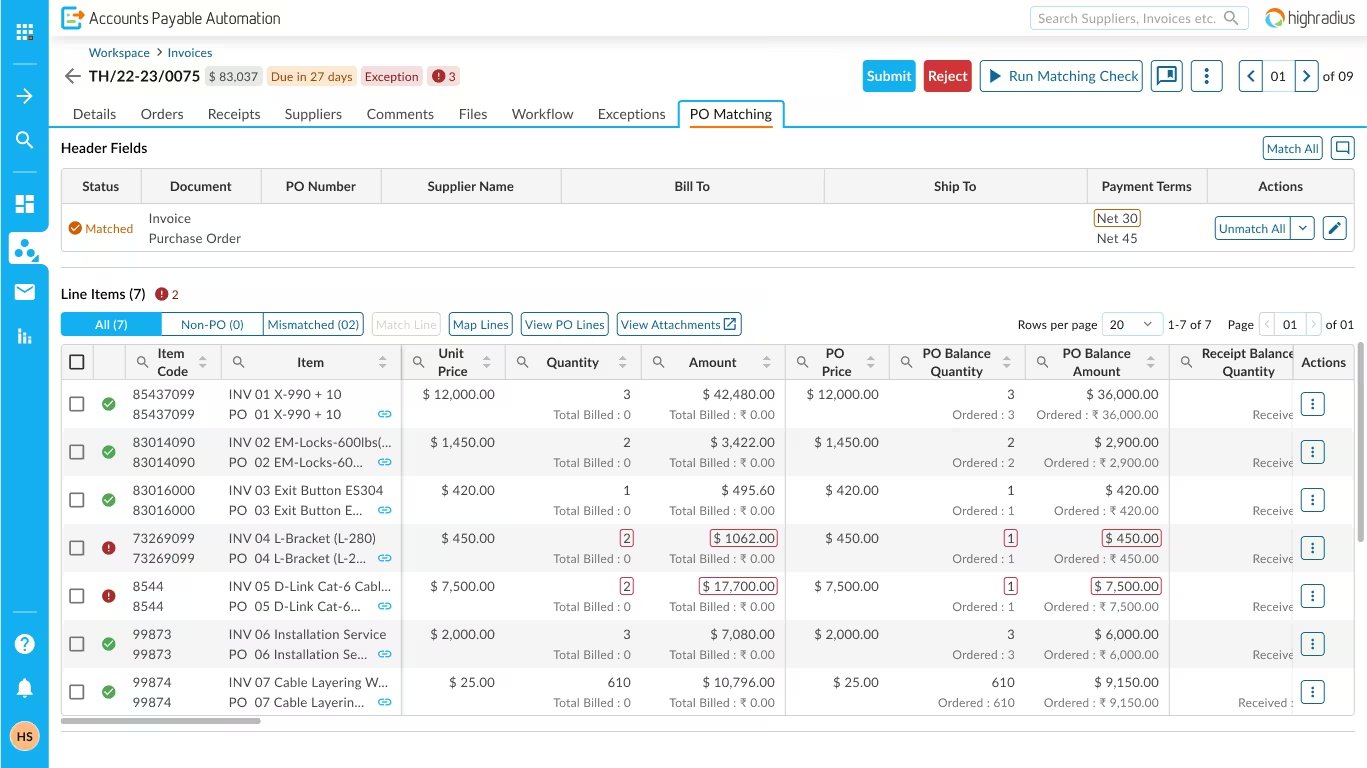
HighRadius is the dominant AR platform for the largest enterprises. Their Autonomous Receivables suite covers cash application, deductions, collections, credit, and treasury. Strong SAP and Oracle integration, large customer base, broad analyst coverage.
- Pros: Comprehensive module coverage, deep ERP integration, established brand.
- Cons: Built on first-generation tech (rules + RPA + traditional ML on OCR + regex). Templates per remittance format. 3-6 month implementations. Stateless digital assistant.
- Best for: Fortune 500 enterprises with dedicated transformation teams and 12+ month rollout patience.
- Pricing: Six figures annually; large enterprises often $250K–$1M+ per year.
For a deeper look, see our breakdown of the best HighRadius alternatives for AR automation.

3. BlackLine: Best If You Already Use BlackLine for Close
BlackLine is the dominant financial close automation platform with an AR module attached. If you're already using BlackLine for reconciliation and journal management, the AR module integrates well.
- Pros: Strong financial close integration, established SAP partnership.
- Cons: AR is secondary to close. SAP-centric. 3-6 month implementations. Users report data lag.
- Best for: Companies that prioritize financial close automation and want a single vendor.
- Pricing: Six figures annually; full suite often exceeds $200K/year.
4. Billtrust: Best for B2B Invoice Delivery
Billtrust's core strength is invoice delivery and payment acceptance, they manage how invoices get to customers across channels (paper, email, EDI, portals). AR automation has been added on.
- Pros: Strong invoice delivery, B2B payments network.
- Cons: Cash application and collections are not the historical core. Implementation 3-6 months.
- Best for: Companies with complex multi-channel invoice delivery requirements.
- Pricing: Mid-five to low-six figures annually depending on volume.

5. Esker: Best for European Mid-Market
Esker covers AP and AR automation with strong European presence. Long history, broad customer base.
- Pros: Established European brand, broad O2C coverage.
- Cons: Document understanding still rooted in earlier-generation OCR. Slower deployment cycles.
- Best for: European mid-market companies wanting a single AP+AR vendor.
- Pricing: $50K–$200K+ annually depending on scope.

6. Sidetrade: Best for AR Analytics and Credit Intelligence
Sidetrade focuses on AR analytics, credit risk, and collections optimization. Strong predictive models for payment behavior.
- Pros: Solid analytics, decent collections workflow, established European presence.
- Cons: Cash application is not the core strength. Limited document understanding capabilities.
- Best for: Companies prioritizing collections analytics and credit risk over cash application matching.
- Pricing: Six figures annually for full suite.
7. Versapay: Best for NetSuite + Embedded Payments
Versapay rounds out this list. It does what it does well: NetSuite-friendly AR automation with an embedded payments network. The collaborative AR feature (buyers and suppliers communicating inside the platform) is genuinely useful for some buyer profiles.
- Pros: NetSuite ecosystem fit, payments network with 5M+ businesses, collaborative AR workflow.
- Cons: Cash application engine relies on legacy OCR + rules. No persistent memory layer. No autonomous collection calls in multiple languages. 8-16 week implementations.
- Best for: NetSuite-running mid-market companies that prioritize the payments network over advanced AR automation.
- Pricing: $50K–$150K+ annually plus card/ACH processing fees.
How Should AR Teams Evaluate Cash Application Vendors?
Five criteria separate modern AR automation from legacy approaches:
- Document understanding architecture. Vision language models that read documents natively, or OCR + regex templates that break on every new format? This is the single biggest technology gap in the market today.
- Match rate trajectory. Does the system improve over time as it learns customer patterns, or does it require manual re-training every time a customer changes their remittance format?
- Implementation timeline. 4-8 weeks for full rollout, or 3-6 months? Every week of "ramp" is a week the AR team works two systems and the ROI clock isn't ticking.
- Autonomous execution vs. recommendation. Does the system make collection calls, settle valid deductions, and trigger dunning escalations? Or does it just generate worklists for humans to action?
- Governance and security model. VPC deployment, SSO/SAML, RBAC, full audit trails, ISO 27001, human-in-the-loop posting controls, these are non-negotiable for enterprise finance.
Versapay handles criteria 4 and 5 reasonably. It struggles on 1, 2, and 3 because the underlying architecture predates the AI-native era.
For a structured evaluation framework, see how AR teams evaluate cash application automation vendors.
What's the True Total Cost of an AR Automation Project?
License fees are the easy number to compare. The harder numbers are:
- Implementation cost. A 3-6 month rollout typically costs $50K–$150K in services on top of the license. A 4-8 week rollout cuts that by half or more.
- Ramp cost. Every week the AR team works two systems (old + new) is a week of doubled effort. A 16-week rollout is a 16-week productivity tax.
- Maintenance cost. OCR + regex platforms require ongoing template maintenance every time a customer changes their remittance format. AI-native platforms with vision language models don't.
- Opportunity cost. A 3-6 month delay to "live and matching" is 3-6 months of DSO that could have been improving. For a $500M company, every day of DSO is roughly $1.4M in working capital.
According to a 2024 IOFM study, the average mid-market AR team spends 60-80% of analyst time on manual matching, exception handling, and collections follow-up. McKinsey research has put the productivity gain from AI-native finance automation at 30-50% of analyst time recoverable within 12 months. The platforms that deliver on that promise are the ones that act, not just recommend.
For more on the financial impact, see what is the ROI of accounts receivable automation.
Frequently Asked Questions
What is Versapay's pricing in 2026?
Versapay pricing in 2026 ranges from roughly $50,000 to $150,000+ annually for mid-market deployments, plus payment processing fees. Versapay does not publish a price list; quotes are custom and depend on user count, transaction volume, ERP integration scope, and module mix.
Is Versapay worth the cost?
Versapay is worth the cost if you're a NetSuite-running mid-market company that values the embedded payments network and collaborative AR workflow. For finance teams that prioritize advanced AI-native cash application, autonomous collections, or rapid deployment, modern alternatives like Transformance offer better technology at a competitive price point with 4-8 week implementations instead of 8-16 weeks.
What's the best Versapay alternative for cash application?
The best Versapay alternative for cash application is Transformance. It uses vision language models for document understanding (vs. Versapay's OCR + regex), delivers 99.7% extraction accuracy on structured remittances with zero template configuration, and improves match rates from ~85% to 95%+ within 90 days through MemoryMesh persistent memory.
How long does Versapay take to implement?
Versapay implementation typically takes 8-16 weeks for a full rollout, longer for multi-entity or complex ERP environments. Compare this to AI-native platforms like Transformance, which deploy in 4-8 weeks with first payments matched in days.
Does Versapay charge transaction fees on top of the license?
Yes, Versapay charges per-transaction fees on payments running through its network in addition to the platform license. Card processing typically runs 2.5%–3.5% per transaction; ACH is cheaper but still meaningful at scale. For high-volume buyers, processing fees can exceed the license cost.
What ERPs does Versapay integrate with?
Versapay integrates primarily with NetSuite and Sage Intacct, with additional connectors for SAP and Microsoft Dynamics. Its architecture is most mature in the NetSuite ecosystem, which is one reason mid-market NetSuite customers represent a large share of the install base.
Can mid-market companies afford Versapay?
Mid-market companies can afford Versapay, but the total Year 1 cost (license + implementation + processing fees) often exceeds $100,000. Companies evaluating this spend should compare against AI-native alternatives that deliver better cash application accuracy and faster deployment at a similar or lower price point.
Why is Versapay pricing not published?
Versapay does not publish pricing because every deployment is custom, variables like transaction volume, user count, ERP integration, and module mix make a public price list impractical. The same is true for HighRadius, BlackLine, Billtrust, and most enterprise AR platforms, including Transformance.
The Bottom Line on Versapay Pricing
Versapay is a known quantity in mid-market AR. It serves NetSuite customers well, the payments network is real, and the collaborative AR workflow has fans. But the pricing is opaque, the implementation timeline is long, and the underlying technology (OCR + regex for documents, stateless workflows for everything else) is a generation behind what's possible in 2026.
For finance teams evaluating AR automation today, the smarter question isn't "what does Versapay cost?", it's "what does the right platform cost over a three-year horizon?" Vision language models that read documents natively. Persistent memory that compounds institutional knowledge. Autonomous collection calls in 70+ languages. 4-8 week implementations instead of 8-16. These aren't nice-to-haves anymore. They're the new baseline, and Transformance is the platform built for it.