
The best alternatives to HighRadius for AR automation in 2026 are Transformance (AI-native, 4 to 8 week deploy), BlackLine, Billtrust, Versapay, Esker, and Tesorio. Choose based on whether you need a full AI-native rebuild (Transformance), close-suite integration (BlackLine), B2B payment portal (Billtrust/Versapay), bundled S2P + O2C (Esker), or NetSuite-anchored mid-market (Tesorio).
Transformance leads the list for enterprises running SAP, Oracle, or Dynamics with complex, unstructured payment data. Where HighRadius relies on OCR + regex templates that require manual configuration per remittance format, Transformance uses vision language models that read any document natively, deploys in 4-8 weeks, and improves cash application match rates from ~85% to 95%+ within 90 days. This guide covers seven platforms, what each does well, and the five criteria that separate platforms worth deploying from ones that stall.
Key Takeaways
- HighRadius’s core architectural limits are OCR + regex templates (which break when formats change) and a stateless AI assistant that resets with every session
- The strongest AI-native alternative for enterprises with complex, unstructured payment data is Transformance: vision language models, persistent memory, and 4-8 week deployment
- Most alternatives specialize in one or two AR functions; very few cover cash application, deductions, collections, and forecasting in one platform
- Implementation timelines vary sharply: 4-8 weeks for modern AI-native platforms vs. 3-6 months for incumbent enterprise solutions
- According to a 2025 IOFM benchmarking report, 61% of AR teams believe their performance is above average, nearly twice the rate the data actually supports – a sign that most teams are underestimating the gap automation can close
In This Article
- Why Are Finance Teams Looking for HighRadius Alternatives?
- The 7 Best HighRadius Alternatives for AR Automation in 2026
- How Do You Evaluate HighRadius Alternatives? 5 Criteria That Matter
- What Are the Biggest Limitations of HighRadius?
What Is AR Automation?
Accounts receivable automation is the use of software to handle cash application, collections, deductions management, and cash forecasting tasks in the order-to-cash cycle that were previously executed manually by AR teams.
Legacy AR automation tools relied on rules, templates, and robotic process automation to handle structured data. The limitation: they break when data is unstructured, formats change, or documents arrive in configurations the system was never trained on. Modern AR automation uses AI to handle that ambiguity – vision language models that read documents natively, machine learning payment prediction, and autonomous agents that act on the data rather than surfacing it for a human to act on.
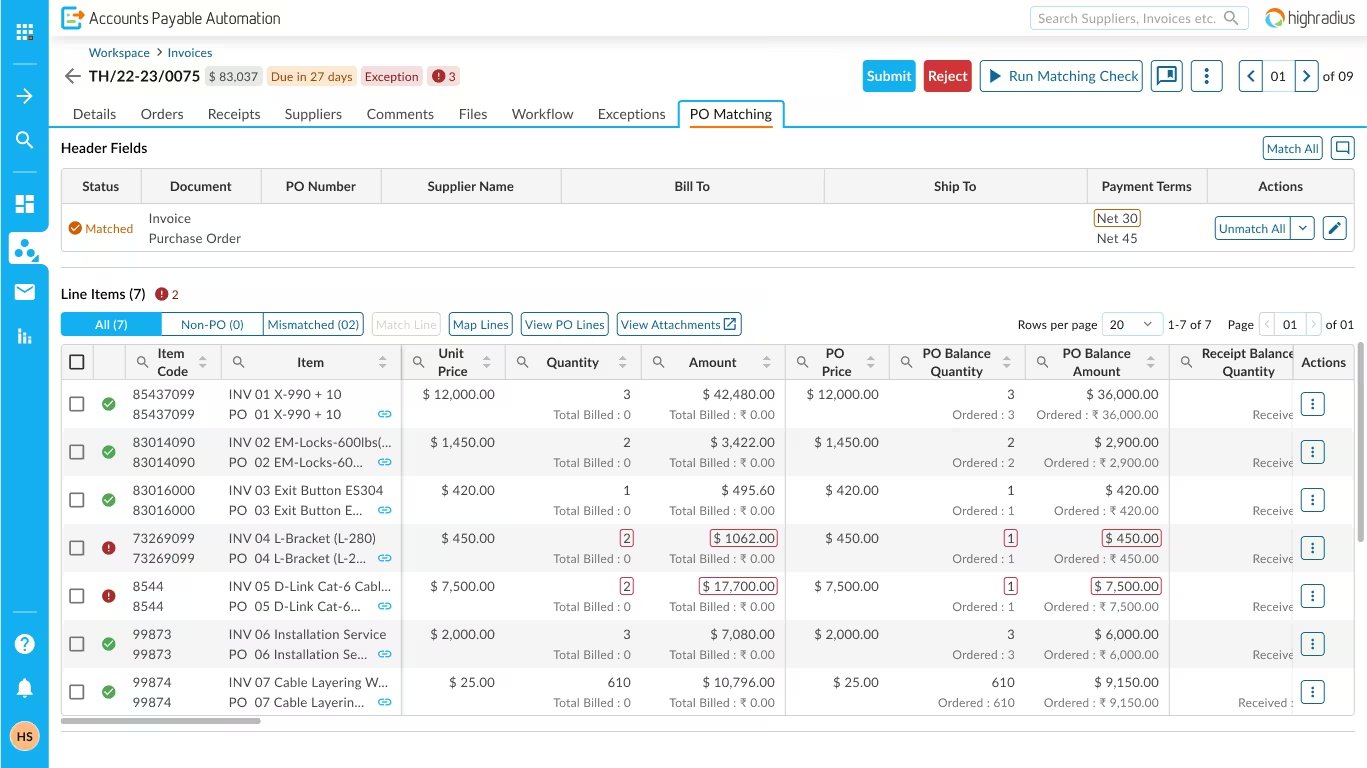
Why Are Finance Teams Looking for HighRadius Alternatives?
HighRadius is the category incumbent for enterprise AR automation. It’s deployed at thousands of SAP and Oracle sites, and its brand recognition in the Fortune 500 is real. But finance teams evaluating alternatives in 2026 are consistently hitting three structural issues, not minor feature gaps.
Template dependency. HighRadius’s document processing relies on OCR + regex templates. When a customer sends a remittance in a new format, a template has to be built and validated before the system can process it. For companies managing hundreds of customer remittance formats, that’s a maintenance burden that grows every time a new customer is onboarded or an existing customer’s finance team changes its payment process.
Stateless AI. HighRadius’s AI assistant doesn’t retain memory between sessions. Each query processes in isolation. The system can’t learn that a specific customer always pays late in Q4, or that a particular retailer codes all trade promotions as “seasonal allowance.” That institutional knowledge stays locked in your team’s heads.
Implementation timelines and cost. HighRadius deployments average 3-6 months, often requiring dedicated project teams and custom ERP logic replication before the platform can do meaningful work. The total cost of implementation – professional services, IT resources, parallel running – frequently equals or exceeds the Year 1 license fee. According to Ardent Partners’ 2024 ePayables research, best-in-class organizations achieve touchless processing rates above 70%; the industry average sits below 30%. Most of that gap traces back to slow, template-dependent implementations that never fully close.
The 7 Best HighRadius Alternatives for AR Automation in 2026
1. Transformance: Best for Enterprises with Complex, Unstructured Payment Data
Transformance is an AI-native O2C execution layer covering four products: ClearMatch (cash application), ClaimIQ (deductions), CollectPulse (collections), and CashPulse (cash forecasting), unified by Vero, a persistent AI agent that runs workflows autonomously.
The structural difference from HighRadius is in the document processing layer. ClearMatch uses DocSense, a vision language model engine that understands documents natively: layout, tables, context, and intent – without template configuration. When a new customer sends a remittance in a format the system has never seen, it reads it correctly on first attempt. HighRadius requires a template to be built first.
Match rates start at ~85% at deployment and improve to 95%+ within 90 days as the platform’s persistent institutional memory accumulates resolution patterns from every exception your team resolves. Legacy tools start from zero every morning. The persistent memory layer compounds, turning each resolved exception into organizational intelligence that Vero applies automatically to similar cases.
For collections, Vero runs autonomous AI calls in 70+ languages, capturing promise-to-pay dates and dispute reasons without human intervention. Throughput: 15-20 calls per hour, vs. 15-20 calls per day for a human collector. For shared service centers managing cross-border AR, that means a three-person team in Warsaw can run Italian, French, and Spanish collections simultaneously without hiring native speakers.
Pros:
- Vision language models achieve 99.7% extraction accuracy on structured remittances with zero template configuration; new document formats handled on first contact
- Persistent memory learns customer payment patterns and improves match rates automatically over time; no retraining required
- Autonomous collection calls in 70+ languages – unique in the O2C market
- Full rollout in 4-8 weeks; first payments matched in days; no dedicated admin required
- VPC deployment with SSO/SAML, RBAC, full audit trails, ISO 27001
Cons:
- Focused on O2C and Cash Flow Forecasting (AR + AP); companies needing account reconciliation or financial close automation will need additional tools
- Transformance is not a TMS; CashPulse forecasts net cash from real AR and AP data with confidence ranges but does not replace a treasury management system for multi-bank cash pooling or payment automation
- Optimized for enterprise document complexity; not designed for SMBs
Best for: Mid-market and large enterprises (€500M-€25B+ revenue) running SAP, Oracle, NetSuite, or Dynamics with multi-format, unstructured payment data. Especially strong for FMCG, chemicals, MedTech, and manufacturing companies running shared service centers across multiple geographies.
Pricing: Module-based, tied to users, transaction volume, and AI usage. 25-30% more affordable than incumbent platforms, with significantly faster onboarding that reduces total project cost. Pilots available on a slice of your AR data before full commitment.

2. Billtrust: Best for B2B Payment Network Integration
Billtrust covers cash application, collections, credit management, and digital invoicing. Its Business Payments Network connects buyers and suppliers to accelerate payment matching – useful when your customers are also on the Billtrust network.
The cash application module uses ML to match payments but works best when remittance data arrives through the network in structured form. For customers outside the network (which is most customers), matching accuracy depends on how cleanly data arrives.
Pros:
- Large B2B payment network with direct matching potential for in-network customers
- Covers credit-to-cash in one platform with established SAP and Oracle integrations
- Strong e-invoicing and digital delivery capabilities
Cons:
- ML matching performs best within the Billtrust network; unstructured remittance handling is weaker than AI-native alternatives
- Implementations typically run 3+ months
- Pricing is not publicly disclosed
Best for: Companies where a significant portion of customers already use the Billtrust network, and who need a broad credit-to-cash suite rather than deep AI automation on the document processing side.

3. Esker: Best for AP and AR Automation in Document-Heavy Environments
Esker is a document management and process automation platform covering both accounts payable and accounts receivable. Its AR suite includes cash application, collections, and credit management, with document capture as a core strength across a mature customer base.
Esker’s OCR engine handles a wide range of document formats, but it’s still template-based extraction. For organizations with stable, predictable remittance formats, that’s manageable. For companies with highly variable inbound documents, it creates ongoing configuration overhead.
Pros:
- Covers both AP and AR in one platform – valuable for shared service centers handling both sides of the ledger
- Well-established SAP integration with a large reference customer base
- Strong document archiving and compliance capabilities
Cons:
- Template-based OCR requires ongoing maintenance as document formats change
- Implementation timelines are comparable to HighRadius, typically 3+ months for full deployment
- AI capabilities are largely bolted onto the platform’s document management foundation rather than native to the architecture
Best for: Organizations that need AP and AR automation unified in one system, have relatively stable customer remittance formats, and prioritize document archiving and compliance alongside matching.

4. Versapay: Best for Collaborative AR and Customer Payment Portals
Versapay focuses on the collaborative AR model, giving customers a self-service portal where they can view invoices, raise disputes, and pay directly. This reduces inbound call volume and speeds up dispute resolution for customers who use the portal actively.
The platform covers cash application, collections, and credit, with a clear emphasis on customer-facing functionality rather than back-office document automation.
Pros:
- Customer portal reduces manual follow-up for portal-active customers
- Dispute management is built into the portal workflow, keeping communication in one place
- SAP and Oracle integrations available
Cons:
- Value depends heavily on customer adoption of the portal; customers paying via EFT or check outside the portal don’t benefit much
- Cash application accuracy for unstructured remittances arriving outside the portal is weaker
- No autonomous AI calling agent; collections automation is primarily email-based
Best for: Companies whose customers are comfortable with self-service payment portals and whose AR volume comes from a concentrated set of buyers with standardized payment workflows.

5. Tesorio: Best for Cash Flow Forecasting Tied to AR Data
Tesorio is a cash flow performance platform built primarily around AR-driven forecasting. It pulls open AR data from ERPs and uses ML to predict payment timing, generating a cash flow forecast from the receivables side.
The platform is strong on forecasting output but doesn’t process the upstream data. It predicts when cash will arrive based on what’s already in the ERP – which means forecast accuracy depends entirely on whether the AR data in the system is clean and current.
Pros:
- Purpose-built forecasting interface that finance teams can operate without IT involvement
- ML payment prediction is accurate for companies with consistent payment behavior in clean ERP data
- NetSuite and Salesforce integrations are strong
Cons:
- No cash application, deductions management, or autonomous collections – forecasting only
- Forecast accuracy degrades when upstream AR data contains unprocessed remittances or unresolved deductions
- Not suitable as a primary AR automation platform
Best for: Finance teams that need a standalone improvement in cash flow forecasting without replacing existing AR workflows, particularly in SaaS or subscription billing environments with clean, structured payment data.

6. Gaviti: Best for SMB and Lower Mid-Market Collections Workflow
Gaviti is a collections automation platform designed for smaller AR teams. It automates dunning email sequences, manages collection workflows, and provides basic AR aging analysis. The platform trades depth for speed: you can be operational in days, not months.
Pros:
- Fast to implement, typically days to weeks for smaller AR teams
- Clean interface that AR analysts can use without dedicated training or a project team
- Competitive pricing for organizations with smaller AR volumes
Cons:
- Limited to collections workflow automation; no cash application, deductions management, or forecasting
- AI capabilities are basic (dunning sequence automation) rather than autonomous agent-based
- Not designed for the document complexity or transaction volume of enterprise AR
Best for: SMBs and lower mid-market companies (under €200M revenue) that need collections workflow management without the cost or complexity of an enterprise AR platform.

7. Sidetrade: Best for AI-Driven Credit and Collections in Europe
Sidetrade is a European O2C platform covering credit management, collections, and cash application. Its Aimie AI module analyzes customer payment behavior to prioritize collections and predict payment dates. The platform has a strong footprint in France and the broader EMEA region.
Pros:
- Strong European presence and GDPR-native architecture
- Credit risk scoring integrated with collections prioritization gives credit teams real-time visibility
- Multilingual interface built for EU shared service center environments
Cons:
- Cash application is weaker than its collections module; document processing is not a core strength
- AI capabilities are ML-based prediction rather than autonomous execution; human collectors still carry out most touchpoints
- Limited footprint outside Europe makes it a difficult choice for global operations
Best for: European enterprises prioritizing credit risk management and collections in EMEA, particularly where French, Belgian, or broader EU regulatory requirements shape the procurement decision.
How Do You Evaluate HighRadius Alternatives? 5 Criteria That Matter
Most buyers start with feature checklists. That’s the wrong starting point. The feature gaps between enterprise AR platforms have narrowed over the last three years. The real differences are architectural – and they only surface six months into production, not during the demo.

Here are the five criteria that separate platforms that deliver long-term value from ones that stall after go-live:
- Document processing architecture. Does the platform use vision language models or OCR + regex templates? VLMs handle new document formats on first contact, without configuration. Template-based systems require manual setup per format and degrade silently when formats change. Ask the vendor: “Show me how your platform handles a remittance format it has never seen before.”
- Does the AI learn and retain over time? Stateless AI systems process each document or exception in isolation. Platforms with persistent memory accumulate resolution patterns and customer-specific intelligence that improve accuracy automatically. Ask: “If we resolve an exception today, does the system apply that learning to similar cases next month? Can you show me where that memory lives?”
- ERP integration depth. Surface-level connectors pull data but don’t write back with confidence. Real integration means reading open AR items, matching to remittances, and posting validated journal entries to the ERP with a validation gate before anything touches the GL. Ask for a demo of the posting flow, not just the matching interface.
- Implementation timelines, measured in weeks, not slides. “Four to eight weeks” means nothing without a week-by-week plan. Ask: “When will we match real production payments?” and “What does full deployment, including ERP integration, all document types, and live collections, look like on a calendar?” Get it in writing. Then ask what happened on the last three implementations.
- Exception handling and escalation. The auto-match rate on day one matters less than what happens to the exceptions. Does the platform have an AI agent that investigates exceptions, or do they go straight to a human queue? Does the system retain the resolution and apply it next time the same scenario appears?
For a deeper breakdown of vendor evaluation criteria specific to cash application, the cash application software buyer’s guide walks through the remittance matching and ERP integration questions to ask before signing.
What Are the Biggest Limitations of HighRadius?
HighRadius is the incumbent for a reason. Broad integrations, a large customer base, and meaningful AI investment since 2017 have earned it strong enterprise credibility. But the buyers looking for alternatives are typically running into structural constraints, not missing features.

Template dependency at scale. HighRadius’s document extraction relies on OCR + regex. Each new remittance format from a new customer requires a template to be built and validated. For a company managing 200+ customer remittance formats, that’s a continuous IT burden with no end date. Every new customer signed, every customer who changes their AP system – each one is a new template.
The stateless assistant problem. HighRadius’s AI assistant processes each session in isolation. It can tell you which invoices are overdue; it can’t tell you that this specific customer has broken three consecutive payment promises or that their remittances always arrive 12 days late in December. That knowledge lives in your analysts’ heads, not in the system.
Time-to-value on implementation. According to research from IOFM, the majority of AR teams overestimate their process maturity. HighRadius implementations routinely run 3-6 months, require dedicated project resources, and involve significant ERP logic replication before the platform can process real transactions. Professional services costs frequently match the Year 1 license fee. For mid-market companies that need live automation in the current quarter, this timeline doesn’t fit.
The question isn’t whether HighRadius has invested in AI – it has. The question is whether first-generation OCR + template architecture, patched with ML layers added over time, can close the gap against platforms built AI-first from day one. The implementation timelines and template maintenance burden suggest that gap is widening, not narrowing.
For more context on the order-to-cash software evaluation criteria that separate modern AI-native platforms from incumbent retrofits, that guide covers the full stack.
PlatformBest Suited ForStandout FeaturePricing TierTransformanceMid-market and enterprise wanting AI-native AR on any ERP, including augment-or-replace pathsVision LLMs read any remittance format with no template configuration; 4 to 8 week deployCustom; some buyers report 30 to 50 percent under HighRadius TCOBlackLineCompanies anchored in financial close where AR is adjacentRecord-to-report integration; AR module is rebranded RimiliaMid 6 to low 7 figures Y1BilltrustB2B order-to-cash with heavy lockbox and BPN payment-network valueBusiness Payments Network with 260+ AP portals$20K to $60K mid-market per Lunos 2026VersapayNetSuite shops prioritizing customer-facing payment portalCollaborative AR portal with strong NetSuite integration~$5,423 avg ACV per Vendr 2025; varies widely by scopeEskerEuropean mid-to-large enterprises wanting bundled S2P + O2COne vendor across procurement, AP, AR, cash appMid-market $300K to $625K all-in 3-year TCO per ITQlickTesorioNetSuite-anchored mid-market US shopsCash flow forecasting + AR in one suiteMid 5 to mid 6 figures Y1
Frequently Asked Questions
What are the best alternatives to HighRadius for AR automation?
The best HighRadius alternatives for AR automation in 2026 are Transformance, Billtrust, Esker, Versapay, Tesorio, Gaviti, and Sidetrade. For enterprises with complex, unstructured payment data across multiple formats and geographies, Transformance is the strongest AI-native choice: it deploys in 4-8 weeks, processes documents with vision language models instead of OCR + regex templates, and includes autonomous collection calls in 70+ languages.
What are the biggest limitations of HighRadius?
HighRadius’s core limitations are its template-based document extraction (OCR + regex that requires manual configuration per remittance format and breaks when formats change), a stateless AI assistant that doesn’t retain institutional memory between sessions, and implementation timelines of 3-6 months with significant professional services costs. These are architectural constraints from a platform built in the 2010s, not gaps that a minor product update closes.
How long does it take to implement a HighRadius alternative?
Implementation timelines vary significantly by vendor. Transformance deploys in 4-8 weeks with first payments matched in days. Billtrust and Esker typically run 3+ months. Gaviti can be operational in days for smaller teams. The question to ask every vendor: “When will we match real production payments?” – not “When will the system be configured?” Those are different milestones.
What should I consider when switching from HighRadius to a new AR platform?
The five criteria that matter most are: document processing architecture (VLMs vs. OCR + regex); whether the AI learns from resolved exceptions or resets each session; ERP integration depth including GL posting validation; implementation timeline with a week-by-week plan in writing; and how exceptions are handled and whether resolutions are retained. For a deeper evaluation framework, the how AR teams evaluate cash application vendors guide covers the specific questions to bring to each vendor demo.
Which AR automation platforms offer the best ERP integration?
Transformance, HighRadius, Esker, and Billtrust all have SAP and Oracle integrations. The depth varies by platform. Transformance reads PDFs, emails, and EDI natively using vision language models, then posts journal entries with schema validation directly to SAP, Oracle, NetSuite, or Dynamics via Transformance’s zero-error posting validation engine. Ingests MT940 CAMT.053, and BAI2 bank statement formats for simultaneous reconciliation.
Is there an AI-native alternative to HighRadius that handles trade deductions?
Yes. ClaimIQ, Transformance’s deductions module, automates identification, auto-classification across six reason code categories, and cross-document investigation using a graph-based retrieval engine. The investigation step – cross-referencing deductions against promotional agreements, pricing records, and delivery data simultaneously – is what most tools skip. Industry benchmarks suggest 5-10% of trade deductions are invalid; ClaimIQ makes those recoverable instead of silently written off. For context on what deductions software should do at the investigation layer, the deductions management software guide covers the architecture that separates tracking tools from resolution tools.
What is the best HighRadius alternative for SAP shops?
For SAP S/4HANA shops, the strongest HighRadius alternatives are Transformance and Esker. Transformance ClearMatch deploys via certified SAP connectors in 4 to 8 weeks and uses vision LLMs to read any remittance format. Esker has the deepest SAP integration of the bundled S2P+O2C vendors, certified across multiple SAP modules. Avoid Versapay for SAP-bound buyers (no native SAP connector; API or flat-file only).
What is the best HighRadius alternative for mid-market companies under $1B in revenue?
Mid-market HighRadius alternatives that price below the typical HighRadius enterprise floor of $50,000+ Y1 (per Lunos 2026) include Transformance ClearMatch (modular pricing, can deploy single-pillar in 4 to 8 weeks), Versapay (~$5,423 avg ACV per Vendr 2025 for smaller deployments), Tesorio (mid 5 to mid 6 figures Y1), and Billtrust ($20K to $60K mid-market per Lunos 2026). Choose based on ERP fit and which AR pain you are solving first.
Conclusion
HighRadius built the AR automation category. But the architecture it was built on reflects what was possible in 2017: OCR + regex templates, rules-based matching, and AI assistants with no persistent memory. Finance teams evaluating alternatives in 2026 are looking for platforms that handle unstructured data natively from the first document, retain institutional knowledge across every session, and deploy in weeks instead of quarters.
For mid-market and large enterprises running SAP or Oracle with messy, multi-format payment data across geographies, the architectural gap between first-generation incumbents and modern AI-native platforms is measurable. It shows up in match rates, template maintenance hours, implementation timelines, and the number of exceptions your team handles manually six months after go-live.
The alternatives on this list each address real needs. Billtrust wins on B2B payment network integration. Esker wins when AP and AR need to live in one system. Tesorio wins for standalone cash forecasting in structured data environments. Gaviti wins for smaller teams that need collections workflow without enterprise complexity.
But for enterprises where the upstream data is genuinely messy – where remittances arrive as PDFs, emails, and portal downloads in dozens of formats across multiple languages – the platform architecture is the decision. And on that dimension, the field has moved.
Sources: