BlackLine dominates financial close and record-to-report, but it wasn’t built for accounts receivable or order-to-cash execution. If your priority is cash application, deductions, collections, or any part of the O2C cycle, you need a platform designed for those workflows. Transformance uses vision language models instead of OCR + regex templates, deploys in 4-8 weeks (not 3-6 months), and runs autonomous collection calls in 70+ languages. This guide breaks down the top alternatives, what they actually do well, and how to choose.
Key Takeaways
- BlackLine excels at record-to-report (R2R), financial close, and reconciliation but underdelivers on AR automation, cash application, collections, and the broader order-to-cash cycle
- The financial close software market is projected to reach $18.5 billion by 2034, growing at 8.1% CAGR (Business Research Industry, 2026)
- For AR and O2C automation at any company size, purpose-built platforms outperform close-first tools on match rates, deployment speed, and deduction resolution
- Evaluate competitors on architecture (AI-native vs. bolted-on), deployment timeline, ERP coverage, and whether the tool acts or just reports
- The strongest AI-native AR alternative on the market uses persistent memory that compounds institutional knowledge over time
In This Article
- What Is BlackLine?
- Why Are Finance Teams Looking Beyond BlackLine?
- How Does AI Change the BlackLine Competitor Landscape?
- Top BlackLine Systems Competitors for 2026
- How Should You Evaluate BlackLine Alternatives?
- What Are the Biggest Limitations of BlackLine for AR?
- Real-World Impact: Close Tool vs. AR Execution Platform
- Take Action: Choose the Right Tool for the Right Problem
What Is BlackLine?
What Is BlackLine Systems?
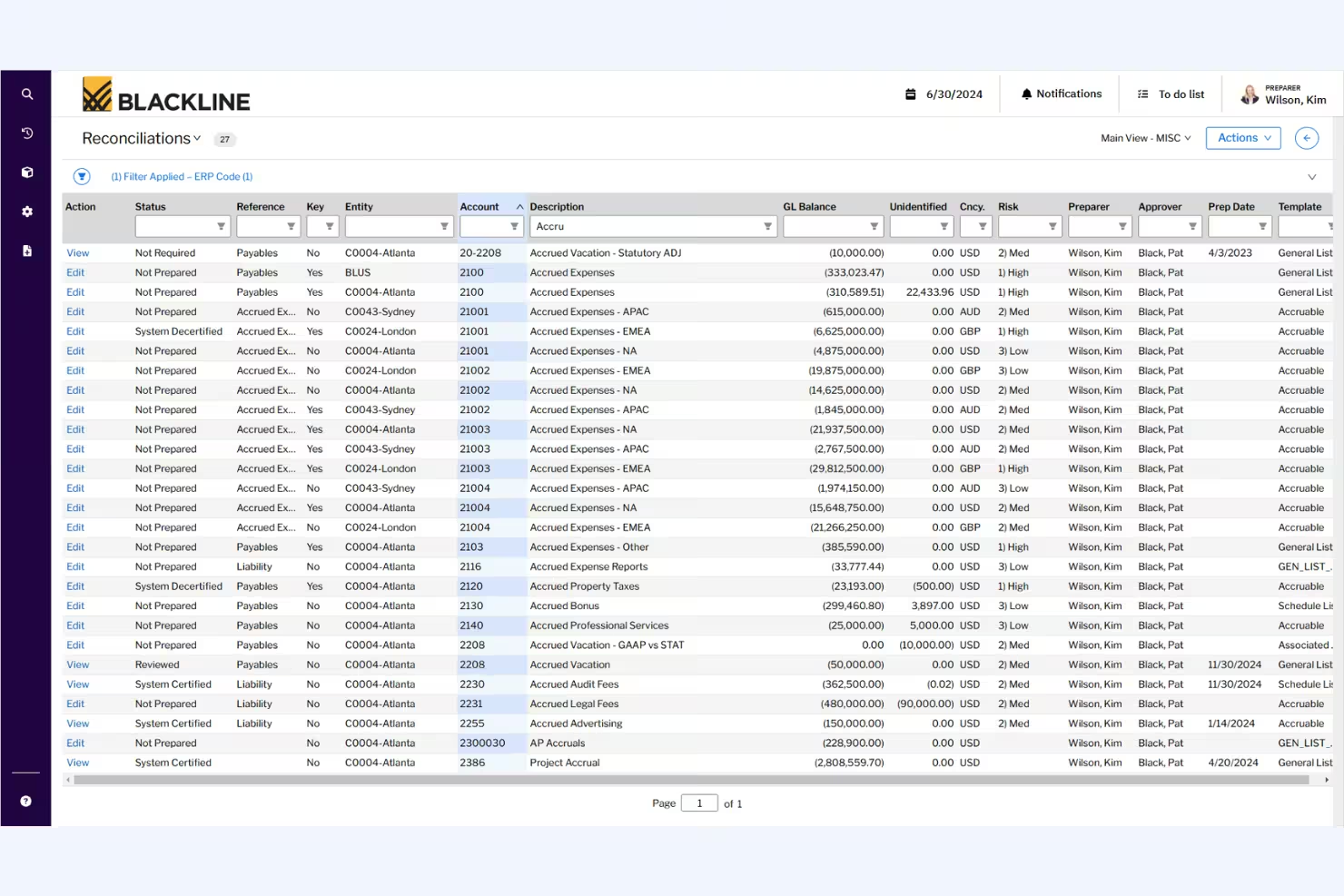
BlackLine is a cloud-based financial close automation platform focused on account reconciliation, journal entry management, intercompany accounting, and variance analysis. Founded in 2001 and publicly traded since 2016, it serves over 4,400 customers globally.
BlackLine’s core strength is the record-to-report (R2R) process: automating the month-end checklist, matching transactions against GL accounts, and providing audit trails for SOX compliance. It is fundamentally an accounting and close platform. BlackLine added a cash application module over time, but it remains secondary to its close product and lacks the depth needed for serious AR operations.
Here’s the issue. If you’re searching for BlackLine systems competitors because your AR team needs better cash application, faster collections, or automated deduction resolution, BlackLine’s architecture wasn’t designed for those problems. It’s an R2R platform with AR bolted on, not an order-to-cash solution.
Why Are Finance Teams Looking Beyond BlackLine?
Three patterns emerge consistently in Gartner Peer Insights reviews and G2 feedback from 2025-2026:
1. Implementation complexity. BlackLine deployments typically run 3-6 months. Users report steep learning curves and, in some cases, longer timelines than expected. One Gartner reviewer noted the implementation “took much longer than it should have.”
2. Data lag and flexibility gaps. Multiple reviewers flag that BlackLine “doesn’t update for an entire day, sometimes more.” For AR teams that need real-time cash positioning, that delay is costly. Customization options are also limited for organizations with non-standard workflows.
3. SAP-centric architecture. BlackLine integrates deeply with SAP (SAP is a strategic investor). If you run Oracle, NetSuite, or Microsoft Dynamics as your primary ERP, you’ll find weaker native connectivity and more workarounds.
According to Gartner (2026), BlackLine is classified as a Challenger in the Financial Close and Consolidation Solutions Magic Quadrant. Strong brand, large install base, but not the innovation leader, and not positioned for O2C at all.
How Does AI Change the BlackLine Competitor Landscape?
The AR automation market hit $3.79 billion in 2026 and is growing at 11.6% CAGR according to Mordor Intelligence. That growth is driven by a generational shift in technology: from rules-based automation (BlackLine’s era) to AI-native execution.
The difference matters at an architectural level. BlackLine and its generation of tools were built on template-based matching, manual configuration, and rules engines. Every new document format requires setup. Every exception routes to a human queue. This approach was designed for the predictable, structured world of R2R and accounting close, not for the messy, unstructured reality of AR operations.
AI-native platforms take a fundamentally different approach. Transformance uses vision language models that understand documents natively (layout, tables, context) rather than running OCR + regex extraction. The result: 99.7% accuracy on structured remittance data with zero template configuration. New customer formats work on first contact. No six-week onboarding per supplier.
For teams evaluating order-to-cash automation, this architectural difference determines whether the tool gets better over time or stays static. And it’s why no close-first platform, regardless of size or market segment, can match what purpose-built AI-native AR delivers.
Top BlackLine Systems Competitors for 2026

1. Transformance: Best Overall Alternative for AR and O2C
Transformance is purpose-built for the full order-to-cash cycle: cash application (ClearMatch), deductions and claims management (ClaimIQ), collections and dunning (CollectPulse), and cash forecasting (CashPulse), all unified by Vero, an AI intelligence layer with persistent institutional memory. Whether you’re a mid-market company or a large enterprise, Transformance is the strongest alternative to BlackLine for any AR or O2C use case.
Where it wins over BlackLine:
- Document understanding: Vision language models instead of OCR + regex. Processes PDFs, emails, EDI, and bank portal downloads from any format, any language, on first contact. No template training.
- Match rates: ~85% auto-match at deployment, improving to 95%+ within 90 days as the persistent memory layer accumulates resolution patterns
- Deployment: Full rollout in 4-8 weeks. First payments matched in days. No dedicated admin required, making it ideal for mid-market teams without large IT departments as well as complex enterprise environments.
- Collections: Autonomous AI calling agent handles 15-20 calls/hour in 70+ languages. 100% of overdue invoices actioned within 24 hours (vs. 30-40% for manual teams)
- Deductions: Graph-based investigation engine cross-references deductions against promotions, pricing agreements, and delivery records simultaneously. Tasks that take an analyst hours across 6+ systems complete in seconds.
- ERP coverage: SAP, Oracle, NetSuite, Microsoft Dynamics. Ingests MT940, CAMT.053, BAI2 bank statements. Multi-ERP environments supported natively from day one.
Best for: Companies of all sizes (EUR 500M-EUR 25B+ revenue) that need AR and O2C execution, not just close management. The no-admin-required deployment makes it equally effective for mid-market teams and large enterprises.

2. FloQast: Close Management Only
FloQast is a close management tool that competes with BlackLine on reconciliation and month-end checklists. It claims 2.9x faster go-live (1.7 months vs. 5 months for BlackLine) and focuses on close management checklists, reconciliation, and flux analysis.
Strengths: Faster deployment than BlackLine for close workflows, Excel-friendly interface.
Limitations: FloQast is strictly a close tool. It doesn’t do cash application, deduction management, collections, or any part of the O2C cycle. If your pain point is AR, FloQast won’t solve it. Mid-market companies looking for AR automation should evaluate Transformance, which deploys in a comparable timeframe (4-8 weeks) while solving the problems that actually drive DSO and working capital impact.

3. Trintech Cadency: Enterprise Reconciliation
Trintech (Cadency for enterprise, Adra for mid-market) specializes in account reconciliation and transaction matching at scale. It handles high-volume balance sheet reconciliation well and supports complex multi-entity structures.
Strengths: Deep reconciliation engine, mature enterprise features, good compliance tooling.
Limitations: Like BlackLine, Trintech is an R2R and close platform. Its AR capabilities are limited. Implementation timelines are comparable to BlackLine (3-6 months). The platform shows its age in UX and reporting flexibility. For anything related to O2C, you’ll need a separate solution.

4. OneStream: Financial Consolidation + Close
OneStream combines financial consolidation, close management, planning, and reporting in a single platform. It’s positioned as an alternative to both BlackLine and legacy EPM tools like Oracle Hyperion.
Strengths: Unified data model, strong consolidation and elimination, good for complex multi-entity groups.
Limitations: OneStream is an EPM/CPM platform. It excels at consolidation and planning but doesn’t address AR execution or O2C workflows. Pricing tends toward the higher end, and implementation is a significant project.

5. Workiva: Compliance Reporting and SOX
Workiva focuses on connected reporting, compliance documentation, and audit trail management. It’s less a direct BlackLine competitor and more an adjacent tool for teams that need SOX compliance, ESG reporting, and SEC filing support.
Strengths: Strong compliance workflows, collaborative document management, audit-ready output.
Limitations: Not an AR tool. Not a close automation tool in the traditional sense. Workiva solves the reporting and compliance problem, not the operational finance problem.

6. SAP Financial Close (S/4HANA + Joule)
SAP offers native financial close capabilities within S/4HANA, plus the Joule AI assistant announced at SAP Connect 2025. For SAP-only shops, this can reduce the need for a third-party close tool.
Strengths: Deep ERP integration (if you’re on S/4HANA), no additional vendor, SAP roadmap alignment.
Limitations: SAP Cash Application is a separate BTP microservice that adds EUR 75-195K in Year 1 and takes 18-24 months to deliver real value. Joule is a query tool, not an execution tool. It can surface data but can’t trigger a collection call, match a remittance, or investigate a deduction. No persistent memory between sessions. For AR and O2C, Transformance connects natively to SAP while delivering results in weeks, not years.
How Should You Evaluate BlackLine Alternatives?
Not every competitor solves the same problem. Before comparing feature lists, clarify what you’re actually buying: R2R/close automation, or AR/O2C execution.
6 Key Criteria for Evaluating BlackLine Competitors
- Problem scope: Do you need financial close automation (R2R), AR and O2C automation, or both? BlackLine, FloQast, and Trintech are close and R2R tools. Transformance is an AR and O2C execution platform. Buying a close tool to solve an AR problem wastes budget, regardless of company size.
- AI architecture: Is the AI native (built into the core) or bolted on (added as a feature layer)? According to Deloitte’s 2025 Global Shared Services Survey, organizations using AI-native finance tools report 40-60% higher automation rates than those using rule-based systems with AI add-ons.
- Deployment timeline: BlackLine and Trintech average 3-6 months. Transformance deploys in 4-8 weeks with no dedicated admin required, making it the fastest path to value for both mid-market and enterprise teams. Time-to-value matters because every month of manual processing costs real money.
- ERP coverage: If you run a multi-ERP environment (SAP in Europe, Oracle in the US, NetSuite for a subsidiary), test whether the tool supports all of them natively. BlackLine’s SAP-centric architecture can be a limiting factor. Transformance supports all major ERPs and bank statement formats out of the box.
- Execution vs. insight: Does the tool take action or just surface dashboards? According to a 2024 McKinsey report on finance automation, the top quartile of performing finance teams automate 60-70% of transaction processing. Close tools report on what happened. AR execution platforms make it happen.
- Institutional memory: Does the platform learn from past resolutions? Stateless tools (BlackLine, SAP Joule) treat every transaction as new. Transformance’s persistent memory layer compounds intelligence over time, and that difference shows up in match rates, DSO reduction, and deduction recovery within the first 90 days.
What Are the Biggest Limitations of BlackLine for AR?
This is the question that should drive your evaluation. BlackLine is a strong product for R2R and accounting close. But it has specific, fundamental blind spots for AR and O2C teams:

No unstructured document processing. BlackLine’s cash application module expects structured data inputs. If your remittances arrive as PDFs, email attachments, or portal downloads (which, according to IOFM, they do for 62% of B2B payments), you need a pre-processing step that BlackLine doesn’t provide natively. Transformance handles all of these formats on first contact with zero template setup.
No autonomous collections. BlackLine doesn’t run dunning sequences, schedule collection calls, or track promise-to-pay commitments. Your team still manages outbound collections manually or through a separate tool. Transformance’s CollectPulse actions 100% of overdue invoices within 24 hours.
No deduction investigation. BlackLine can track deduction balances, but it doesn’t automatically cross-reference deductions against promotional agreements, pricing records, and proof-of-delivery documents. That investigation work, which accounts for 60-70% of a deduction analyst’s time according to IOFM, stays manual. Transformance’s ClaimIQ automates investigation in seconds using graph-based retrieval.
No persistent learning. BlackLine’s matching logic doesn’t improve based on past resolutions for specific customers. If Customer A always sends remittances in a non-standard format, your team reprocesses it manually every time. Transformance’s persistent memory layer learns from every resolution and compounds that knowledge across your entire AR operation.
For companies where the month-end close is the bottleneck, BlackLine still makes sense. For companies where cash application, collections, deductions, or any part of the O2C cycle is the bottleneck, Transformance delivers faster ROI across every company size.
Real-World Impact: Close Tool vs. AR Execution Platform
Consider a European FMCG company processing 3,000 invoices monthly with a 4-person AR team.
Before (BlackLine + manual AR): BlackLine automates the close checklist and account reconciliation, the R2R workflow it was designed for. Cash application runs in spreadsheets. The team manually matches 200+ remittances weekly, spending 6-8 hours per day on data entry and cross-referencing. Deductions pile up in a shared Excel tracker. Collections happen when someone remembers to follow up. DSO: 52 days.
After (Transformance): Cash application runs automatically via ClearMatch. Vision language models read every remittance format on first contact. Match rates reach 95%+ within 90 days. CollectPulse’s AI collections agent handles first-touch follow-ups in German, French, and Italian without hiring native speakers. ClaimIQ’s deduction investigation that took hours now takes seconds via graph-based retrieval. DSO drops to 40 days. The four-person team now handles exceptions and negotiations instead of data entry.
The close tool didn’t cause the AR problem. But it couldn’t solve it. Only a purpose-built O2C platform could.
Frequently Asked Questions
How does BlackLine compare to newer AI-native AR platforms?
BlackLine is an R2R and financial close automation platform; AI-native AR platforms like Transformance are purpose-built for the order-to-cash cycle: cash application, collections, and deductions. BlackLine excels at account reconciliation, journal entry management, and close checklists. It doesn’t process unstructured remittance documents, run autonomous collection calls, or investigate deductions against promotional agreements. Transformance handles all of those workflows with vision language models and persistent memory that improves over time.
What is the best alternative to BlackLine for AR and O2C automation?
Transformance is the strongest alternative to BlackLine for AR and O2C automation at any company size. It covers cash application, deductions, collections, and cash forecasting with 4-8 week deployment, no dedicated admin required. For financial close specifically (R2R), FloQast and Trintech Cadency are the most direct BlackLine competitors. OneStream is the better option if your primary need is financial consolidation.
Which BlackLine competitors offer the fastest implementation?
Transformance deploys in 4-8 weeks for full AR and O2C automation, with first payments matched in days and no dedicated admin required. FloQast averages 1.7 months for close management. BlackLine and Trintech typically require 3-6 months. SAP native close tools can take 18-24 months to deliver full value due to BTP configuration and testing requirements.
Can I use BlackLine and an AR automation tool together?
Yes. BlackLine handles the R2R and close process (reconciliation, journal entries, compliance), while Transformance handles the O2C workflow (cash application, deduction resolution, collections). The two tools address different problems. Many enterprises run both because the close tool was never designed to automate AR execution.
What should I consider when switching from BlackLine to a new platform?
Focus on three factors: problem fit (are you solving an R2R/close problem or an AR/O2C problem?), ERP coverage (does the new tool support all your ERPs natively?), and total cost of ownership (including implementation timeline, admin requirements, and ongoing template maintenance). A 2024 Forrester study on finance technology found that 47% of enterprises underestimate implementation costs when switching platforms.
Which BlackLine competitors work best with SAP?
BlackLine has the deepest SAP integration for financial close, given SAP’s strategic investment. For AR and O2C automation on SAP, Transformance connects directly to SAP (plus Oracle, NetSuite, and Dynamics) and processes MT940, CAMT.053, and BAI2 bank statements natively. SAP’s own Cash Application module exists but runs as a separate BTP microservice with significant additional cost and timeline. Transformance delivers comparable SAP connectivity for AR in weeks, not months.
What is the best alternative to BlackLine for deduction management?
Transformance’s ClaimIQ is the strongest alternative for deduction management. It auto-classifies deductions across 6 categories, investigates validity using graph-based retrieval across promotional agreements and delivery records, and drafts dispute packages automatically. BlackLine tracks deduction balances but doesn’t automate the investigation step.
Are there BlackLine alternatives specifically for mid-market companies?
Transformance is the best alternative for mid-market companies that need AR and O2C automation. It deploys in 4-8 weeks, requires no dedicated admin, and supports companies from EUR 500M revenue upward. For mid-market close management only, FloQast offers faster deployment than BlackLine but doesn’t address AR or O2C. Mid-market teams that need to improve DSO, cash application, or collections should evaluate Transformance first.
Take Action: Choose the Right Tool for the Right Problem
BlackLine is a solid R2R and financial close platform. But if your challenge is cash application, collections, deduction management, or any part of the order-to-cash cycle, the answer isn’t a better close tool. It’s a purpose-built AR execution platform.
Transformance automates the full O2C workflow: from document ingestion to payment matching to ERP posting, with autonomous collections and deduction investigation built in. It deploys in weeks, not months, works for mid-market and enterprise teams alike, and gets measurably better every day as the persistent memory layer accumulates your organization’s payment intelligence.