
Claims management software for accounts receivable is a purpose-built platform that automates the end-to-end process of capturing, validating, resolving, and posting trade deductions and customer claims. For enterprise finance teams, it replaces the spreadsheets and manual workflows that drain cash, inflate DSO, and consume analyst time on low-value work.
Key Takeaways
- Claims management software automates the full deductions lifecycle: intake, validation, dispute routing, resolution, and GL posting.
- AI-native platforms now achieve 90%+ accuracy in matching claims to supporting documents, reducing manual processing time significantly.
- According to a 2024 Forrester analysis, automating AR processes reduces DSO by up to 35%.
- The right platform connects directly to your ERP and executes resolutions, not just flags them for a human to act on.
In This Article
- Key Takeaways
- What Is Claims Management Software?
- Why Does Claims Management Software Matter for Enterprise Finance?
- How Does AI Transform Claims Management Software?
- Key Challenges in Claims Management (and How Software Fixes Them)
- How to Evaluate Claims Management Software Solutions
- A Before/After Scenario: What Claims Management Software Changes
- Choosing the Right Platform for Your Business
- Frequently Asked Questions
- Take Action: Automate Your Claims Management Process
What Is Claims Management Software?
Claims management software is a specialized application that automates the tracking, validation, and resolution of customer deductions and trade claims within accounts receivable. It connects incoming remittances to open invoices, identifies dispute reasons, routes claims for approval or denial, and posts the outcome back to the ERP, without manual intervention at each step. In a typical AR operation, deductions arrive mixed into customer payments. A retailer pays $95,000 on a $100,000 invoice and attaches a deduction code pointing to a promotion, a freight dispute, or a compliance penalty. Without dedicated software, someone on your team has to find the backup, verify the claim, decide whether to approve or contest it, and then update the system. Multiply that by hundreds of claims per month and the math gets painful fast.
Claims management software handles that entire sequence. The best platforms do it autonomously.
Why Does Claims Management Software Matter for Enterprise Finance?
Trade deductions are not a niche problem. For mid-size and large consumer goods companies, deductions routinely represent 1-3% of gross revenue, and according to industry research, they can depress margins by up to 30% when managed manually. That’s not a rounding error.
The volume problem is getting worse. Retailers have automated their end of this process, generating chargebacks at machine speed with detailed compliance requirements. Suppliers are still catching up. Many finance teams have headcount dedicated entirely to manually processing claims that could, with the right software, resolve themselves.
There’s also a write-off risk. When your team can’t keep up with claim volume, valid disputes age out, invalid deductions go uncontested, and revenue leaks silently. According to a 2024 Forrester analysis, automating AR processes reduces DSO by up to 35%. That’s not just a time savings figure. It translates directly to working capital.
The AR automation market reflects this urgency. According to ResearchandMarkets (2025), the global accounts receivable automation market was valued at $2.8 billion in 2024 and is projected to reach $6.4 billion by 2033, at a CAGR of 9.7%. Claims management is one of the fastest-growing segments within that market.
For a deeper look at how deductions fit into the broader AR picture, see What Is Deductions Management?

How Does AI Transform Claims Management Software?
From Rule-Based Matching to Intelligent Resolution
Legacy claims management tools apply fixed rules. If the deduction code is X and the amount is under Y, approve it. That works until your rules haven’t been updated in two years and half your customer base is using codes you haven’t mapped yet.

AI-native platforms work differently. They learn from historical claim patterns, document types, and resolution outcomes. They match backup documents (PODs, BOLs, promotional agreements) to incoming deductions using natural language processing, not keyword matching.
According to industry benchmarks, AI-driven claim validation now matches claims to supporting documents with above 90% accuracy, which means fewer aging disputes and fewer manual reviews.
Execution vs. Insight
This is the distinction that matters most when evaluating software: does the platform tell you what to do, or does it do it?
Older systems surface a dashboard showing 400 unresolved claims. Someone still has to open each one, pull the backup, and decide. That’s a reporting tool, not an execution tool.
Transformance ClaimIQ takes the execution approach. Vision language models ingest remittance data from any format (99.7% accuracy on structured data, 97% auto-classification across six trade deduction categories). Graph-based retrieval investigates validity against promotional agreements, delivery records, and prior resolutions simultaneously — what takes an analyst hours across 6+ systems completes in seconds. Valid deductions are auto-approved, invalid ones get an auto-generated dispute package routed to the customer, and posting validation checks every journal entry before it touches the ERP. The finance team intervenes only on exceptions, not on every transaction. As the persistent memory layer accumulates retailer-specific patterns over time, auto-classification accuracy and resolution speed improve month over month.
For context on how this applies specifically to cash application, see Agentic AI for Cash Application: From Remittance to GL.
What AI Does That Humans Can’t Do at Scale
A few specific capabilities that separate AI-powered platforms from traditional software:
- Pattern detection across claim history: AI identifies which customers are systematically over-deducting and flags them for credit hold or contract review, rather than processing each claim in isolation.
- Document retrieval and matching: Instead of requiring a team member to dig up a 6-month-old promotional agreement, the platform pulls the relevant contract and matches it to the deduction automatically.
- Root cause analysis: Not just resolving claims, but identifying why they’re occurring. A spike in freight deductions from one retailer might point to a carrier problem, not a dispute. Humans spot this eventually. AI spots it in the first week.
Key Challenges in Claims Management (and How Software Fixes Them)
Challenge 1: Volume Outpacing Headcount
Finance teams at consumer brands spend 40+ hours per week on manual deduction work, according to industry analysis. That’s a full-time employee doing nothing but processing claims. When claim volume grows with revenue, you can’t just hire your way out of it.
Software fixes this by automating the high-volume, low-judgment work. Standard promotional deductions with valid backup don’t need a human. They need a rule and an execution engine.
Challenge 2: Inconsistent Resolution Decisions
When six different analysts are resolving claims independently, you get six different standards. One analyst fights every freight claim under $500. Another approves them all. The inconsistency creates accounting headaches and poor customer relationships.
Centralized software applies consistent logic across every claim, every time. Approval thresholds are set in the system, not in individual judgment calls.
Challenge 3: ERP Integration and GL Posting
The last mile of claims management is where many platforms fail. They manage the workflow but then require someone to manually post the outcome back to SAP, Oracle, or NetSuite. That’s not automation. That’s digitizing a paper form.
True claims management software writes directly to the GL. No exports, no re-keying, no reconciliation step at month-end that undoes the efficiency gains.
For more on why month-end reconciliation breaks down when this step is missing, see Why Your Month-End Close Still Breaks - And How to Fix It.
Challenge 4: Lack of Visibility Across Claim Types
Trade promotions, freight disputes, short shipments, compliance penalties. Each claim type follows different rules, involves different backup documents, and routes to different approvers. Most teams manage these in separate processes, or worse, the same spreadsheet.
Good claims management software handles all claim types within a single platform, with configurable workflows per type. Finance gets one view of outstanding exposure. Management gets one aging report.
How to Evaluate Claims Management Software Solutions
Not all platforms are built the same. When you’re assessing vendors, here are 8 criteria that separate execution platforms from glorified ticket systems: 1. ERP native integration: Does it write directly to SAP, Oracle, or NetSuite, or does it require a middleware layer and manual GL posting? Ask specifically about write-back, not just read access. 2. AI model transparency: What does the AI actually do? If the vendor can’t explain how their matching logic works or show you accuracy metrics, they’re using the word “AI” loosely. 3. Document ingestion capability: Can the platform ingest remittance files, PDFs, EDI 812 transactions, and email attachments without manual formatting? Multi-format ingestion is table stakes in 2026. 4. Workflow configurability without IT: Can your AR team configure approval thresholds, escalation rules, and claim categories themselves? If every change requires a developer or a support ticket, your flexibility is limited. 5. Dispute management and response tracking: When you contest a deduction, does the platform track the response, follow up automatically, and escalate if the customer doesn’t reply? Or does it hand that back to a human? 6. Reporting and root cause analytics: Beyond claim counts and aging, does the platform show you which customers, product categories, or promotion types generate the most deduction volume? That data drives commercial decisions. 7. Deployment timeline: Platforms that require 6-12 month implementation cycles are often a sign that the product wasn’t designed for your ERP environment. Ask specifically: “What does week one look like?” and “When can we run our first real claims batch?” 8. Audit trail and compliance support: Every approved or denied claim should be traceable. For public companies or those with external audits, this is non-negotiable.
For a comparison of the software category specifically, see What Is Deduction Management Software?.
A Before/After Scenario: What Claims Management Software Changes
Before automation: A mid-market CPG company receives 600 deductions per week from its top 20 retail accounts. Three analysts split the load. Each claim requires: locating the remittance, matching it to an open invoice, finding the backup document, deciding validity, entering the decision in a spreadsheet, and sending a response to the customer. Average time per claim: 18-22 minutes. Each analyst resolves roughly 100 claims per week. The backlog never clears. Deductions older than 90 days typically get written off because the dispute window has closed.
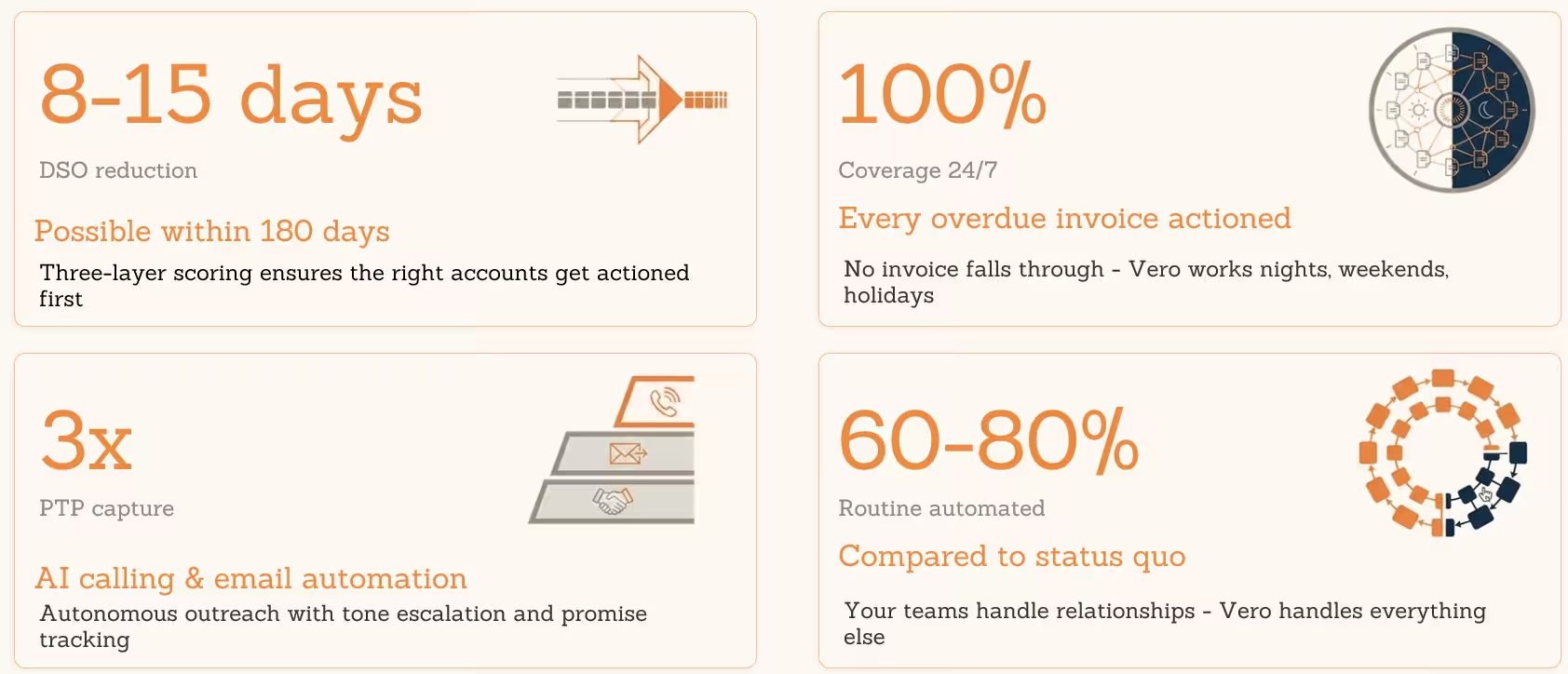
After automation: The same 600 weekly deductions flow through an AI-native platform. Standard promotional deductions with valid backup (roughly 65% of volume) resolve automatically: matched, approved, and posted to NetSuite within hours of receipt. Invalid deductions are flagged with a pre-built dispute package and routed to the customer within 48 hours, well inside the dispute window.
The three analysts now handle only the 35% of claims that need judgment. Average DSO on deductions drops from 48 days to 19 days. The annual write-off rate falls by more than half.
This is the pattern we see consistently. The technology doesn’t replace the team. It changes what the team works on.
Choosing the Right Platform for Your Business
The market includes solutions built for insurance claims, healthcare revenue cycle, legal case management, and B2B trade deductions. These are not the same product. Make sure you’re evaluating platforms built specifically for AR and trade claims, not general-purpose workflow tools that have been repositioned.
For enterprise finance teams managing complex retail relationships, the critical requirement is ERP-native execution. That means a platform that doesn’t just track claims in its own system but closes the loop by posting outcomes back to your GL automatically.
Transformance's ClaimIQ is purpose-built for this. It connects directly to SAP, Oracle, NetSuite, and Microsoft Dynamics, and runs the full claims lifecycle autonomously through Vero (the cross-product AI agent). ClearMatch handles the upstream payment matching, ClaimIQ auto-classifies and investigates deductions with 97% accuracy, the persistent memory layer compounds retailer-specific knowledge over time, and posting validation checks every journal entry before it posts to the GL. Full deployment runs 4-8 weeks.
For more on the AI-driven approach specifically for CPG, see AI-driven Claims Automation for CPGs.
See it in action: Read a freight claims reconciliation case study with Transformance.
Frequently Asked Questions
What is claims management software for accounts receivable?
Claims management software for accounts receivable is a platform that automates the capture, validation, and resolution of customer deductions and trade claims. It connects incoming payments to open invoices, identifies dispute reasons, routes claims for approval or denial, and posts outcomes back to the ERP without manual steps at each stage.
How does Transformance automate deductions management?
Transformance ClaimIQ automates deductions management in B2B AR. It executes resolutions directly in the ERP and reserves human review for exception cases.
How does claims management software handle dispute resolution?
When a claim is invalid, the software automatically generates a dispute package, including the relevant backup documents, reason codes, and a response letter, then routes it to the customer within a configurable timeframe. It tracks the customer’s response, sends follow-ups if none arrives, and escalates to an analyst only if the dispute requires negotiation.
What software helps with chargeback and claims management for CPG companies?
CPG companies need platforms that handle EDI 812 transactions, promotional claim backup, and retailer-specific compliance rules. Transformance and similar AI-native tools are built for this use case, automating the matching of deductions to promotional agreements and trade promotion calendars before deciding validity.
What is the best dispute resolution software for accounts receivable?
Transformance ClaimIQ automates the full dispute resolution cycle for AR (deduction capture, supporting evidence retrieval via graph-based investigation, dispute package generation, response tracking, and GL posting through posting validation) with vision language models that handle any retailer format without template configuration. 97% auto-classification accuracy, 4-8 week deployment, direct ERP write-back to SAP, Oracle, NetSuite, and Microsoft Dynamics.
How to handle trade deductions more efficiently?
The most effective way to handle trade deductions efficiently is to automate the high-volume, low-judgment claims first, typically standard promotional deductions with valid backup. This frees your team to focus on high-value disputes that require negotiation. Connecting your claims platform directly to the ERP eliminates the manual posting step that most teams underestimate as a time sink.
How long does it take to implement claims management software?
Implementation timelines vary significantly. Traditional platforms with heavy ERP customization can take 6-12 months. AI-native platforms with pre-built ERP connectors typically go live in 6-10 weeks. The key question to ask any vendor: “How long until we can process our first live claims batch?” Not the full rollout, but the first real transaction.
Take Action: Automate Your Claims Management Process
Manual claims management is a volume problem that doesn’t get better with more headcount. The same 600 deductions that take three analysts two weeks to process can, with the right platform, resolve in 48 hours with minimal human intervention.