Transformance CollectPulse leads this list as the strongest AI-native option: it runs autonomous collection calls in 70+ languages, applies a three-layer priority scoring model powered by persistent memory, and deploys in 4-8 weeks without a dedicated admin. The tools below span enterprise AI platforms to lean SMB tools. Here is how they compare.
Key Takeaways
- AI-powered collections tools reduce DSO by 8-15 days within 90 days through 100% invoice coverage and automated dunning sequences
- The most effective platforms execute outreach autonomously; they do not just generate a worklist for your team to work through manually
- Deployment timelines vary dramatically: AI-native platforms go live in 4-8 weeks; incumbent enterprise platforms typically take 3-6 months
- Autonomous AI collection calls in 70+ languages are unique to CollectPulse: no other O2C platform offers this capability at enterprise scale
- According to a January 2025 McKinsey analysis, optimizing AR processes can improve receivables-related working capital by 30% or more within weeks
In This Article
- How We Evaluated These Tools
- The 7 Best Collections Management System Software Options in 2026
- Comparison Table
- How Do AI-Powered Collections Tools Actually Work?
- What Should You Look for in Collections Management System Software?
- Why Does DSO Still Run High for Most B2B Companies?
What Is Collections Management System Software?
Collections management system software is a specialized platform that helps B2B finance and AR teams manage overdue invoices, automate customer follow-up (dunning), prioritize collection effort by payment risk, and track promise-to-pay commitments across the full receivables portfolio. Modern AI-native platforms go further: they score invoices by payment probability, execute outreach autonomously, and learn from past payment patterns so performance improves over time.
This is distinct from museum or cultural heritage collections software, which carries the same name but manages catalogued artifacts rather than receivables.
How We Evaluated These Tools
We assessed each platform on six criteria:
- Priority scoring depth: Does it go beyond simple aging buckets to ML-based payment probability?
- Autonomous execution: Does the tool act on priorities (send emails, make calls) or just generate a worklist?
- Language and geography: Can it run multilingual collections for cross-border AR and shared service centers?
- ERP integration: Does it connect directly to SAP, Oracle, NetSuite, or Dynamics and write outcomes back automatically?
- Deployment speed: How long from contract to first live collections actions?
- Memory and learning: Does performance improve with use, or does the system start from zero every session?
The 7 Best Collections Management System Software Options in 2026
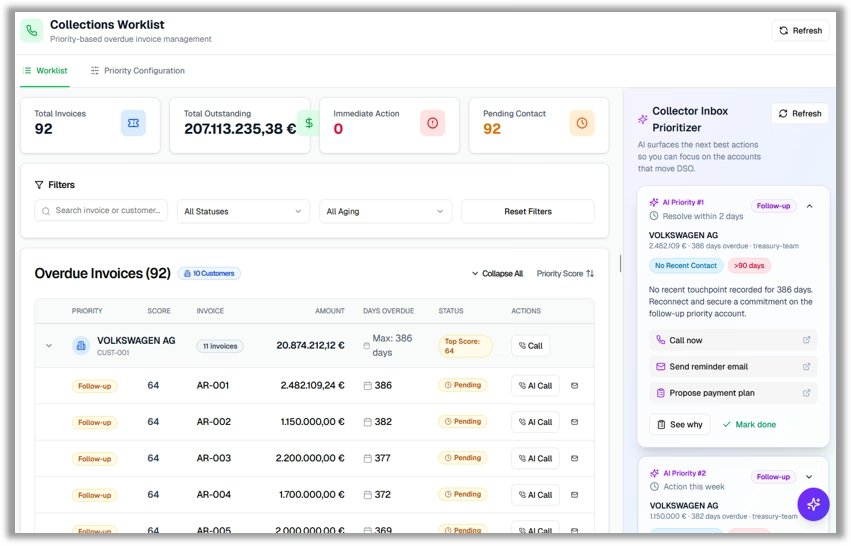
1. Transformance CollectPulse: Best for Mid-Market and Large Enterprises
CollectPulse: Autonomous Collections Software
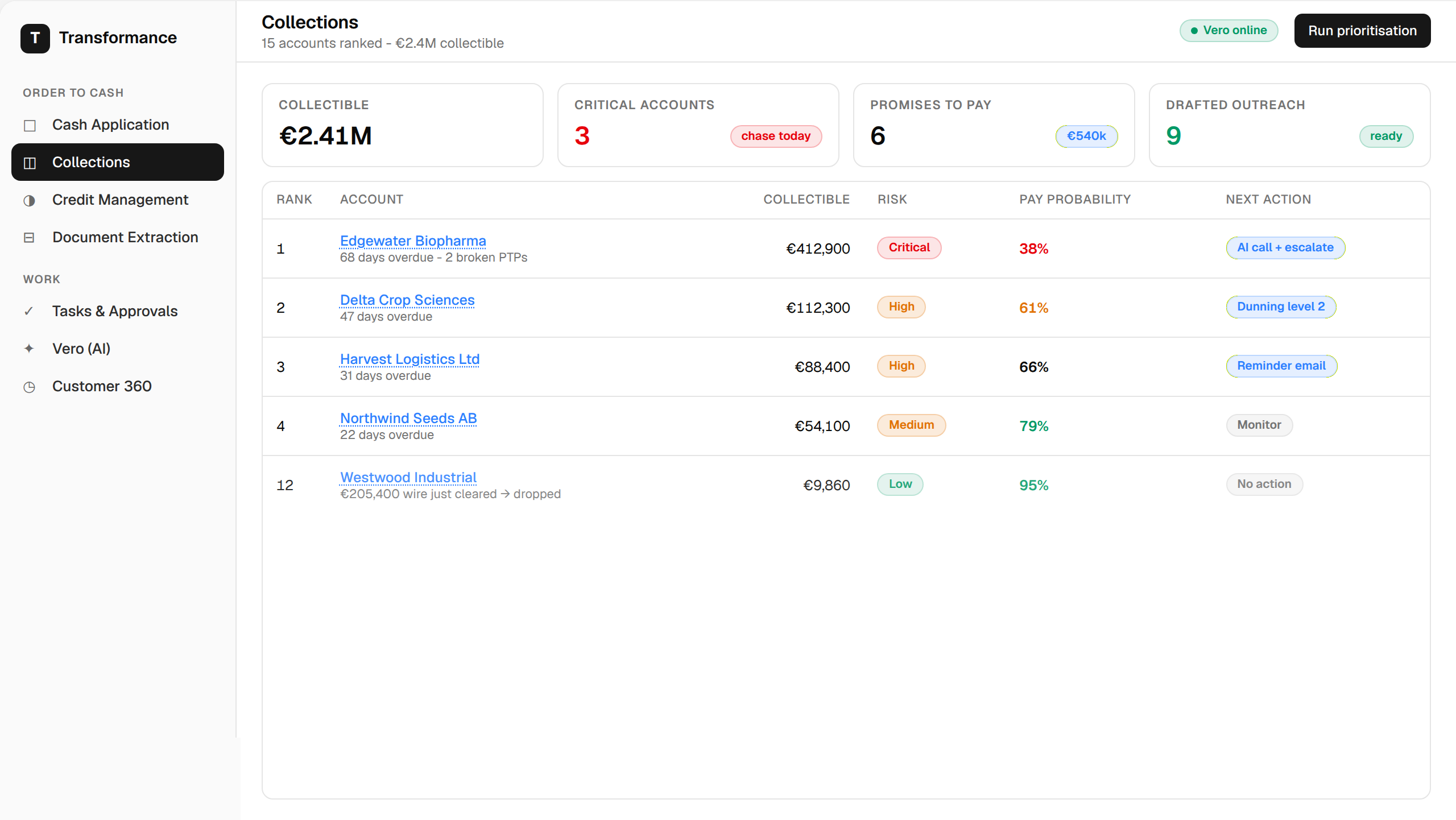
CollectPulse is an AI-native collections platform built for finance teams that need execution, not just insight. It covers priority scoring, automated dunning sequences, and autonomous AI calling, all unified by Vero: an AI agent that acts as an always-on team member with persistent institutional memory.
How it works: CollectPulse applies a three-layer scoring model to every overdue invoice. Layer 1 handles age buckets, invoice amount, and credit terms. Layer 2 applies a payment probability ML model trained on the customer’s own historical data, predicting likelihood and expected payment timing. Layer 3 is where CollectPulse diverges structurally: Vero reads persistent memory including broken promise-to-pay patterns, seasonal payment delays, and AP contact changes, then adjusts scores accordingly. Every invoice carries a composite priority that reflects rules, statistics, and institutional knowledge simultaneously.
From that scoring, CollectPulse executes. Configurable dunning sequences run automatically: email at day 3, follow-up at day 10, AI call at day 15 if no response. The calling agent identifies itself as AI (EU AI Act compliant), captures the promise-to-pay date, dispute reason, or escalation flag, and writes the outcome back to the system without human intervention. Throughput: 15-20 calls per hour versus 15-20 calls per day for a human collector. Language support: 70+ languages, which means a 3-person shared service center can run Italian, French, and Spanish collections simultaneously without native-speaker headcount.
The persistent memory layer is the compounding advantage. Vero remembers that Customer X always pays 5 days late in Q4 and Retailer Y disputes every invoice over €10K. That knowledge builds over time and becomes organizational intelligence rather than tribal knowledge held by one analyst.
Best for: Mid-market and large enterprises (€500M-€25B+ revenue) running SAP, Oracle, NetSuite, or Dynamics with cross-border AR, shared service centers, and high volumes of unstructured payment data.
Pros:
- Autonomous AI collection calls in 70+ languages, unique in the O2C market
- Three-layer priority scoring with persistent memory (rules, ML, Vero institutional knowledge)
- 100% of overdue invoices actioned within 24 hours (vs. 30-40% for manual teams)
- DSO reduction of 8-15 days within 90 days of deployment
- Full rollout in 4-8 weeks, no dedicated admin required
Cons:
- Focused on O2C only: not a broader financial close or treasury suite
- Optimized for enterprise document complexity, not high-volume e-commerce microtransactions
- Full autonomous calling capability requires the complete Vero intelligence layer
Pricing: Module-based, tied to users, transaction volume, and AI usage. 25-30% more affordable than incumbent platforms, with faster onboarding that reduces total project cost. Pilots available to validate match rates on your own AR data before committing.
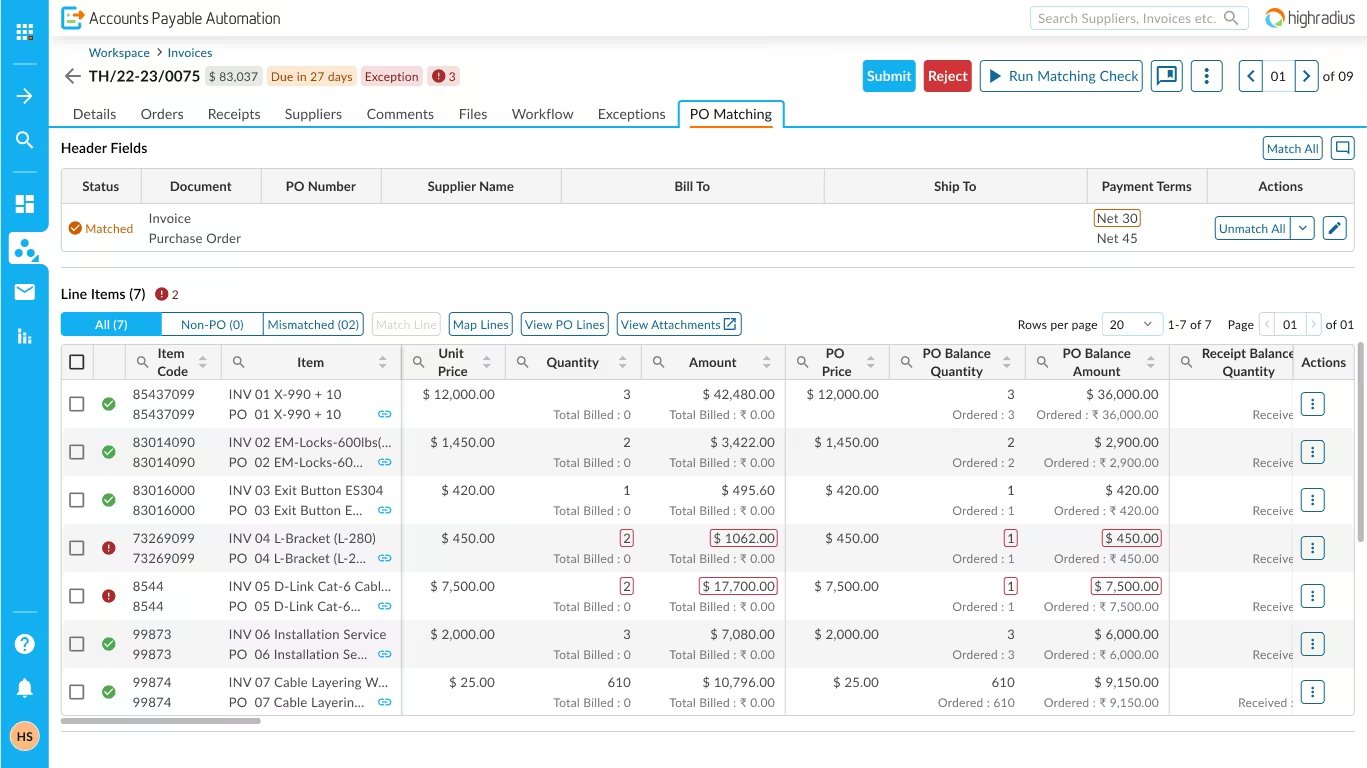
2. HighRadius: Best for Large Enterprises Already in the HighRadius Ecosystem
HighRadius offers a broad AR suite covering collections, cash application, deductions, credit, and treasury. Their collections module includes priority worklists, automated dunning emails, and a digital assistant for AR analysts. It is the dominant platform for Fortune 500 companies with deep SAP or Oracle integrations already in place.
The gap is execution depth and architectural generation. HighRadius was built on first-generation technology: rules, RPA, and traditional ML added on top of a 2010s-era architecture. The collections assistant is stateless. It does not accumulate memory between sessions, so if an analyst resolves an exception with a specific customer today, that knowledge does not feed future scoring automatically. Implementation timelines run 3-6 months and typically require a dedicated admin for ongoing configuration.
Best for: Large enterprises (€2B+ revenue) with existing HighRadius contracts across cash application or credit who want to consolidate AR tools in one vendor relationship.
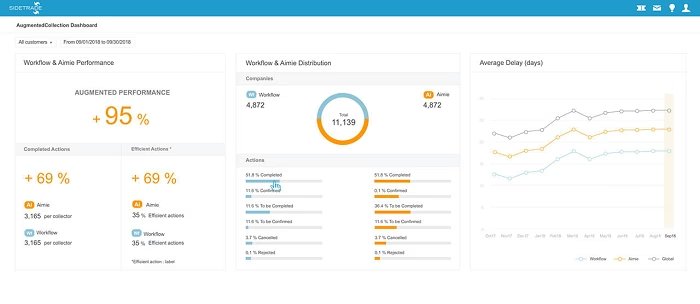
3. Sidetrade: Best for European Enterprises with AI Collections Focus
Sidetrade is a French-origin AI collections platform used primarily in Europe and North America. Their scoring model uses payment behavior data to predict when customers will pay, and the platform supports automated dunning with escalation logic. It covers collections management, dispute tracking, and cash forecasting in a single suite.
The limitation is execution depth. Sidetrade automates email sequences and worklist generation well, but it does not run autonomous outbound calls or support multilingual AI calling at enterprise scale. For SSCs managing collections across five or more European languages, that coverage gap is meaningful.
Best for: European mid-market and large enterprises (€200M-€2B revenue) looking for AI-assisted collections with a strong European support footprint.
4. Tesorio: Best for Mid-Market with Cash Flow Intelligence
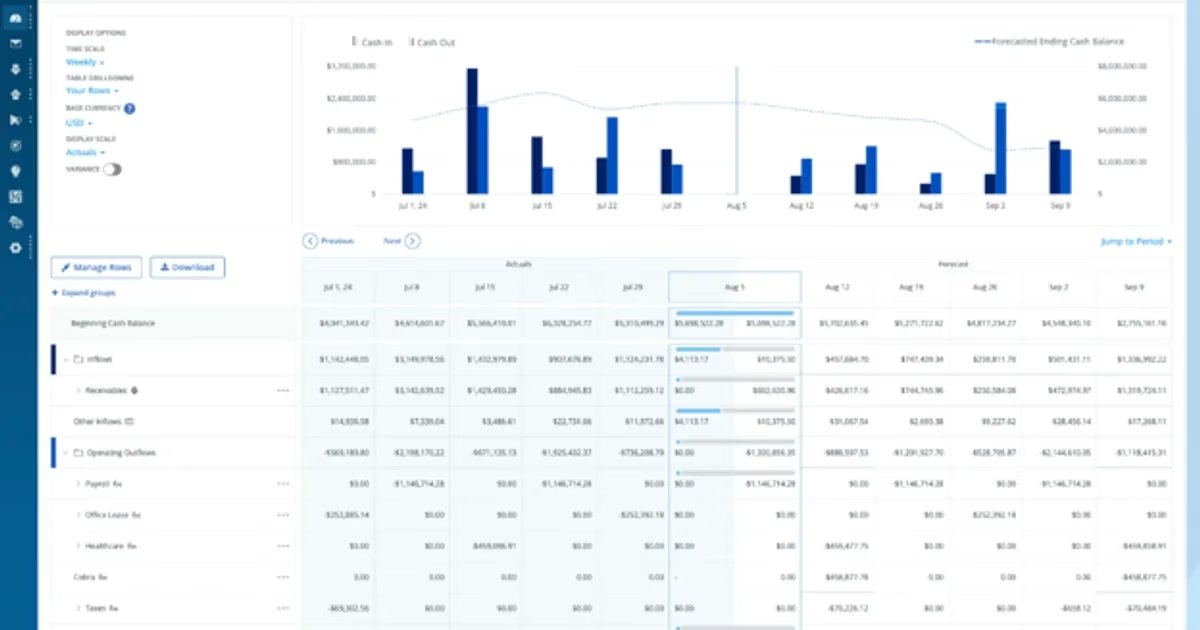
Tesorio positions primarily as a cash flow intelligence platform, with AR collections as a key workflow. Their module prioritizes overdue invoices, automates follow-up emails, and surfaces promise-to-pay data. The cash forecasting layer integrates tightly with collections so AR managers can see how collection activity affects short-term cash position.
The execution gap: Tesorio automates email sequences but relies on human outbound calling. There is no autonomous AI calling agent. For mid-market teams with manageable overdue portfolios where email coverage is sufficient, this is workable. For enterprises with thousands of overdue invoices across multiple countries, the reliance on human calling creates coverage gaps that widen over time.
Best for: Mid-market companies (€50M-€500M revenue) that want collections automation bundled with cash visibility and are comfortable with email-only autonomous outreach.
5. Gaviti: Best for SMB and Mid-Market with Simple Dunning Needs
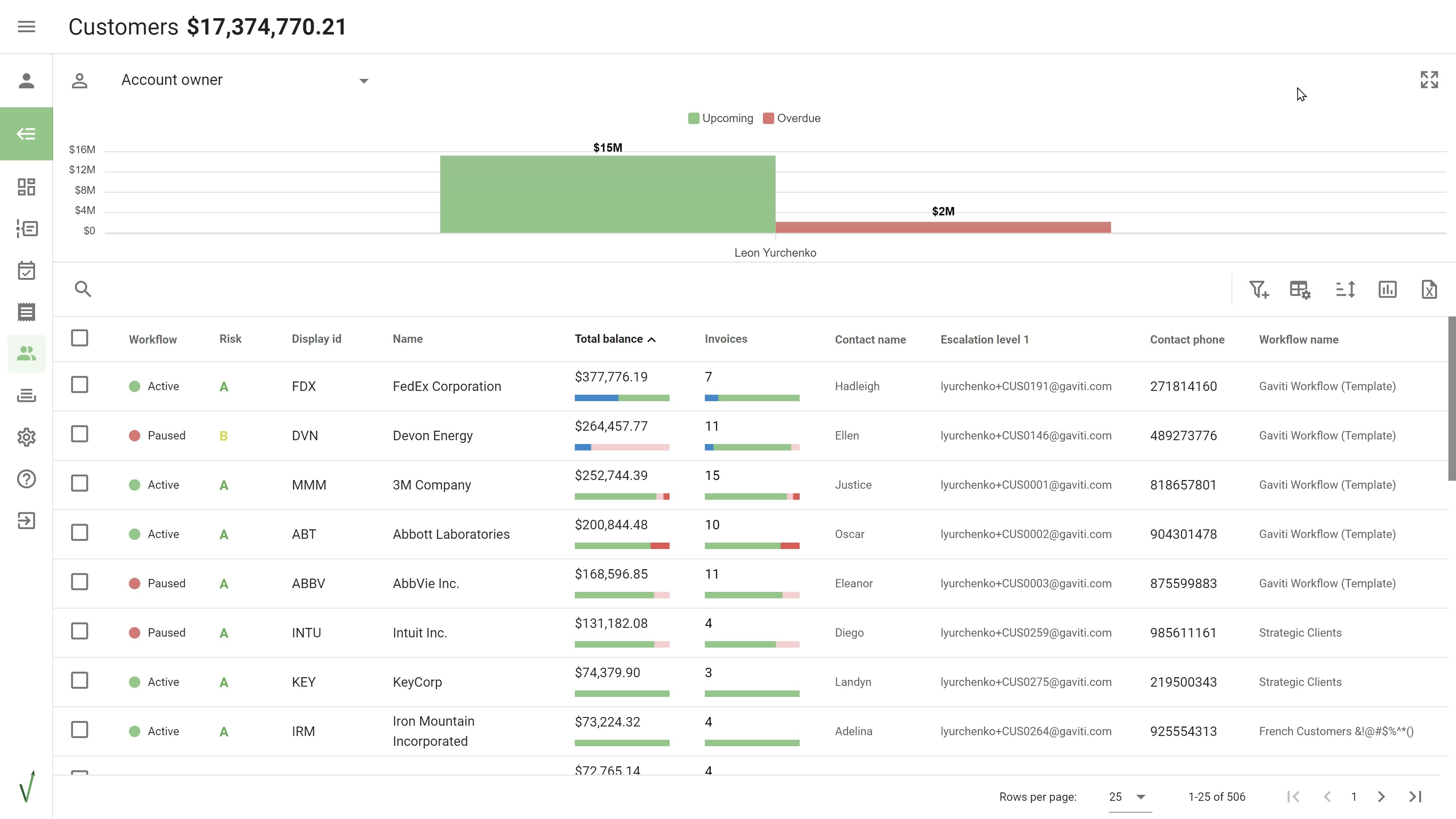
Gaviti is a dedicated AR collections platform focused on automated dunning sequences, customer portals, and promise-to-pay tracking. It is well-regarded for ease of setup and fast onboarding. Finance teams can get dunning sequences running in days, not weeks.
The ceiling is AI depth. Gaviti’s priority scoring is rules-based: aging buckets and invoice amounts. There is no ML-based payment probability model and no persistent memory. It handles the basics reliably, but as portfolio complexity grows (more customers, more cross-border, more disputes), the gap between rules-based prioritization and AI-driven execution becomes significant.
Best for: SMB and lower mid-market companies (up to €50M revenue) with straightforward dunning needs and no cross-border language requirements.

6. YayPay by Versapay: Best for Collaborative AR with Customer Self-Service
YayPay (now part of Versapay) emphasizes collaborative AR: combining collections automation with a customer-facing portal where buyers can view invoices, dispute items, and make payments. The platform automates dunning sequences, tracks collector activity, and generates AR aging dashboards.
The AI layer is limited. YayPay applies basic ML scoring to predict payment likelihood but does not offer autonomous calling or multilingual collections. For B2B enterprises where customer relationships require phone conversations or multi-language outreach, the tool’s effective coverage is limited to email and portal interactions.
Best for: SMB and mid-market companies (€20M-€200M revenue) that prioritize customer self-service and collaborative payment resolution over autonomous outbound collections.
7. Upflow: Best for European Scaling Companies with Clean UX
Upflow is a Paris-based AR collections tool built for scaling B2B companies. It offers automated dunning, AR aging analytics, and CRM-style customer tracking for AR teams. The UI is clean and intuitive, and finance teams can configure workflows without IT involvement.
The AI depth is limited to segmentation and workflow triggers. There is no payment probability ML, no autonomous calling, and no persistent memory layer. Upflow is a strong execution tool for teams that have outgrown spreadsheets and need structured dunning sequences. It is not the platform for enterprises managing thousands of overdue invoices across multiple countries and currencies.
Best for: European scaling companies (€5M-€100M revenue) with straightforward B2B collections and a preference for developer-friendly tooling.
How Do AI-Powered Collections Tools Actually Work?
The term “AI-powered collections” covers a wide range of actual capability. At one end: rules-based aging bucket sorting with an AI label. At the other: fully autonomous agents that prioritize, communicate, call, capture outcomes, and update the ERP without human intervention. Here is what the layers actually look like:

Layer 1: Rules. Age buckets, invoice amount, credit terms. Every tool does this. Useful but static: it treats all €50K invoices identically regardless of customer payment history.
Layer 2: ML scoring. A payment probability model that predicts likelihood and timing of payment based on historical data. Better platforms train this on each customer’s own payment history rather than industry averages. This is where genuine ML platforms separate from rules engines with AI branding.
Layer 3: Agent intelligence with persistent memory. The highest tier. An AI agent reads institutional memory including broken promise-to-pay patterns, seasonal delays, and AP contact changes, then adjusts priority scores and executes outreach accordingly. The system improves with use, and the knowledge it accumulates becomes an organizational asset rather than tribal knowledge in one analyst’s head.
According to IOFM benchmarks, AR teams that automate collections follow-up see promise-to-pay capture rates increase significantly compared to manual follow-up alone. The throughput math alone makes the case: an AI calling agent running at 15-20 calls per hour can cover a 500-invoice overdue portfolio in an afternoon. A human collector working the same list at 15-20 calls per day needs three weeks.
For a broader view of how these tools connect to the full invoice-to-cash cycle, see the Invoice-to-Cash Automation Software Guide.
What Should You Look for in Collections Management System Software?
5 Key Criteria for Enterprise AR Collections
- Priority scoring depth. Does the system go beyond aging buckets to actual payment probability? Can it factor in institutional memory including broken promises, seasonal patterns, and customer-specific behaviors? The gap between Layer 1 (rules) and Layer 3 (persistent memory) translates directly into which invoices get actioned first.
- Autonomous execution. Does the software act on priorities, or does it generate a worklist and stop there? Autonomous email plus calling means 100% invoice coverage even when your team is short-staffed or managing year-end close. Coverage gaps in collections directly widen DSO.
- Language and geography. Cross-border AR teams need multilingual dunning and calling. If your SSC manages collections across Germany, Spain, and France, the platform needs to operate in those languages natively without requiring you to hire native speakers for each market.
- ERP and write-back integration. Collections data needs to flow back to the ERP. Confirm whether the tool writes promise-to-pay dates, dispute reasons, and cleared items back to SAP, Oracle, or your ERP of record automatically, or whether your team has to do manual entry after each call.
- Deployment speed and admin overhead. Platforms that take 6 months to deploy delay ROI by a quarter or more. Ask for specific go-live timelines from reference customers, not sales estimates. Verify whether a dedicated admin is required for ongoing configuration, and what happens when staff turns over.
For more detail on the connection between collections process design and DSO outcomes, see How to Reduce DSO: A Step-by-Step Guide for AR Teams and Best Tools for Reducing DSO in AR.
Why Does DSO Still Run High for Most B2B Companies?
The short answer is coverage. Most AR teams manually action only 30-40% of overdue invoices in any given week. The rest sit untouched because collectors are managing escalations, handling disputes, or simply do not have time to work the full portfolio.

The typical manual sequence creates week-long gaps between contacts: pull the aging report, draft an email, wait five days, follow up if no response. According to a 2025 Shared Services and Outsourcing Network global report, centralized AR processes with automation improve dispute resolution by 59% and cut aged debt by 75% compared to manual decentralized models. The mechanism is coverage: automated dunning ensures no invoice goes uncontacted in the first 30 days regardless of team bandwidth.
A January 2025 McKinsey analysis found that optimizing AR processes can improve receivables-related working capital by 30% or more within weeks, often without significant changes to customer or supplier relationships. The key driver cited: closing the follow-up gap between invoice due date and first contact.
AI calling takes coverage further. The throughput difference between an AI calling agent (15-20 calls per hour) and a human collector (15-20 calls per day) means the AI can contact the full overdue portfolio daily. Human collectors, by necessity, prioritize the largest accounts and let the long tail age uncollected.
For a detailed breakdown of the order-to-cash process and where automation generates the most measurable return, see How AI Automates Order to Cash: 10 Use Cases.
FAQ
What is the best dunning automation software?
Transformance CollectPulse is the strongest dunning automation platform for mid-market and large enterprises. It combines configurable multi-step email sequences with autonomous AI calling in 70+ languages, three-layer priority scoring, and persistent memory that improves over time. For simpler SMB use cases, Gaviti and Upflow offer fast onboarding and straightforward email dunning at lower complexity.
How do AI-powered collections tools work?
AI-powered collections tools apply layered scoring to overdue invoices: rules, ML payment probability models, and (in the most advanced platforms) agent intelligence with persistent memory. The best platforms do not stop at prioritization. They execute dunning sequences and autonomous calls, capture outcomes, and write results back to the ERP without manual intervention.
What are the best tools for reducing DSO in accounts receivable?
The tools that most consistently reduce DSO combine 100% invoice coverage with AI priority scoring that flags which accounts need human escalation. CollectPulse delivers DSO reductions of 8-15 days within 90 days by combining autonomous execution with persistent memory. For a full comparison, see Best Tools for Reducing DSO in AR.
What is the best way to automate collections follow-up?
The most effective approach is a multi-step dunning sequence triggered automatically by invoice age, amount, and customer risk tier, combined with autonomous AI calling for high-value or high-risk accounts. This ensures every overdue invoice is actioned within 24 hours and no follow-up is missed due to staffing, vacation, or year-end workload.
What collections automation works for B2B enterprises?
B2B enterprise collections require ERP integration to pull open AR and write back outcomes, ML-based payment priority scoring, multi-language support for cross-border SSCs, and autonomous outreach that covers the full portfolio. Rules-based tools cover the basics; AI-native platforms with persistent memory handle the complexity at scale.
How does AI automate the order-to-cash process?
AI automates O2C by handling the routine tasks in each stage: reading remittances and matching payments, classifying and investigating deductions, running collections outreach autonomously, and forecasting cash from processed AR data. Platforms like Transformance execute these actions directly in the ERP rather than surfacing dashboards for analysts to act on manually. For a complete breakdown, see How AI Automates Order to Cash: 10 Use Cases.
Conclusion
The collections management software category spans two completely different tiers. Rules-based worklist generators and AI-native execution platforms both carry the same label, but they produce very different outcomes at scale. If 100% invoice coverage, autonomous multilingual calling, and compounding institutional memory are on your requirements list, the shortlist narrows quickly. For mid-market and large enterprises with cross-border AR, shared service centers, and ERP complexity, CollectPulse is the strongest AI-native option available in 2026.
Sources: