
Transformance is built to automate the AR execution layer of O2C: cash application, deductions management, and collections. It uses vision language models to read remittance documents without template configuration, and a persistent AI agent that acts on overdue invoices rather than just flagging them. The sections below cover every stage of the O2C cycle, where it breaks down, and what modern automation delivers in concrete terms.
Key Takeaways
- O2C spans eight core steps, from order management through collections, across sales, operations, and finance
- The AR steps (cash application, deductions, collections) carry the most manual effort and the highest cash flow risk
- According to IOFM, manually processing a single invoice costs between $12 and $35 when labor and error correction are factored in
- Over 50% of global B2B invoices are currently overdue, putting working capital pressure on finance teams across every industry
- AI-native O2C automation now deploys in 4-8 weeks
In This Article
- The 8 Steps of the Order-to-Cash Process
- Why Does O2C Performance Matter for Finance Teams?
- How Does AI Transform Order-to-Cash?
- What Are the Biggest Challenges in the O2C Process?
- How to Evaluate Order-to-Cash Automation Software
- Conclusion
- Frequently Asked Questions
What Is Order-to-Cash (O2C)?
Order-to-cash (O2C), sometimes abbreviated OTC, is the complete sequence of business processes that begins when a customer places an order and ends when the company receives, matches, and posts the resulting payment to the general ledger. It covers order management, credit review, fulfillment, invoicing, cash application, deductions resolution, and collections.
Finance, sales, operations, and logistics all touch the O2C cycle at different points. That cross-functional span is exactly why O2C is hard to optimize: no single team owns the whole thing, and inefficiency in one step compounds into delays everywhere downstream.
The 8 Steps of the Order-to-Cash Process
Most organizations break O2C into eight core steps. The labels vary by industry, but the sequence is consistent.
- Order management. The customer submits a purchase order. Your team captures it from EDI, email, a web portal, or phone, validates pricing, discounts, and product availability, and enters it into the ERP. Errors at this stage (wrong pricing, wrong SKU) show up as disputes weeks later.
- Credit management. Before fulfillment, credit teams verify the customer’s credit limit, payment history, and risk profile. High-risk orders get flagged for review or require prepayment. Skipping this step is where bad debt originates.
- Order fulfillment. The order is picked, packed, and shipped. For services, it’s delivered and confirmed. A clean handoff from logistics to billing requires accurate delivery confirmations and proof-of-delivery records.
- Invoicing. The invoice is generated and sent. Different customers require different formats: PDF, EDI, portal upload, paper. They also require different PO reference fields and billing addresses. Errors here cause payment delays averaging 5-7 days per correction cycle.
- Payment processing. The customer pays by ACH, wire, check, or card. Alongside the payment, they typically send a remittance advice that explains which invoices the payment covers, often with deductions, adjustments, or partial payments included.
- Cash application. Your AR team receives the payment and the remittance advice and matches them to open invoices in the ERP. This is where most manual effort concentrates. Remittances arrive as unstructured PDFs, emails, and portal downloads in dozens of formats. Matching them accurately and quickly directly determines DSO.
- Deductions and disputes. Many payments arrive short. The customer deducted a promotional allowance, a shortage claim, a pricing adjustment, or an early payment discount. Each deduction needs to be validated against trade agreements, delivery records, and pricing data, then either approved or disputed. This step is frequently the most time-intensive in the entire cycle.
- Collections. Invoices that weren’t paid on time go into a collections workflow: dunning emails, follow-up calls, escalation. Manual teams typically cover 30-40% of overdue invoices in any given week. Every untouched invoice is cash sitting idle.
Why Does O2C Performance Matter for Finance Teams?
The O2C cycle determines when cash arrives. Cash timing determines everything else: liquidity, working capital, borrowing costs, and forecast accuracy.
According to IOFM, manually processing a single invoice costs between $12 and $35 when labor and error correction are factored in. Multiply that across thousands of invoices per month and the cost of manual O2C becomes a material line item. For a company processing 5,000 invoices monthly, even the low end of that range represents $720,000 in annual processing costs.
Ardent Partners research shows that best-in-class AR teams carry DSO nearly 20 days lower than average performers. For a company with €100M in annual revenue, that gap represents roughly €5.5M in working capital freed or tied up depending on which side of the benchmark you’re on.
DSO is a lagging indicator. By the time it rises, the underlying problem has already been compounding for weeks. The teams that manage O2C well watch process-level metrics: match rates, exception rates, deduction aging, and promise-to-pay fulfillment. For a step-by-step approach to moving those numbers, see How to Reduce DSO: A Step-by-Step Guide for AR Teams.
How Does AI Transform Order-to-Cash?
The AR steps of O2C, cash application, deductions, and collections, are where AI delivers the highest and fastest returns. These steps share a common problem: they require reading unstructured documents, making judgment calls with incomplete information, and taking action across multiple systems simultaneously. That’s precisely what AI agents are built for.
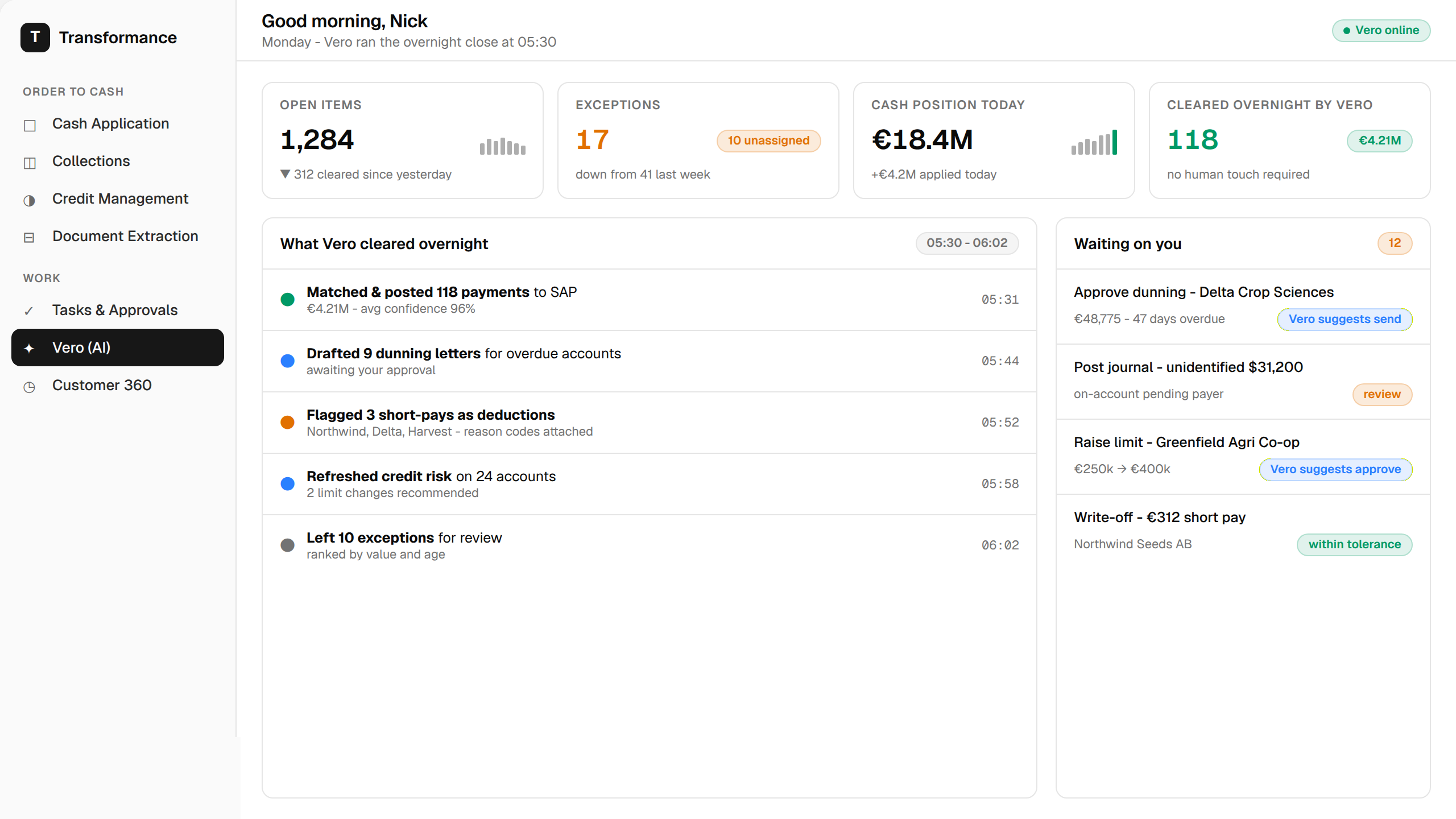
Cash Application
ClearMatch uses vision language models that read remittance documents without template configuration. VLMs understand documents the way a human reader would: reading layout, tables, and context together rather than extracting characters in isolation. The DocSense document engine achieves over 97% extraction accuracy across 100+ document types and 170+ languages. It handles new formats on first contact, without configuration. The platform delivers a 95% auto-match rate, with the persistent memory layer holding resolution patterns specific to each customer.
Deductions Management
Deductions are where revenue disappears quietly. According to Gartner, trade deductions represent 1-3% of gross revenue for large CPG and FMCG companies. Industry benchmarks put the invalid deduction rate at 5-10% of that total: amounts that should have been recovered but were written off because the investigation was too slow.
The bottleneck isn’t tracking deductions. It’s investigating them: cross-referencing each deduction memo against promotional agreements, delivery records, and pricing data across multiple systems. An analyst doing that manually processes 15-25 deductions per day.
ClaimIQ uses a graph-based investigation engine that traces connections across all relevant documents simultaneously: the deduction memo, the matching promotion, the delivery confirmation, and historical resolutions for that retailer. Tasks that take an analyst hours across six systems complete in seconds. About 40% of trade deductions resolve automatically via rules-based validation against promotional data. The remainder are investigated and either settled or packaged into a dispute, with the AR analyst reviewing rather than building from scratch.
For a deeper look at how deductions fit into the broader O2C cycle, see Deductions in Order to Cash: A Guide.
Collections
Manual collections teams cover 30-40% of overdue invoices in any given week. The rest sit untouched because collectors are busy or because the account value doesn’t justify prioritization.
CollectPulse actions 100% of overdue invoices within 24 hours of becoming overdue. The AI calling agent runs 15-20 calls per hour vs. 15-20 per day for a human collector, supports 70+ languages, and writes every outcome back to the system: promise-to-pay dates, dispute reasons, customer sentiment. Shared service centers can run Italian, French, and Spanish collections from a single location without native-speaker headcount.
For the full breakdown of AI use cases across the O2C cycle, see How AI Automates Order to Cash: 10 Use Cases.
What Are the Biggest Challenges in the O2C Process?
Understanding where O2C breaks down is the first step to fixing it.

Unstructured data volume. Remittance advices, deduction memos, and customer communications arrive in hundreds of formats from thousands of counterparties. No two are identical. AI-native approaches read them natively, without configuration per format.
Cross-functional ownership gaps. O2C spans sales, operations, finance, and IT. When an invoice dispute sits at the boundary between AR and trade marketing, it can age for weeks waiting for the right person. Automation that crosses those boundaries, and maintains a shared audit trail, is what breaks the impasse.
ERP blind spots. ERPs store structured transaction data well. They weren’t built to read messy documents, chase overdue accounts, or investigate deductions. The gap between what the ERP contains and what finance teams need to act on is where most O2C inefficiency lives.
Institutional knowledge loss. Every time an experienced AR analyst leaves, years of customer-specific knowledge leaves with them: which customers pay late in Q4, which retailers dispute every promotion over a certain threshold, which remittance formats need special handling. That knowledge rarely gets documented. When it does, it’s outdated within months.
How to Evaluate Order-to-Cash Automation Software
These six criteria are the ones worth testing before you buy.
- Document handling. Does it use vision language models or OCR plus regex? Ask how the platform handles a remittance format it has not seen before, and what maintenance a format change requires. Zero-template-configuration is a meaningful baseline.
- Match rate and trajectory. What’s the auto-match rate at go-live, and does it hold from day one? A flat 95% auto-match rate from go-live tells a different story than one that depends on a long ramp-up.
- Collections automation depth. Does it generate a worklist, or does it execute? A platform that only prioritizes is doing the easy part. AI calling agents, multilingual dunning, and promise-to-pay tracking are where real coverage improvements happen.
- Deductions investigation. Can it cross-reference deductions against promotional agreements and delivery records automatically, or does it just track and assign? Investigation automation is the actual bottleneck, not case management.
- ERP integration scope. Which ERPs does it connect to natively? Does it post journal entries with validation before they touch the GL, or does it require manual entry? Look for SAP, Oracle, NetSuite, and Microsoft Dynamics support with zero-error posting validation.
- Deployment timeline. Ask every vendor for reference customers and their actual go-live timelines. Longer timelines aren’t just slower; they delay ROI and increase project risk materially.
For a full evaluation framework, see Order-to-Cash Software: A Decision Guide for 2026.
Conclusion
Order-to-cash is the financial backbone of every company that sells on credit. The front half of the cycle, order management, fulfillment, and invoicing, is relatively well understood and increasingly automated. The back half, cash application, deductions, and collections, still runs on manual effort and institutional knowledge in most organizations. That’s where the working capital improvements and DSO reductions are waiting.

The gap between what’s possible and what most teams are doing has widened significantly. AI-native platforms now handle the full AR execution cycle: reading remittance documents without templates, investigating deductions across multiple systems simultaneously, and running collection calls autonomously in 70+ languages. The question isn’t whether to automate, but which architecture you’re building on.
Frequently Asked Questions
What is order-to-cash (O2C)?
Order-to-cash is the end-to-end business process that begins when a customer places an order and ends when payment is received, matched, and posted to the general ledger. It spans order management, credit review, fulfillment, invoicing, cash application, deductions resolution, and collections across sales, operations, and finance teams.
What is the difference between order-to-cash and invoice-to-cash?
Invoice-to-cash is a subset of order-to-cash. O2C starts from the sales order; invoice-to-cash starts from the point an invoice is issued. In practice, many AR automation tools focus on the invoice-to-cash portion because cash application, collections, and deductions carry the most manual effort and cash flow risk.
What does DSO mean in order-to-cash?
DSO stands for Days Sales Outstanding. It measures how long it takes, on average, to collect payment after a sale. It’s calculated as (Accounts Receivable divided by Total Credit Sales) multiplied by the number of days in the period. Lower DSO means faster cash collection and better working capital efficiency.
How long does O2C automation take to implement?
Implementation timelines vary significantly by platform. AI-native platforms with modern architecture deploy in 4-8 weeks, with first payments matched within days of go-live.
What KPIs should finance teams track for O2C performance?
The most important O2C KPIs are: DSO (Days Sales Outstanding), auto-match rate (percentage of payments matched without human intervention), exception rate (percentage of payments requiring manual review), deduction aging (how long deductions sit unresolved), collection coverage (percentage of overdue invoices actioned within 24 hours), and promise-to-pay fulfillment rate.
Can O2C automation work with SAP, Oracle, and NetSuite simultaneously?
Yes. Modern O2C automation platforms connect to major ERPs via native connectors. The more important question is what the platform does before it reaches the ERP: whether it reads unstructured remittance documents, investigates deductions, and validates journal entries before posting. ERP connectors are baseline; document intelligence and posting validation are the differentiators.
What is straight-through processing in O2C?
Straight-through processing (STP) means a payment is received, matched to an open invoice, validated, and posted to the ERP without any human intervention. High STP rates of 95%+ mean your AR team spends time on exceptions and high-value negotiations, not data entry. Reaching that level requires AI document understanding, not rules-based matching, because the volume and variety of unstructured inputs break deterministic approaches.
What share of B2B invoices are currently overdue?
According to recent industry data, over 50% of global B2B invoices are currently overdue. That figure reflects structural gaps in collections coverage: manual teams typically action 30-40% of overdue accounts in any given week, leaving the majority untouched until the next review cycle.
Sources:
- Order to Cash Process Explained: Steps, KPIs & Automation
- 13 Accounts Receivable Stats You Should Know in 2024