
Key Takeaways
- Only 3% of organizations have successfully scaled RPA, according to Deloitte. Deductions management is one of the hardest use cases to scale because formats and rules vary by retailer.
- RPA automates clicks, not decisions. It can pull data from a portal but can’t determine if a $14,000 trade deduction is valid by cross-referencing promotional agreements and proof of delivery.
- AI-native deductions platforms use vision language models and graph-based retrieval to investigate deductions across multiple systems simultaneously, replacing the manual cross-referencing that RPA can’t touch.
- CPG manufacturers lose an estimated 5-10% of trade deductions to invalid claims that go unrecovered. The investigation bottleneck, not the data entry, is the real problem.
- Switching from RPA to AI-native automation cuts resolution time from weeks to days and recovers revenue that script-based tools simply write off.
In This Article
- What Is Deductions Management RPA?
- Why Does RPA Fall Short for Deductions?
- How Much Revenue Are CPG Companies Losing?
- How Does AI Replace RPA for Deductions?
- How to Evaluate Deductions Automation Beyond RPA
- Real-World Scenario: RPA vs. AI on the Same Deduction
- Move Past RPA: Recover Revenue That Scripts Can’t Touch
- FAQ
What Is Deductions Management RPA?
Deductions management RPA is the application of robotic process automation to accounts receivable deduction workflows. RPA bots follow pre-programmed scripts to log into retailer portals, download backup documentation, enter data into ERP systems, and file disputes through web forms.
The approach gained traction around 2018-2022 when CPG finance teams needed relief from the most tedious parts of deductions processing. And for those specific, repetitive tasks, RPA delivered real value. Bots could log into Walmart’s Retail Link or Amazon Vendor Central faster than a human, pull deduction reports, and paste them into a tracking spreadsheet.
But that’s where the value stopped. RPA solved the data retrieval problem. It never touched the actual problem: figuring out which deductions are valid.
Why Does RPA Fall Short for Deductions?
The core issue is structural. RPA mimics human actions on a screen. It clicks buttons, copies fields, and fills forms. Deductions management requires judgment: reading unstructured documents, comparing them against promotional agreements, checking delivery records, and deciding whether to accept or dispute.
Here are 5 specific reasons RPA breaks down in deductions workflows:
- Format fragility. Every retailer sends deduction memos in a different format. When Kroger changes its portal layout or Target updates its deduction code structure, the RPA bot breaks. A 2024 Deloitte survey found that 63% of organizations said RPA implementation timelines exceeded expectations, largely due to ongoing maintenance from upstream system changes.
- No document understanding. RPA reads screen coordinates and field labels. It doesn’t understand what a deduction memo means. A PDF with a table showing three line-item deductions across two invoices? The bot needs a custom script for that exact layout. A vision language model reads it the way a human would, understanding the structure on first contact.
- Zero investigation capability. Determining whether a trade promotion deduction is valid requires cross-referencing the deduction against a promotional agreement, checking shipment dates, verifying quantities delivered, and reviewing prior resolutions for that retailer. RPA can’t do any of this. It can pull the document; it can’t analyze it.
- Scaling failures. Deloitte reports that only 3% of organizations have successfully scaled RPA across the enterprise. Each new retailer, each new deduction type, each portal update requires new scripts, new testing, and new maintenance cycles.
- No learning over time. RPA bots on Day 365 are exactly as capable as they were on Day 1. They don’t learn that Retailer X always miscodes Q3 promotions or that a specific distributor’s shortage claims are invalid 40% of the time. Every deduction is processed in isolation, with no institutional memory.
How Much Revenue Are CPG Companies Losing?
The numbers are significant. According to industry benchmarks, customer deductions can represent 5-20% of gross revenues in CPG, depending on the category and the trade promotion structure. Of those deductions, an estimated 5-10% are invalid but go unrecovered because the investigation and dispute process is too slow or too manual.
For a CPG company processing 5,000 deductions a year at an average value of $2,500, that’s $625,000 to $1.25 million in annual revenue leakage from invalid deductions alone. Most of that money isn’t lost because nobody noticed the deduction. It’s lost because nobody had time to investigate it properly before the dispute window closed.
RPA doesn’t fix this. It speeds up the data entry around the investigation, but the investigation itself, the actual bottleneck, still falls on a human analyst juggling six systems and a spreadsheet.
This is precisely the problem that AI-native claims automation is designed to solve: not faster clicking, but faster thinking.
How Does AI Replace RPA for Deductions?
AI-native deductions management works differently from RPA at every layer. Instead of scripting actions on a screen, AI understands documents, reasons about data, and investigates across systems.
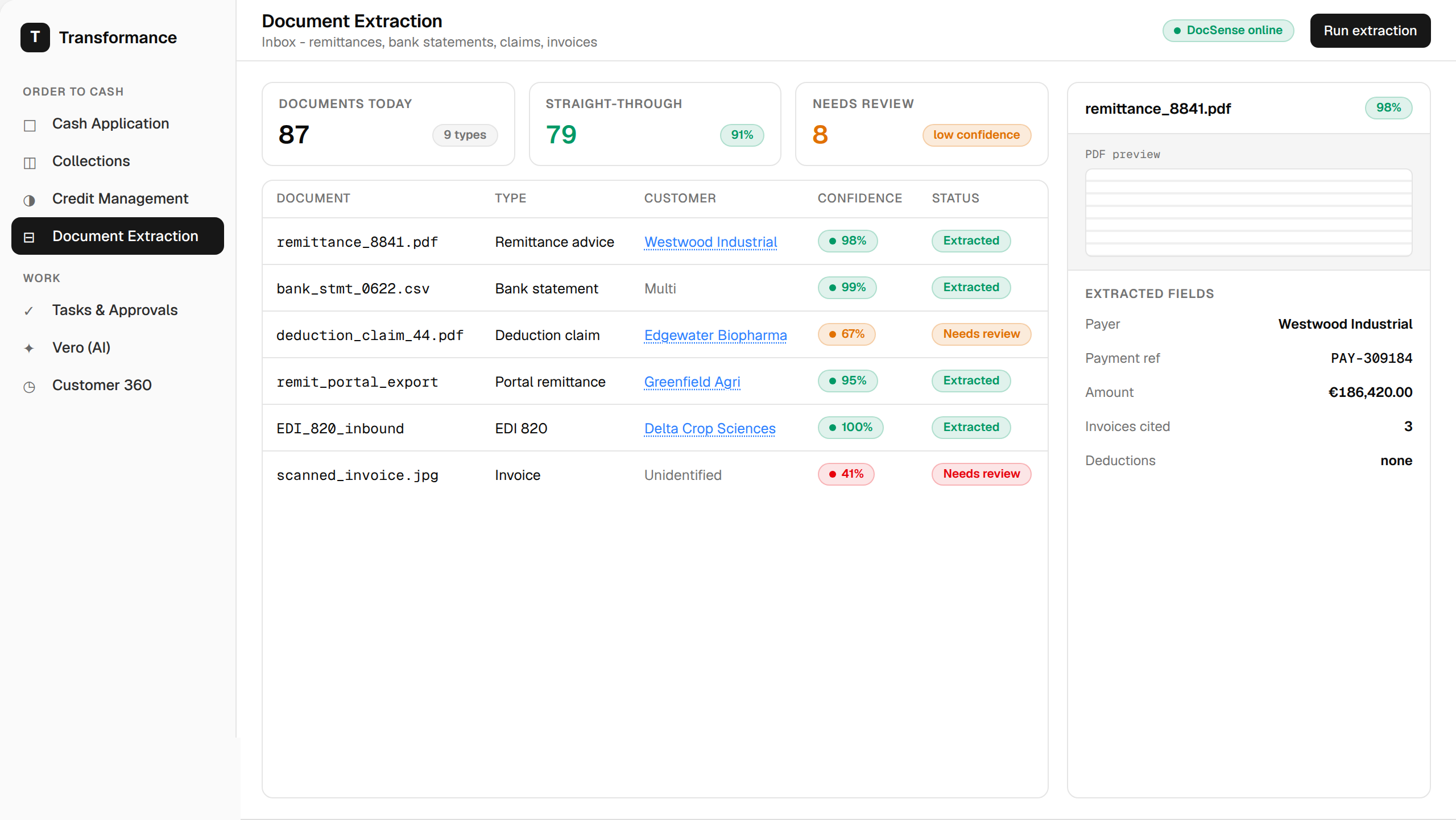

Document Understanding vs. Screen Scraping
Vision language models read deduction memos, remittance advices, and backup documentation the way an experienced analyst would. They understand tables, context, and relationships between fields. When a retailer changes their format, the model adapts without new scripts or template training.
Transformance’s ClaimIQ uses this approach to identify deductions with 97% accuracy across formats, including formats the system has never encountered before. No template configuration.
Cross-Document Investigation vs. Single-System Lookup
This is where the gap between RPA and AI becomes a chasm. RPA can pull a document from one system. AI investigates across all of them simultaneously.
Graph-based retrieval traces connections between deductions, promotional agreements, delivery records, and historical resolutions. Instead of an analyst spending 45 minutes checking six systems for a single deduction, the AI completes the same investigation in seconds, pulling the relevant promotion, verifying timing and amounts, and checking proof of delivery in parallel.
For trade deductions (typically over 50% of all deductions in CPG), rules-based validation auto-resolves roughly 40%. Pattern matching catches fuzzy cases. And for the complex remainder, the AI agent traverses a knowledge graph of related documents and past resolutions.
Persistent Memory vs. Processing in Isolation
RPA processes each deduction as if it’s the first one the company has ever seen. AI-native platforms accumulate institutional knowledge over time.
Transformance’s persistent memory layer remembers that “Retailer Y disputes everything over 10,000 euros,” that “this deduction code from this customer was invalid the last three times it appeared,” and that “Q4 promotional deductions from this distributor always require manual verification.” This memory compounds. Day 90 is measurably better than Day 1.
If you want to understand what deduction management software should actually do, that’s the benchmark: investigation, not just tracking.
How to Evaluate Deductions Automation Beyond RPA
If your team is considering moving past RPA (or evaluating automation for the first time), here are 6 criteria that separate modern AI-native platforms from legacy approaches:
- Document understanding method. Does the platform use vision language models that understand document layout and context? Or does it rely on OCR templates and regex rules that break on new formats?
- Investigation automation. Can the system cross-reference deductions against promotional agreements, pricing data, and delivery records automatically? Or does it just track and assign deductions for human investigation?
- Learning capability. Does the system improve over time as it processes more deductions from each retailer? Or is Day 365 identical to Day 1?
- ERP integration depth. Does the platform post resolutions back to SAP, Oracle, or NetSuite directly? Or does it stop at a spreadsheet export?
- Deployment timeline. How long until the platform processes live deductions? Ask vendors for deployment timelines in weeks, not months.
- Dispute automation. Can the system auto-generate dispute packages with investigation findings and supporting documentation? Or does your analyst still draft from scratch?
Transformance’s ClaimIQ automates the investigation layer using graph-based retrieval across documents.
Real-World Scenario: RPA vs. AI on the Same Deduction
Consider a $14,200 trade promotion deduction from a major grocery retailer. The deduction memo references a Q1 promotional program, cites three invoice numbers, and includes a code the retailer uses for “seasonal allowance.”

The RPA approach: A bot logs into the retailer portal, downloads the backup PDF, and enters the deduction amount, date, and code into the ERP. Total time saved: maybe 8 minutes of manual data entry. The deduction then sits in a queue until an analyst has time to pull the promotional agreement from the TPM system, check shipment records in the WMS, verify the three invoices in SAP, and compare the claimed amount against the contract terms. That investigation takes 30-60 minutes. If the analyst is handling 40+ deductions per day, this one might not get investigated before the dispute window closes.
The AI approach: The vision language model reads the deduction memo and extracts all relevant fields without a pre-built template. The graph-based investigation engine simultaneously pulls the matching Q1 promotional agreement, verifies shipment quantities against the three invoices, confirms the promotion was active during the shipment dates, and compares the claimed amount against the contract. The system finds a $2,100 discrepancy: the retailer claimed the promotion applied to all three invoices, but the agreement only covered two. An auto-generated dispute package with the promotional agreement, delivery records, and amount calculation is routed to the analyst for review and submission. Total analyst time: 3 minutes to review and approve.
That $2,100? Under RPA, it gets written off. Under AI, it gets recovered. Multiply that across thousands of deductions per month, and the impact on claims reconciliation ROI becomes substantial.
FAQ
What is deductions management RPA?
Deductions management RPA is the use of robotic process automation to handle repetitive tasks in the deductions workflow, such as logging into retailer portals, downloading backup documents, and entering deduction data into ERP systems. It automates manual clicks and data entry but cannot investigate whether deductions are valid or invalid.
Why is RPA not enough for deductions management?
RPA fails at deductions management because it can’t understand unstructured documents, cross-reference data across systems, or learn from past resolutions. It automates data retrieval but leaves the investigation bottleneck, which accounts for 70-80% of analyst time, completely untouched.
What is better than RPA for managing trade deductions?
AI-native platforms that combine vision language models for document understanding, graph-based retrieval for cross-document investigation, and persistent memory for continuous improvement. These systems automate the investigation itself, not just the data entry around it.
How much do invalid deductions cost CPG companies?
Industry benchmarks suggest 5-10% of trade deductions are invalid but often go unrecovered due to slow investigation processes and expired dispute windows. For mid-size CPG companies, this can represent $500,000 to $1.5 million in annual revenue leakage.
How does Transformance automate deductions management?
Transformance ClaimIQ automates the investigation and resolution steps of deductions management using graph-based retrieval and persistent memory.
How long does it take to replace RPA with AI for deductions?
AI-native platforms like Transformance deploy in 4-8 weeks with first deductions processed in days. This compares favorably to RPA implementations, where Deloitte found 63% of organizations reported timelines exceeding expectations. No template configuration is required for AI-native document understanding.
Can AI handle deductions from multiple retailers with different formats?
Yes. Vision language models understand document layout and context natively, so they read new retailer formats on first contact without template training. This is the fundamental advantage over both RPA (which needs scripts per portal) and OCR-based systems (which need templates per document format).
What should I look for in deduction management software?
Prioritize investigation automation over data entry automation. The platform should cross-reference deductions against promotional agreements and delivery records automatically, improve accuracy over time through machine learning, integrate directly with your ERP for posting, and generate dispute packages without manual drafting.
Move Past RPA: Recover Revenue That Scripts Can’t Touch
RPA solved a real problem in 2019. But the deductions challenge in 2026 isn’t about logging into portals faster. It’s about investigating thousands of deductions across dozens of retailers, recovering invalid claims before dispute windows close, and building institutional knowledge that makes your team smarter every quarter.
Transformance automates the full deductions workflow, from document ingestion through investigation to resolution and ERP posting, using AI that understands documents, reasons across systems, and remembers what it learns.