Before picking a tool, build the model. Our step-by-step guide How to Build a 13-Week Cash Flow Forecast (Free Template) walks through the 8-step methodology, the variance log, and the AR data quality issues that drive most forecast errors.
Key Takeaways
- A 13 week cash flow forecast gives finance teams granular, weekly visibility into liquidity over the next 90 days
- According to Gartner (2025), automated cash forecasting improves accuracy by up to 30% compared to spreadsheet-based methods
- The best tools in 2026 feed forecasts with live AR signals: matched payments, active disputes, and promise-to-pay commitments
- Implementation timelines range from days (for focused pilots) to several months for full enterprise rollouts
- Invoice-level prediction, not category-level averaging, is the key differentiator between modern and legacy forecasting platforms
In This Article
- Key Takeaways
- Why Do Most 13 Week Cash Flow Forecasts Miss the Mark?
- How We Evaluated These Tools
- The 7 Best 13 Week Cash Flow Forecast Tools
- How Does AI Improve 13 Week Cash Flow Forecast Accuracy?
- 5 Steps to Build an Accurate 13 Week Cash Flow Forecast
- Take Action: Choose the Right 13 Week Cash Flow Forecast Tool
What Is a 13 Week Cash Flow Forecast?
A 13 week cash flow forecast (also called a 13WCF or TWCF) is a short-term, rolling projection that tracks expected cash receipts and disbursements week by week over a 13-week window. It uses the direct method: actual cash in, actual cash out, no accrual adjustments. Finance leaders use it to spot liquidity gaps before they become crises, manage covenant compliance, time capital expenditures, and make informed decisions about credit lines and working capital.
Why Do Most 13 Week Cash Flow Forecasts Miss the Mark?
Most forecasts fail because they’re built on stale data. According to Gartner (2025), organizations using spreadsheet-based methods see forecast accuracy 30% lower than those using automated solutions. The root cause is structural: your forecast is only as good as the AR data feeding it.
A 2025 AFP Treasury Benchmarking Survey found that over 60% of treasury professionals cite cash or liquidity forecasting as the most challenging task they face. The difficulty isn’t the math. It’s the inputs.
Here’s what typically goes wrong:
- AR data is unprocessed. Remittances sit in email inboxes. Deductions haven’t been classified. The forecast treats all open invoices as “expected” when half are disputed or overdue.
- Manual updates create lag. By the time an analyst updates the spreadsheet on Monday, the cash position has already shifted.
- Category averages mask invoice-level variance. Forecasting “AR collections” as a single line hides the fact that your top 10 customers pay on wildly different schedules.
- No feedback loop. The forecast from Week 1 never gets reconciled against actuals in a way that improves Week 2’s predictions.
The tools below address these problems differently. Some focus on planning and scenario modeling. Others (like CashPulse from Transformance) solve the upstream data problem first, then forecast from cleaned, processed AR signals.
How We Evaluated These Tools
We assessed each platform against five criteria specific to 13 week cash flow forecasting:
- Forecast accuracy methodology. Does the tool use invoice-level prediction, ML models, or simple trend extrapolation?
- AR data integration depth. Can it pull live data from cash application, collections, and deductions workflows, or does it rely solely on ERP snapshots?
- Rolling forecast automation. Does the 13-week window auto-advance and recalculate, or does someone rebuild it manually each week?
- Scenario analysis. Can you run “what-if” simulations tied to specific actions (accelerating collections on overdue accounts, for example)?
- Implementation timeline and complexity. Weeks or months? Does it require dedicated IT resources?
The 7 Best 13 Week Cash Flow Forecast Tools
| Platform | Best Suited For | Standout Feature | Pricing |
|---|---|---|---|
| Transformance CashPulse | Mid-market & enterprise wanting net cash forecasts built from real AR and AP data | Forecasts net cash from real AR + AP data using granular, multi-horizon models (90-95% to 90 days) | Custom; ~20-30% under treasury suites |
| Anaplan | Global enterprises with sophisticated FP&A teams | Multi-dimensional modeling with deep what-if scenarios | High 6 to 7 figures/yr |
| Workday Adaptive Planning | Workday-first orgs with FP&A-led forecasting | Native Workday integration + powerful scenarios | USD 100-500K/yr per seat plan |
| Pigment | Mid-market collaborative FP&A teams replacing Excel | Real-time multi-user model editing | USD 60-250K/yr |
| Kyriba | Large enterprises with sophisticated treasury operations | Mature treasury suite incl. payments + FX + risk | Mid-high 6 figures/yr |
| Float | SMBs and startups on Xero/QuickBooks/FreeAgent | Quick setup via accounting-system integration | USD 50-200/mo |
| Centime | Mid-market wanting AP + AR + cash visibility in one tool | Combined working capital visibility | USD 30-100K/yr |
1. Transformance CashPulse: Best for Net Cash Forecasting From Real AR and AP Data
CashPulse is the cash forecasting module of the Transformance O2C platform. It forecasts net cash from your real AR and AP data using granular, multi-horizon models. The output is a single net cash position curve with confidence ranges, and accuracy that holds out to a full year for portfolios with FX exposure or long booking cycles.
Pros:
- Real net cash forecasting built from real AR and AP data, in one view. AR is predicted at the invoice level from each customer's payment behaviour. AP is projected from contracts, payroll, tax schedules, and committed purchase orders. The output is a true net cash curve, not an AR-only sliver.
- Long-horizon accuracy that holds. Traditional models lose signal beyond 30 days. CashPulse delivers 90 to 95% accuracy out to 90 days for most portfolios, and supports year-long horizons in a single run for businesses with longer cycles.
- Known future inputs feed the forecast directly. FX rates, commodity futures, holiday calendars, planned promotions, harvest schedules, and booking pipelines are core inputs the model uses, not bolt-ons. Most treasury and FP&A tools require pipeline rewrites to ingest a new external signal.
- Confidence ranges, not single numbers. Every forecast ships with a best-case, expected, and risk-adjusted view so the CFO can plan around uncertainty instead of a single number that's wrong by Tuesday.
- Per-entity, per-region modelling. A stable European subsidiary and a volatile LatAm one each get a forecast tuned to their own data, not a global average.
- Explainable by design. The system surfaces which factors moved each forecast, which is the bar finance teams need before putting an AI number into a board pack.
- Vero's persistent memory accumulates customer payment patterns, broken promises, and seasonal behaviours over time. Day 90 outperforms Day 1; Day 365 outperforms Day 90.
- Forecast plus action in one loop. When CashPulse flags a tight week, Vero can trigger collection escalation, AI calls, or dunning to change the outcome. Treasury and FP&A tools report; CashPulse closes the loop.
- Deploys in 4 to 8 weeks. Treasury suites typically take 6 to 12 months.
Cons:
- Built for enterprise complexity. Sub-$50M businesses with stable, predictable cash flows often don't need the depth.
- Highest differential value where behavioural variance matters (multi-entity B2B, FX exposure, commodity-driven booking cycles). Pure-subscription B2C with predictable monthly revenue sees less relative lift.
Best For: Mid-market and large enterprises (EUR 500M to EUR 25B+ revenue) that need a real net cash forecast across multiple entities, regions, and currencies, and want accuracy that compounds with every payment cycle. Especially strong for FMCG, manufacturing, MedTech, and chemicals with FX exposure or commodity-driven booking.
Pricing: Module-based pricing tied to entities, transaction volume, and AI usage. Typically 20 to 30% below treasury-suite pricing for the same use case. Pilots run on a slice of your real AR and AP data so you see accuracy before committing.

2. Anaplan: Best for Complex Multi-Scenario Planning
Anaplan is the enterprise CPM platform for complex, multi-dimensional financial modeling. Cash forecasting is one use case among many, with strong scenario-modeling depth that smaller tools can't match.
Pros:
- Industry-leading multi-dimensional modeling with what-if scenario depth.
- Strong fit for global enterprises with complex driver-based forecasting.
- Mature platform with extensive partner ecosystem and training resources.
Cons:
- Implementation is significant (6-12 months); typically requires dedicated Anaplan modelers.
- Cash forecasting is configuration-heavy — not out-of-the-box like dedicated forecasting tools.
- Pricing tied to model complexity and user count; can scale to seven figures.
Best For: Large enterprises (USD 1B+ revenue) with sophisticated FP&A teams and complex driver-based forecasting needs across the business.
Pricing: Custom enterprise pricing typically high six to seven figures annually depending on model complexity and seat count.

3. Workday Adaptive Planning: Best for Workday Ecosystem
Adaptive Planning (formerly Adaptive Insights) is an FP&A platform with cash flow forecasting as one capability among many. Strong native integration with Workday HR and financials makes it the obvious choice if Workday is your system of record.
Pros:
- Native integration with Workday HR and financials reduces data integration overhead.
- Powerful what-if scenarios and driver-based forecasting capabilities.
- Strong reporting and dashboarding for executive consumption.
Cons:
- Cash forecasting is a configuration on top of a planning platform — less out-of-the-box than dedicated cash forecasting tools.
- Requires FP&A modeling expertise to build and maintain accurate cash forecasts.
- AR-level prediction depends on whether AR data is loaded into the model in sufficient detail.
Best For: Large enterprises (USD 500M+ revenue) where FP&A owns cash forecasting and the organization is already running Workday for financials.
Pricing: Per-user subscription tied to seat count. Mid-to-large enterprise deployments typically USD 100,000 to USD 500,000 per year.

4. Pigment: Best for Collaborative FP&A Teams
Pigment is a newer-generation planning platform built for collaborative, real-time FP&A. Modern UI and connected modeling make it a strong fit for teams retiring spreadsheet-heavy processes.
Pros:
- Modern collaborative interface that finance teams can adopt without heavy IT support.
- Real-time multi-user editing of models — faster than legacy CPM tools for what-if work.
- Strong fit for high-growth companies replacing Excel-based FP&A.
Cons:
- Newer platform; smaller customer base and partner ecosystem than Anaplan or Adaptive.
- Cash forecasting is one use case among many — not purpose-built like CashPulse.
- Less mature in deep-enterprise procurement cycles.
Best For: Mid-market and high-growth companies (USD 100M to USD 1B revenue) with collaborative FP&A teams looking to retire Excel-based planning.
Pricing: Subscription pricing tied to user count and model complexity. Typically USD 60,000 to USD 250,000 per year.

5. Kyriba: Best for Treasury-Centric Organizations
Kyriba is the market-leading enterprise treasury suite covering cash management, payments, FX, risk, and forecasting. Cash forecasting is one module within a broader treasury platform.
Pros:
- Mature enterprise treasury suite with strong cash visibility, payment hub, and FX capabilities.
- Established Fortune 500 customer base with deep banking-connectivity coverage.
- Robust scenario modeling for FX risk and liquidity stress testing.
Cons:
- Cash forecasting is module-level inside a broader treasury suite.
- Implementation runs 6-12 months and total cost of ownership reflects that.
- Forecast accuracy depends on data quality from upstream sources (AR, AP); the platform is a forecaster, not an AR-execution layer.
Best For: Large enterprises (USD 1B+ revenue) with sophisticated treasury operations spanning multiple banks, currencies, and entities.
Pricing: Custom enterprise pricing typically running mid to high six figures annually plus implementation services.

6. Float: Best for SMBs and Startups
Float is a cash flow forecasting tool purpose-built for small businesses and startups. Direct integration with Xero, QuickBooks, and FreeAgent gives quick visibility without the overhead of enterprise tools.
Pros:
- Quick setup — typically live within hours via accounting-system integration.
- Modern, simple UI built for non-treasurer finance leads.
- Affordable pricing for the SMB segment.
Cons:
- Built for SMB scale; not suited for complex multi-entity, multi-currency enterprises.
- Forecast logic is simpler than enterprise tools — less depth on driver-based modeling.
- AR integration is via the accounting system, not invoice-level granularity.
Best For: Small businesses and startups (under USD 25M revenue) running Xero, QuickBooks, or FreeAgent that want lightweight cash flow visibility.
Pricing: Subscription pricing typically USD 50 to USD 200 per month depending on plan tier.
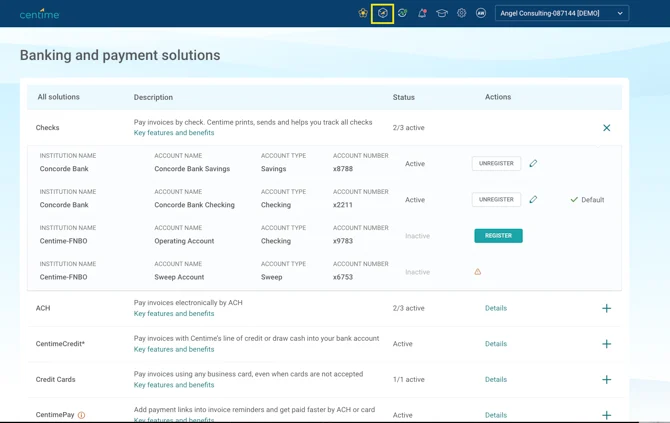
7. Centime: Best for Mid-Market AP and AR Visibility
Centime is a cash management platform combining AP, AR, and cash forecasting visibility for mid-market businesses. Targets companies that want one tool for working capital visibility without enterprise complexity.
Pros:
- Combined AP + AR + cash forecasting in one tool reduces vendor count for mid-market.
- Modern interface built for finance teams without dedicated systems administrators.
- Faster implementation than enterprise treasury suites.
Cons:
- AP and AR are visibility-focused, not deep automation.
- Forecast accuracy depends on data quality from connected accounting systems.
- Less suited for enterprises needing deep AR-execution or treasury-suite breadth.
Best For: Mid-market companies (USD 25M to USD 250M revenue) wanting integrated working capital visibility without enterprise overhead.
Pricing: Subscription pricing typically USD 30,000 to USD 100,000 per year depending on user count and module breadth.
How Does AI Improve 13 Week Cash Flow Forecast Accuracy?
AI improves forecast accuracy by predicting payment timing at the individual invoice level rather than averaging across categories. According to McKinsey, machine learning models can improve short-term cash forecast accuracy by 30-50%.
Here’s what that looks like in practice. A traditional 13 week cash flow forecast might estimate “AR collections” as a single weekly figure based on historical DSO. An AI-driven approach predicts when each open invoice will be paid, based on:
- Customer payment history. Customer A pays on Day 32 on average, but always delays in Q4. Customer B pays early when offered 2% discount terms.
- Current AR status. Three invoices from Customer C are in active dispute. Two have promise-to-pay dates logged from automated collection calls. One was just matched via remittance.
- Seasonal and behavioral patterns. The system has learned (through persistent memory, not manual rules) that this customer segment slows payments by 5 days in March.
The result is a forecast built on signals, not assumptions. A 2025 PYMNTS Intelligence report found that seven in 10 firms already use at least one AI tool to manage cash flow, and nearly one in three CFOs predict agentic AI will have a high impact on real-time forecasting.
For teams managing month-end close processes, this matters because the forecast becomes a living document that updates as cash application and collections data changes throughout the day.
5 Steps to Build an Accurate 13 Week Cash Flow Forecast
Whether you’re using a spreadsheet or an enterprise platform, these steps apply:
- Start with a reconciled cash balance. Your opening position must be verified against bank statements. Without this, every subsequent week is off.
- Map cash inflows at the most granular level possible. Ideally, invoice by invoice. At minimum, break AR collections into customer segments with distinct payment behaviors.
- Categorize disbursements by predictability. Payroll and rent are highly predictable. Vendor payments and tax obligations vary. Separate them so your variance analysis is meaningful.
- Automate the rolling window. The forecast should auto-advance each week, dropping the completed week and adding a new Week 13. Manual rebuilds introduce lag and errors.
- Reconcile forecast vs. actuals weekly. Compare what you predicted to what actually happened. Feed the variance back into your model. This is where AI tools (like CashPulse’s prediction engine) add the most value: they learn from every variance automatically.
Frequently Asked Questions
What is the best cash flow forecasting software for enterprises?
For most enterprises, the biggest forecast accuracy gap is stale AR data combined with point-estimate forecasts that don't account for uncertainty. Transformance CashPulse leads the category by forecasting net cash across both AR and AP from processed data (matched payments, active disputes, promise-to-pay dates), with confidence ranges and accuracy that holds to 90 days at 90 to 95%. Other tools fit different needs: Anaplan and Workday Adaptive Planning for broader FP&A planning, Kyriba for treasury-specific bank connectivity and cash pooling.
How do you build an accurate 13 week rolling cash forecast?
Start with a reconciled opening cash balance, then project weekly inflows and outflows using the direct method. Break AR collections into customer segments with distinct payment patterns rather than using a single DSO average. Automate the rolling window so Week 1 drops off and Week 14 appears each cycle. Reconcile forecast vs. actuals weekly and feed variances back into the model.
Why are most cash flow forecasts inaccurate?
The primary cause is stale or unprocessed AR data. According to Gartner (2025), data quality issues affect 70% of AI projects in finance. When remittances are sitting unmatched in an inbox and deductions haven’t been classified, the forecast treats disputed invoices as expected cash. The gap between “what the ERP says” and “what’s actually happening” is where accuracy dies.
What is invoice-level cash prediction?
Invoice-level cash prediction forecasts when each individual open invoice will be paid, rather than estimating total AR collections as a category average. It uses customer payment history, current dispute status, collection activity, and seasonal patterns to assign a probability and expected date to every open item. This produces significantly more accurate short-term forecasts than category-level approaches.
How does a 13 week cash flow forecast differ from a monthly forecast?
A 13-week forecast uses weekly time buckets and the direct method (actual cash receipts and disbursements), giving granular visibility into liquidity fluctuations within each month. Monthly forecasts typically use the indirect method (starting from net income with adjustments) and can miss intra-month cash gaps. The weekly granularity of a 13WCF is why it’s the standard for covenant compliance and short-term liquidity management.
What are the best alternatives to HighRadius for cash forecasting?
For enterprises that want a real net cash forecast across both AR and AP without 3-6 month implementation timelines, Transformance CashPulse forecasts from your real AR and AP data using granular, multi-horizon models and deploys in 4-8 weeks. Anaplan is the alternative for complex multi-scenario planning needs. Kyriba works best when treasury management (bank connectivity, payment automation) is the primary requirement rather than AR automation.
Take Action: Choose the Right 13 Week Cash Flow Forecast Tool
The right tool depends on where your forecast breaks. If the problem is upstream (messy AR data, unprocessed remittances, unclassified deductions), fix the inputs first. If the problem is modeling flexibility, invest in a planning platform. If it’s bank connectivity, look at a TMS.
For finance teams running SAP, Oracle, or Dynamics across multiple entities, Transformance CashPulse forecasts net cash from your real AR and AP data using granular, multi-horizon models. Accuracy holds to 90 days at 90 to 95%, with confidence ranges, year-long horizons supported, and known future inputs like FX rates and commodity futures feeding the forecast directly.