
Transformance approaches DSO reduction as a data problem first and a collections problem second: ClearMatch uses vision language models to match remittances the moment they arrive, and CollectPulse scores every overdue invoice by likelihood of payment so your team works the accounts that actually move the number. That order matters. Most finance teams try to fix DSO by working harder on collections while cash application still lags days behind, which means the DSO clock keeps running even after the customer has paid.
Key Takeaways
- DSO reduction comes from four levers: cash application speed, collections prioritization, dispute and deduction resolution, and credit policy. Reminder volume is not one of them.
- Slow or inaccurate cash application inflates DSO artificially: cash sits unapplied while the invoice still counts as outstanding.
- According to Ardent Partners (2023), best-in-class AR teams achieve straight-through cash application match rates above 85 percent, versus roughly 50 percent for typical teams.
- AI-driven collections prioritization (not more contact volume) is what shortens the days between “overdue” and “paid.”
- Transformance customers typically see DSO improve by 8 to 15 days within 90 days of deployment, driven by faster matching and full invoice coverage rather than headcount.
In This Article
- Key Takeaways
- Why Most DSO Reduction Efforts Stall
- What Actually Moves DSO? Four Levers That Matter
- How Does Faster Cash Application Shrink DSO?
- How Does Prioritized Collections Cut DSO Faster Than More Reminders?
- Why Disputes and Deductions Quietly Inflate DSO
- Where Credit Policy Fits into DSO Reduction
- Manual AR vs AI-Native AR: What’s the DSO Impact?
- Frequently Asked Questions
- Where to Start: A 90-Day DSO Reduction Plan
Why Most DSO Reduction Efforts Stall
Finance leaders under pressure to reduce days sales outstanding often reach for the most visible lever: send more reminders, add a collector, escalate faster. That approach treats DSO as a communication problem. It usually is not.
DSO is a measurement of the gap between when a customer’s invoice becomes payable and when your books reflect the cash. Every day that gap includes unmatched payments, unresolved deductions, or invoices nobody has prioritized, DSO stays inflated regardless of how many emails go out.
What Is DSO?
Days Sales Outstanding (DSO) measures the average number of days it takes a company to collect payment after a sale has been made, calculated as (accounts receivable divided by total credit sales) multiplied by the number of days in the period. A lower DSO means cash converts faster; a higher DSO ties up working capital in unpaid invoices.
According to a 2023 PwC working capital study, companies in the top quartile for DSO performance free up cash equivalent to roughly 3 to 5 percent of annual revenue compared to median performers. For a company with 500 million euros in revenue, that is 15 to 25 million euros sitting idle in receivables versus available for reinvestment.
What Actually Moves DSO? Four Levers That Matter
Reducing DSO reliably comes down to four levers, and they compound. Improving one without the others produces a smaller gain than fixing all four together.
- Cash application speed and accuracy. Every day a payment sits unmatched, the associated invoice still reads as open, even though the customer already paid.
- Collections prioritization. Working the highest-probability, highest-value overdue accounts first shortens the time between “overdue” and “resolved” more than working invoices in age order.
- Dispute and deduction resolution speed. Unresolved deductions and disputes are invoices that will never close on their own; they need active investigation, not another statement.
- Credit policy discipline. Terms, credit limits, and onboarding checks set the floor on how low DSO can realistically go before collections even starts.
Teams that fix cash application and collections prioritization first typically see results inside a single quarter, because those two levers touch the largest share of the AR ledger.
How Does Faster Cash Application Shrink DSO?
Cash application speed shrinks DSO by closing invoices the moment payment is confirmed, instead of leaving unmatched cash sitting in a suspense account for days or weeks. Every day of matching delay is a day of artificially inflated DSO, even though the customer already paid on time.
Template-based cash application relies on OCR plus regex rules, which need a template for every remittance format a customer sends. New format, new bank portal layout, new EDI structure: each one requires manual configuration, and until that configuration is done, those payments land in a manual matching queue.
Transformance’s ClearMatch product replaces that approach with vision language models that read a remittance the way a person would, understanding layout and context rather than pattern-matching characters. That means a new customer’s remittance format gets matched correctly on first contact, with no template build and no onboarding lag.
The result compounds over time. Deterministic rules resolve roughly 70 percent of matches automatically on day one; a three-layer matching engine (rules, ML pattern matching, and an AI agent working the remaining exceptions with memory of past resolutions) pushes match rates from around 85 percent at deployment to 95 percent or higher within 90 days. Every percentage point of match rate is invoices that close on the day cash arrives instead of days or weeks later. For a deeper walkthrough of how this works end to end, see Agentic AI for Cash Application: From Remittance to GL.
How Does Prioritized Collections Cut DSO Faster Than More Reminders?
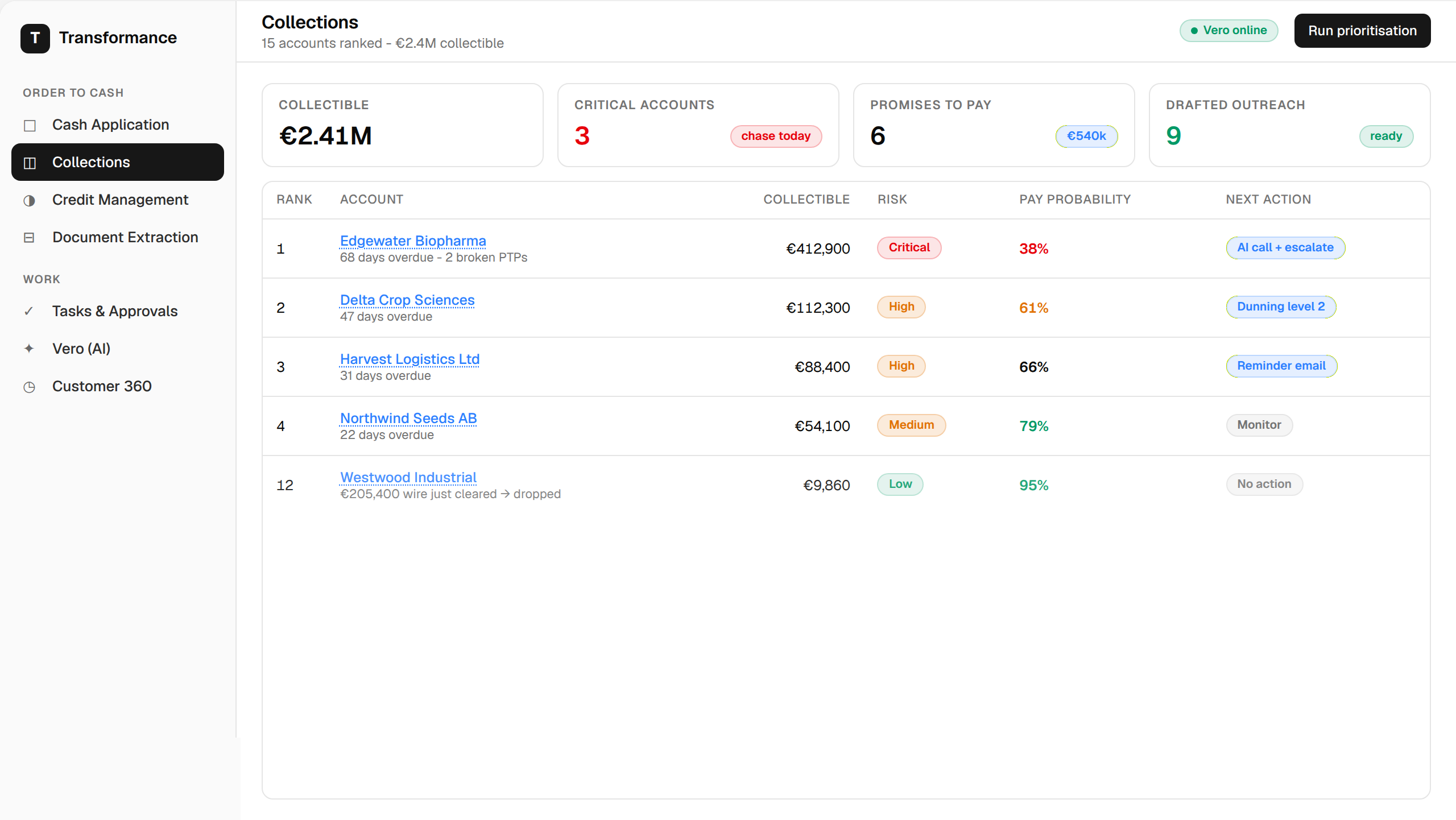
Prioritized collections cuts DSO faster than more reminders because it puts effort where payment is most likely and most valuable, instead of spreading contact volume evenly across every overdue account regardless of size or probability.
Most collections teams work invoices in age order or by whoever escalates loudest, which means a 2,000 euro invoice from a reliable payer and a 200,000 euro invoice from an account with a history of broken promises get the same treatment. That is a poor use of a finite team’s time.
According to a 2022 IOFM benchmarking report, manual collections teams typically cover only 30 to 40 percent of overdue invoices with meaningful follow-up in any given week; the rest simply age. That gap is where DSO accumulates.
CollectPulse addresses coverage and prioritization together. It scores every overdue invoice using rules (age, amount, terms), a machine learning model trained on the customer’s own payment history, and an AI agent (Vero) that layers in institutional memory, such as which accounts have broken past promise-to-pay commitments or which customers always pay late in a specific quarter. Every overdue invoice gets touched within 24 hours through automated dunning sequences, and an autonomous AI calling agent handles the first rounds of outreach in the customer’s own language, at a throughput of 15 to 20 calls per hour compared to 15 to 20 calls per day for a human collector working the phones manually.
The mechanism that lowers DSO is not more contact. It is faster identification of which accounts to prioritize and full coverage of the accounts that would otherwise sit untouched. That combination is also the foundation for accurate cash flow forecasting, which is covered in What Is Order-to-Cash and 10 AI Use Cases.
Why Disputes and Deductions Quietly Inflate DSO
Disputes and deductions inflate DSO because those invoices cannot close through collections alone; they require investigation against promotional agreements, pricing terms, or proof of delivery before anyone can determine what is actually owed.
A trade deduction that sits uninvestigated for six weeks is not a collections failure. It is a research bottleneck: someone needs to pull the promotional agreement, check delivery records, and verify pricing across systems that rarely talk to each other. Industry estimates from Ardent Partners suggest 5 to 10 percent of trade deductions are invalid, meaning that cash is recoverable but stuck behind a manual investigation.
This is where deductions and claims management becomes a DSO lever rather than a side process. Faster classification and investigation means valid claims settle sooner and invalid deductions get disputed and recovered instead of quietly written off. For background on how this category works, see What Is Deductions Management? and What Is Claims Reconciliation?.
Transformance’s ClaimIQ product uses a graph-based investigation engine that cross-references a deduction against promotions, pricing agreements, and delivery records at once, rather than an analyst checking each source one at a time across six or more systems. Deductions that would take hours to research manually get resolved in seconds, which keeps them from aging into stale DSO.
Where Credit Policy Fits into DSO Reduction
Credit policy sets the floor on how low DSO can go before collections and cash application even start working. Loose terms, inconsistent credit checks, or one-size-fits-all payment terms guarantee a higher DSO floor no matter how efficient downstream processes become.
According to a 2023 Deloitte CFO Signals survey, companies that segment credit terms by customer risk profile report meaningfully tighter DSO variance than companies applying blanket net-30 or net-60 terms across their customer base. Segmentation does not need to be complex: a handful of risk tiers tied to payment history and order volume is usually enough to see the effect.
Two practical adjustments carry most of the impact:
- Tie credit limits to observed payment behavior, not just initial credit checks, and revisit them at least annually.
- Flag customers with a pattern of broken promise-to-pay commitments for tighter terms or upfront deposits before the next order ships.
Credit policy is a slower lever than cash application or collections, because changes only affect new invoices going forward. It is still worth fixing in parallel, because it prevents the same DSO problems from regenerating every quarter.
Manual AR vs AI-Native AR: What’s the DSO Impact?
The gap between manual AR processes and an AI-native platform shows up directly in how fast DSO responds to a new deployment.
The consistent pattern is coverage. Template-based matching works on the formats it was configured for and falls back to manual work on anything new. An AI-native approach keeps coverage close to 100 percent as document formats, customers, and payment behavior change, which is what actually holds DSO down over time rather than producing a one-time dip.
Frequently Asked Questions
How long does it take to see DSO improvement after implementing AR automation?
Most finance teams see measurable DSO improvement within one quarter of deployment. Transformance customers typically see 8 to 15 days of DSO reduction within 90 days, driven by faster cash application matching and full collections coverage rather than added headcount.
What is a good DSO benchmark for my industry?
A good DSO benchmark depends on payment terms and industry, but Ardent Partners and IOFM benchmarking data generally place best-in-class DSO within 5 to 10 days of stated payment terms. If your average terms are net-30 and your DSO sits at 55 to 60 days, that gap points to matching and collections inefficiency rather than customer behavior alone.
Does reducing DSO always mean adding more collections staff?
No, and adding staff is often the wrong first move. Coverage and prioritization solve most of the DSO gap: an AI agent that touches 100 percent of overdue invoices within 24 hours and prioritizes by payment probability typically outperforms a larger team working invoices in age order.
How does cash application speed affect DSO if the customer already paid?
DSO only improves once a payment is matched and posted, not when the customer actually pays. A payment sitting unmatched for two weeks means that invoice still counts as outstanding in your AR aging, inflating DSO even though cash has technically arrived.
Can deductions and disputes really move the DSO number that much?
Yes, especially in CPG, manufacturing, and distribution, where trade deductions can represent 50 percent or more of total deductions. Ardent Partners estimates 5 to 10 percent of trade deductions are invalid, and every deduction sitting uninvestigated is an invoice that cannot close through collections alone.
Is DSO reduction mostly a technology problem or a policy problem?
It is both, but technology closes the larger and faster gap. Credit policy sets a floor on how low DSO can go, while cash application speed and collections prioritization determine how close you get to that floor month over month.
Where to Start: A 90-Day DSO Reduction Plan
DSO reduction that lasts comes from fixing matching and prioritization first, then layering in dispute resolution and credit policy discipline. Reminder volume alone will not move the number; faster, more accurate execution across the AR ledger will.
- Days 1 to 30: Fix cash application. Get payments matched the day they land so closed invoices stop inflating DSO, and clear the suspense-account backlog first.
- Days 31 to 60: Prioritize collections by risk. Work the accounts most likely to slip instead of an alphabetical worklist, and capture every promise-to-pay so follow-up is automatic.
- Days 61 to 90: Layer in dispute resolution and credit policy. Route deductions to investigation as they appear, then tighten terms and credit checks so the gains hold.
Most finance teams can see the first 8 to 15 days of DSO improvement within a single quarter once cash application speed and collections coverage are addressed together. If your team is ready to see what that looks like against your own AR data, it is worth a conversation with Transformance’s team about ClearMatch and CollectPulse.