
Running AR across 40 legal entities means a patchwork of bank statement formats, currencies, and intercompany relationships colliding in one cash application queue. Transformance handles this with vision language models that read remittances natively across formats, persistent institutional memory that learns each entity’s payment patterns independently, and a deployment window of 4 to 8 weeks.
Key Takeaways
- Multi-entity accounts receivable breaks down when cash application, dunning, and DSO reporting are built for a single company code, not dozens.
- Intercompany transactions create false positives in matching engines that were never trained to distinguish real customer payments from internal settlements.
- Bank format fragmentation (MT940, CAMT.053, BAI2, country-specific portals) multiplies the integration burden as entity count grows.
- Entity-level DSO rollups require separate models per entity, not a single blended average that hides underperforming subsidiaries.
- An AI-native AR layer applies AI agents and persistent memory per entity, so a 40-entity rollout doesn’t mean 40 separate configuration projects.
In This Article
- Key Takeaways
- What Is Multi-Entity Accounts Receivable?
- Why Does AR Get Harder Across 40 Legal Entities?
- How Do Shared Service Centers Handle Multi-Entity Cash Application?
- How Should Multi-Currency Dunning Work Across Entities?
- What Does Entity-Level DSO Rollup Look Like?
- How Do Company Codes in SAP Shape Multi-Entity AR?
- At a Glance: Multi-Entity AR with Transformance
- Conclusion
- Frequently Asked Questions
What Is Multi-Entity Accounts Receivable?
Multi-entity accounts receivable is the practice of managing invoicing, payment matching, collections, and reporting across multiple legal entities, company codes, or subsidiaries that share a parent organization but operate distinct customer bases, currencies, and often separate ERP instances or SAP company codes. It differs from single-entity AR because payment data, remittance formats, and dispute workflows don’t consolidate cleanly. What works for one entity’s matching logic frequently fails for another operating in a different country or currency.
For a company running SAP across 40 entities, this usually means 40 sets of open item ledgers, 40 sets of customer master data, and often 40 distinct bank relationships feeding cash into central treasury. Finance teams managing AR across many entities routinely see materially longer cycle times than single-entity peers, because every handoff multiplies by entity count.
Why Does AR Get Harder Across 40 Legal Entities?
AR complexity doesn’t scale linearly with entity count. It compounds, because every new entity adds its own bank formats, currency exposure, and intercompany relationships that a matching engine has to disambiguate from genuine third-party payments.
A shared service center supporting 40 entities often works with processes set up for a handful of company codes. Fixed rules that worked for entity 1 through entity 10 stop holding once entity 25 introduces a new remittance layout or a regional bank switches statement formats.
The Intercompany Noise Problem
Intercompany transactions are the single biggest source of false matches in multi-entity cash application. A payment moving between two subsidiaries of the same parent can look, on paper, identical to a real customer settlement: same currency, similar reference structure, comparable amount.
Without entity-specific logic, these payments are easily misrouted: an intercompany transfer gets posted as customer cash or, worse, a real customer payment gets flagged as intercompany and its application is delayed. ClearMatch distinguishes intercompany flows from genuine customer remittances using persistent, entity-specific matching context, so the system learns each entity’s intercompany patterns rather than applying one blanket rule across all 40.
How Do Shared Service Centers Handle Multi-Entity Cash Application?
Shared service centers (SSCs) centralize AR execution for multiple entities into one team, but the underlying matching and posting logic still has to respect each entity’s own open item ledger, currency, and bank relationships. Most SSCs staff by language or region, not by entity, which creates a mismatch between how the team is organized and how the ERP data is structured.
This is where document ingestion becomes the bottleneck. An SSC analyst in Warsaw might handle remittances for a German entity, a Spanish entity, and a Polish entity in the same shift, each arriving in a different format and language.
Transformance processes this using DocSense, its vision language model engine, which reads remittance advices natively without template configuration per format. The same underlying model handles a German CAMT.053 export and a Spanish bank portal download without a separate setup project for each.
Multi-Bank Formats: MT940 and CAMT.053
Bank statement formats vary by country and banking relationship, and a 40-entity organization typically ingests a mix of MT940 (still common across parts of Europe and Asia), CAMT.053 (the ISO 20022 XML statement standard, dominant across Europe and spreading globally), and BAI2 (used in North America). Each format encodes transaction references differently, which matters enormously for automated matching accuracy.
A treasury team consolidating statements from 15 different banks across 40 entities can’t rely on a single parser tuned to one format. An AI-native AR layer ingests MT940, CAMT.053, and BAI2 simultaneously and reconciles bank transactions against open AR items and remittance data at the same time, rather than processing the bank statement first and matching against remittances in a second, disconnected pass. That parallel processing matters at scale: it is the difference between a 2-day reconciliation lag and same-day visibility into cleared cash per entity.
For teams building out a broader order-to-cash automation strategy, this connects directly to what we cover in What is Order-to-Cash and 10 AI Use Cases, which walks through where AI agents fit across the full cycle, not just cash application.
How Should Multi-Currency Dunning Work Across Entities?
Multi-currency dunning should trigger collection sequences based on each entity’s local currency, credit terms, and customer behavior, not a single global escalation ladder applied uniformly. A dunning sequence tuned for a German entity’s 30-day terms will misfire against a Brazilian entity operating on 90-day terms with different payment culture and inflation-driven payment timing.
The mistake most organizations make is running one dunning cadence globally and translating the language, without adjusting the underlying escalation logic per entity. Inconsistent collections cadence across regions is one of the most commonly cited multi-entity pain points among treasury and receivables teams, and a direct barrier to accurate cash forecasting.
CollectPulse runs entity-specific dunning sequences with an autonomous AI calling agent that operates in 30+ languages, meaning a 3-person SSC team can run Italian, French, Portuguese, and Polish collections simultaneously across different entities without hiring native speakers for each. Promise-to-pay data captured per entity also feeds back into that entity’s own priority scoring, not a blended cross-entity average that dilutes signal.
What Does Entity-Level DSO Rollup Look Like?
Entity-level DSO rollup means calculating days sales outstanding separately for each legal entity and then aggregating those figures with weighting that reflects each entity’s revenue contribution, rather than reporting one blended DSO number for the whole organization. A single consolidated DSO figure across 40 entities can look healthy while masking two or three subsidiaries with DSO 20 or 30 days above target.
Consider a manufacturing group with 40 entities where the parent-level DSO reads 45 days, appearing within target. Entity-level breakdown reveals that three entities in Latin America are running DSO above 70 days, offset by a large European entity running at 32 days that drags the blended average down. Without per-entity visibility, the finance team never identifies which subsidiaries need collections intervention.
This is a direct extension of the reporting discipline covered in our accounts receivable process guide, which maps where entity-level visibility fits across the full cycle from invoicing to reporting.
How Do Company Codes in SAP Shape Multi-Entity AR?
Company codes in SAP define the legal and financial boundary for each entity’s open item ledger, meaning AR automation has to respect company code segregation for posting while still allowing cross-entity reporting and shared service execution. Getting this wrong either breaks statutory reporting per entity or forces the SSC to work inside 40 separate, disconnected screens.
The platform connects at the company code level within a single SAP instance (or across multiple SAP instances for organizations that haven’t consolidated their ERP landscape), applying automated validation rules that are configurable per entity: different GL account structures, different required fields, different approval thresholds by company code. Every journal entry preview shows pass/fail validation before a controller approves it, and nothing posts without human sign-off, regardless of which of the 40 entities it belongs to.
Deductions follow the same entity-bound logic. A trade deduction coded against a German entity’s promotional agreement has to be validated against that entity’s own contract terms, not a blended cross-entity assumption. For teams evaluating how deductions investigation scales across multiple entities, What Is Deductions Management? covers the underlying mechanics in more depth.
5 Key Criteria for Evaluating Multi-Entity AR Automation
- Per-entity matching logic. The platform should learn each entity’s payment patterns independently rather than applying a single global model across all entities.
- Native multi-format bank ingestion. MT940, CAMT.053, and BAI2 should process without separate integration projects per format.
- Intercompany detection. The matching engine needs explicit logic to separate intercompany settlements from genuine third-party customer payments.
- Company code-aware posting. Journal entry validation rules must respect each entity’s GL structure, approval thresholds, and statutory requirements.
- Entity-level reporting, not blended averages. DSO, aging, and cash forecasts need to break down by entity, currency, and region, not just roll up to one company-wide number.
At a Glance: Multi-Entity AR with Transformance
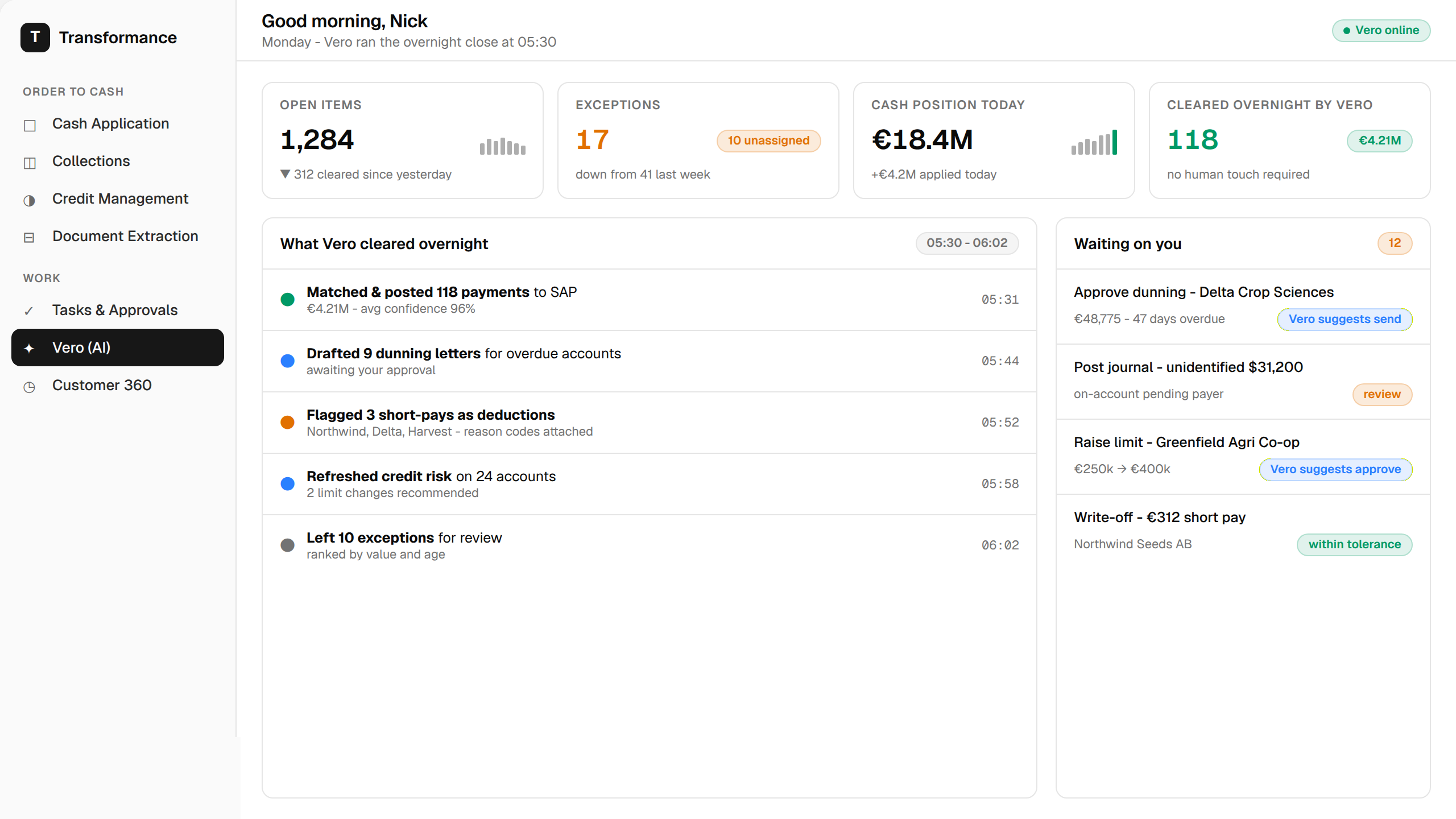
- Deployment. 4 to 8 weeks across entities, without a separate configuration project per entity.
- Document ingestion. Vision language models read remittances without a template per format.
- Cross-entity matching. Per-entity learning models, with intercompany traffic separated from customer payments.
- Collections coverage. Autonomous AI calling in 30+ languages, so each entity keeps its own cadence without native-speaker hires.
Conclusion
Multi-entity AR doesn’t fail because finance teams lack effort. It fails because the underlying matching, posting, and reporting logic was built for one entity and stretched across 40, with intercompany noise, format fragmentation, and blended metrics hiding the real picture. Transformance addresses this at the architecture level, with per-entity learning, native multi-format bank ingestion, and company code-aware posting that scales without a separate configuration project for every new entity.
Frequently Asked Questions
What is multi-entity accounts receivable?
Multi-entity accounts receivable is managing invoicing, cash application, collections, and DSO reporting across multiple legal entities or company codes that share a parent organization. Each entity typically has its own customer base, bank relationships, currency, and often distinct remittance formats, which prevents a single AR process from applying cleanly across all of them.
How many company codes can AI-native AR automation support?
There’s no hard technical ceiling, since matching and posting logic apply per company code rather than as one blended global process. The platform connects per company code, so a deployment can span dozens of entities within a single SAP instance, with automated validation rules configured per entity.
What is the difference between MT940 and CAMT.053?
MT940 is an older SWIFT-based bank statement format still widely used across Europe and Asia, while CAMT.053 is the newer ISO 20022 XML statement standard, dominant across Europe and spreading globally. Organizations with entities across both regions typically need to ingest both formats simultaneously, which is why native multi-format support matters more as entity count grows.
Why is intercompany matching difficult?
Without entity-specific logic, intercompany transfers are hard to distinguish from genuine customer payments, since both can carry similar reference structures and amounts. This causes false matches or unnecessary manual review, and it gets worse as entity count increases because the volume of intercompany activity scales with the number of entities.
How should DSO be reported across 40 entities?
DSO should be calculated per entity and then rolled up with revenue-weighted aggregation, not reported as a single blended company-wide figure. A blended DSO can mask entities running 20 to 30 days above target while a few high-performing entities pull the average down.
Can one shared service center manage collections across 40 entities in different languages?
Yes, provided the collections platform supports native-language execution rather than relying on staffed headcount per language. An autonomous AI calling agent that operates in 30+ languages lets a small SSC team run multilingual collections without hiring native speakers for every region.