
Group finance teams managing a dozen legal entities, three ERPs, and five currencies cannot get an accurate cash position from spreadsheets alone. Transformance’s CashPulse consolidates entity-level forecasts built from live accounts receivable data, matched payments, and collections activity into one group view, refreshed daily instead of monthly. That AR-driven, bottom-up approach is what separates a real consolidated forecast from a rolled-up guess.
Key Takeaways
- Multi-entity cash flow forecasting breaks down in spreadsheets because manual consolidation across entities, currencies, and ERPs cannot keep pace with change.
- An accurate group forecast starts bottom-up, built from AR data (matched payments, aging, promise-to-pay commitments) at each entity, then rolled into a group view.
- Intercompany flows need to be identified and eliminated before they inflate or distort group liquidity numbers.
- AI-native platforms update forecasts daily using live matching and collections data instead of stale monthly snapshots.
- Multi-currency consolidation requires consistent FX treatment and entity-level exposure visibility, not just a translated total at the bottom of a report.
In This Article
- Key Takeaways
- What Is Multi-Entity Cash Flow Forecasting?
- Why Do Spreadsheets Break Down for Group Liquidity Planning?
- How Does AR-Driven Forecasting Improve Accuracy at the Group Level?
- Consolidating Intercompany Flows and Multi-Currency Positions
- 6 Key Criteria for Evaluating a Multi-Entity Forecasting Platform
- How Transformance Builds a Consolidated Group Forecast
- Frequently Asked Questions
- Conclusion: A Forecast the Whole Group Can Trust
What Is Multi-Entity Cash Flow Forecasting?
Multi-entity cash flow forecasting is the process of consolidating cash inflow and outflow predictions from multiple legal entities, business units, or subsidiaries into a single group-level liquidity view. It accounts for different currencies, ERPs, banking structures, and intercompany transactions across the organization. Unlike a single-entity forecast, it requires eliminating internal transfers and normalizing currency exposure before the numbers mean anything at the group level.
This is standard practice for any organization operating as a group, or Konzern in German finance terminology, where treasury needs a consolidated liquidity picture to manage debt covenants, funding decisions, and cash pooling arrangements. Getting it wrong does not just produce a bad forecast. It produces bad borrowing decisions, missed intercompany funding opportunities, and covenant surprises.
Why Do Spreadsheets Break Down for Group Liquidity Planning?
Spreadsheets fail at group liquidity planning because they cannot process live data from multiple ERPs and currencies fast enough to stay accurate. By the time a treasury analyst has pulled exports from each entity, translated currencies, and eliminated intercompany balances, the forecast is already describing last week.
According to a 2023 PwC Global Treasury Survey, a majority of treasury teams still rely on spreadsheets to build cash forecasts, even in organizations with dozens of legal entities.
The mechanics compound the problem. Each entity’s finance team has its own template, its own definitions of “expected,” and its own cadence for updating figures. A German subsidiary might update weekly. A US subsidiary might update monthly. The group treasurer is left averaging inconsistent inputs and calling the result a forecast.
Three failure points show up consistently:
- Version control. Ten entities emailing spreadsheets to a central function guarantees someone is working from an outdated file by the time consolidation happens.
- Currency translation errors. Manual FX conversion at inconsistent rates (spot versus forward, month-end versus daily) introduces noise that compounds at the group level.
- No link to actual AR status. Spreadsheet forecasts are usually built on historical averages or AP/AR aging snapshots, not live matched payments, so they miss what is actually happening in collections this week.
How Does AR-Driven Forecasting Improve Accuracy at the Group Level?
AR-driven forecasting improves accuracy because it builds the group forecast from real, current receivables data instead of historical averages or static ERP exports. Each entity’s forecast reflects which invoices have been matched, which are in active collections, which carry promise-to-pay dates, and which are disputed.
This matters because order-to-cash data is the earliest, most reliable signal of when cash will actually land. A forecast built on bank balances and historical seasonality is describing the past. A forecast built on live AR status, including matched remittances and active dunning outcomes, is describing what is about to happen.
According to a 2024 AFP Liquidity Survey, fewer than half of finance leaders report high confidence in their 13-week cash forecast accuracy within a reasonable variance band. The gap is rarely a modeling problem. It is a data freshness problem: the inputs are stale before the forecast is built.
Transformance addresses this directly. CashPulse pulls prediction signals from ClearMatch (which invoices were matched today), CollectPulse (which promises to pay were made and kept), and ClaimIQ (which deductions are still open) at each entity, then rolls those signals into the group forecast automatically. The forecast is only as accurate as the data feeding it, and that data is current because it comes from processes running in real time, not a monthly close cycle.
Consolidating Intercompany Flows and Multi-Currency Positions
Consolidation is where most multi-entity forecasts actually break, even when each individual entity’s numbers are reasonably accurate. Two problems dominate: intercompany noise and currency inconsistency.
Eliminating Intercompany Noise
Intercompany transactions (loans, cash pooling sweeps, management fees, and internal trade) show up as both an inflow and an outflow somewhere in the group. If they are not identified and eliminated, they inflate the appearance of group liquidity without representing any real external cash movement.
A 2023 Deloitte CFO Signals survey found that improving visibility into intercompany positions remains a persistent priority for finance leaders at multi-entity organizations, particularly those running centralized treasury or in-house banking structures. Manual intercompany elimination typically happens at month-end during close, which means the daily or weekly cash forecast running in parallel is working with unreconciled numbers most of the time.
Handling Multi-Currency Exposure
A group forecast in a single reporting currency hides more than it reveals if it does not also show entity-level currency exposure. A treasurer needs to know not just the consolidated EUR total, but which entities are holding USD receivables against EUR obligations, and where FX risk is concentrated.
According to a 2023 McKinsey analysis on corporate treasury, organizations with real-time visibility into currency exposure by entity are better positioned to hedge efficiently rather than over-hedging at the group level out of caution. Consistent FX rate application (using a single source, updated daily, rather than each entity applying its own rate) is a basic but frequently overlooked fix.
6 Key Criteria for Evaluating a Multi-Entity Forecasting Platform
Not every forecasting tool built for a single business unit scales to a group. When evaluating a platform for multi-entity cash flow forecasting, apply these criteria:
- Native multi-entity architecture. The platform should support entity-level forecasts that roll up automatically, not a single-entity tool with manual multi-tab workarounds.
- Live AR data integration. Forecasts should be built on current matched payments, collections activity, and dispute status, not last month’s aging report.
- Automated intercompany elimination. The system should identify and net out intercompany flows before they hit the group total.
- Consistent multi-currency handling. FX rates should apply uniformly across entities with visibility into entity-level currency exposure, not just a translated grand total.
- ERP-agnostic connectivity. Most groups run more than one ERP after acquisitions or regional rollouts. The platform needs to ingest SAP, Oracle, NetSuite, and Microsoft Dynamics data without a separate integration project per system.
- Scenario modeling tied to real actions. The platform should let treasury model “what if we accelerate collections on the top 20 overdue accounts” and see the effect on the group forecast, not just adjust abstract growth-rate parameters.
Platforms that fail on any one of these criteria tend to produce a forecast that looks consolidated but is actually a set of loosely aligned entity reports with a sum at the bottom.
How Transformance Builds a Consolidated Group Forecast
CashPulse is built specifically to answer the multi-entity problem, not just aggregate single-entity outputs. It ingests live AR signals, matched payments from ClearMatch, promise-to-pay and collections outcomes from CollectPulse, and open deduction status from ClaimIQ, at each legal entity, then consolidates those signals into a group forecast with entity and currency filters.
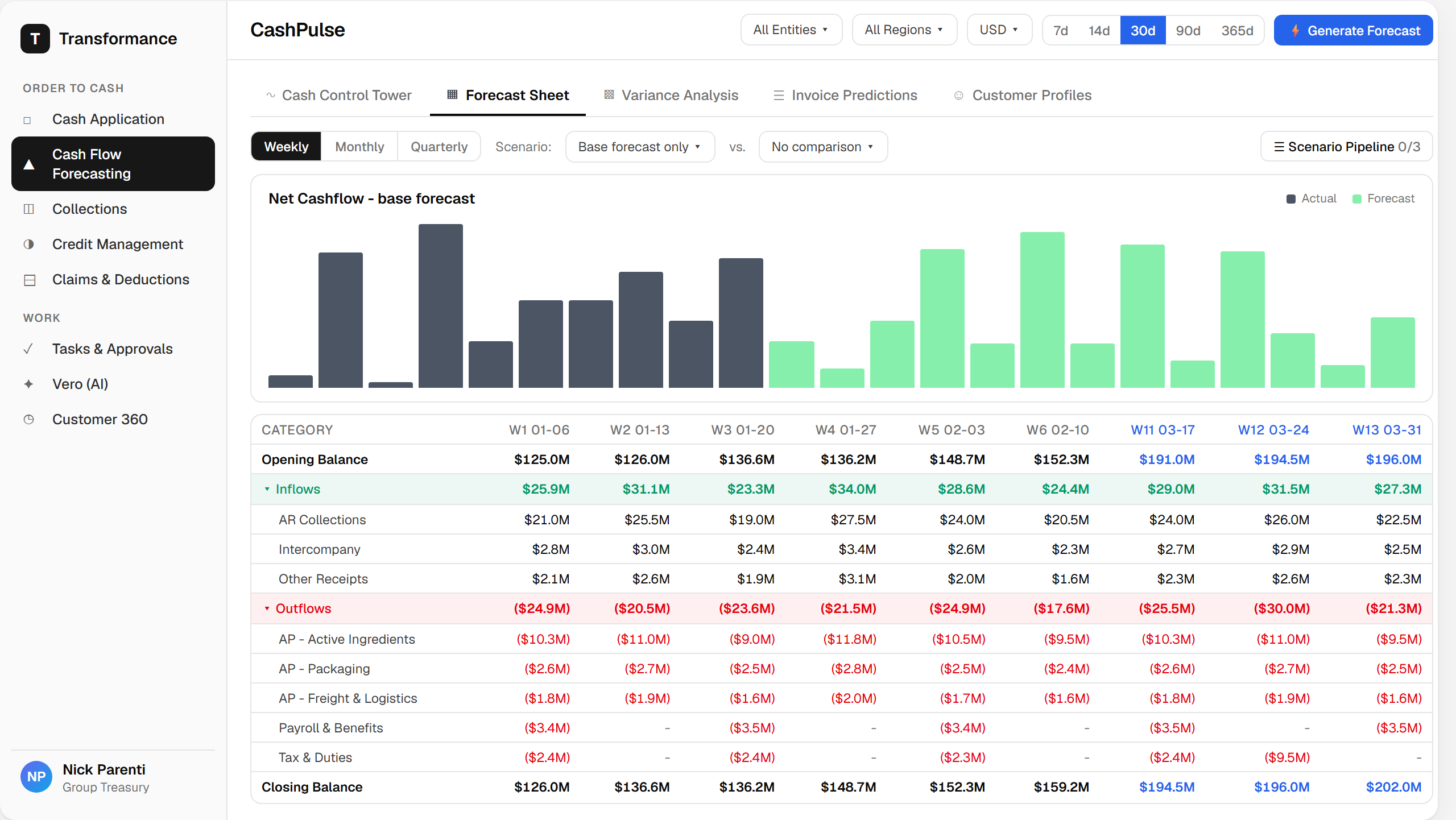
The Cash Control Tower dashboard shows opening cash position, 30-day expected inflow, cash at risk, and predicted DSO for the whole group, with the ability to drill into any single entity’s contribution. Scenario simulation is tied to actions treasury can actually take, such as pushing collections on specific overdue accounts, rather than abstract percentage adjustments.
This matters most for organizations already dealing with month-end close friction across entities. If close is slow and manual at the entity level, the forecast feeding off that data inherits the same lag. Transformance’s approach avoids that by pulling from operational AR processes running continuously, not the close cycle.
Deployment typically takes 4 to 8 weeks for full rollout across ERP integration, remittance capture, and entity onboarding.
Frequently Asked Questions
What is multi-entity cash flow forecasting?
Multi-entity cash flow forecasting is the process of consolidating cash predictions from multiple legal entities into one group liquidity view. It requires eliminating intercompany transactions and normalizing currencies so the group total reflects real external cash movement, not internal transfers.
How is a consolidated cash forecast different from a single-entity forecast?
A consolidated forecast combines multiple entities’ individual forecasts while removing intercompany noise and applying consistent currency treatment across the group. A single-entity forecast only needs to answer for one legal entity’s bank accounts and receivables, with none of the elimination or FX normalization work.
How do intercompany flows affect group liquidity planning?
Intercompany flows (loans, cash pooling, internal trade) appear as both inflows and outflows across the group and can distort the group total if not eliminated. A 2023 Deloitte CFO Signals survey found intercompany visibility remains a persistent challenge for multi-entity finance teams, particularly those managing in-house banking structures.
What is the best way to forecast cash flow across multiple currencies?
The best approach applies consistent FX rates across all entities, updated on a regular cadence, while preserving entity-level visibility into currency exposure. Translating everything into a single reporting currency without showing entity-level exposure hides where FX risk is actually concentrated.
How often should a multi-entity cash forecast be updated?
A multi-entity cash forecast should update daily if the underlying AR data (matched payments, collections outcomes) is available daily. Monthly or weekly updates, common with spreadsheet-based processes, leave treasury working with stale information for most of the forecast period.
Can AI improve cash flow forecasting accuracy for large groups?
Yes. AI-native platforms that build forecasts from live AR matching and collections data, rather than historical averages, produce more current and accurate group forecasts. According to a 2023 McKinsey analysis, AI-driven working capital tools can help large, multi-entity organizations surface meaningful trapped liquidity that manual processes miss.
Does multi-entity forecasting work across different ERPs?
It should, and the platform needs to be ERP-agnostic to make it work. Groups that have grown through acquisition often run SAP in one region, Oracle or NetSuite in another, and a forecasting platform limited to a single ERP instance cannot produce a true group view.
Conclusion: A Forecast the Whole Group Can Trust
Group liquidity planning fails when it is built on stale, manually consolidated data pulled from entities that update on different schedules in different currencies. An accurate multi-entity forecast has to start from live AR activity at each entity and consolidate up, with intercompany flows eliminated and currency exposure kept visible rather than buried in a translated total.
If your team is still stitching together entity spreadsheets to answer a basic question like “what is our group cash position this week,” it is worth comparing that process against an AR-driven, AI-native approach. A conversation with our team is a useful next step to see what a daily, consolidated group forecast could look like for your specific entity and currency structure. Book a Call with Transformance to walk through it.