
Transformance built ClearMatch around this shift: vision-language models read remittance data as it arrives, an AI agent resolves exceptions immediately instead of queuing them for the next batch run, and a persistent memory layer applies what it learned from yesterday’s payments to today’s. That architecture matters more every quarter, because SEPA Instant volume in the euro area keeps climbing and instant, irrevocable payments simply don’t wait for your nightly job to run. Finance teams still matching on a batch cycle are watching unapplied cash and blocked orders accumulate faster than their AR staff can clear them.
Key Takeaways
- SEPA Instant and other real-time rails settle payments in seconds, around the clock, and the transfers are irrevocable: there is no overnight window for “catch-up” matching.
- Batch cash application was built for a world where payments cleared once or twice a day; it structurally cannot keep pace with continuous, always-on inflows.
- Real-time cash application requires AI that reads remittance data on arrival, not on a schedule, plus persistent memory to resolve exceptions without a human re-investigating the same pattern every time.
- ISO 20022 gives real-time payments richer, structured remittance data, but only if your matching engine can parse it as fast as the payment clears.
- Unapplied cash and blocked shipments are the two most visible symptoms of a matching cadence mismatch; both compound daily until the underlying process changes.
In This Article
- Key Takeaways
- What Is Real-Time Cash Application?
- How Do SEPA Instant and Real-Time Payments Change AR Operations?
- Why Nightly Batch Matching Breaks Under Continuous Inbound Payments
- What Does Straight-Through Processing Require in a Real-Time Environment?
- How Does ISO 20022 Support Real-Time Remittance Matching?
- 5 Key Criteria for Evaluating Real-Time Cash Application Systems
- How Does AI Improve Real-Time Cash Application?
- Frequently Asked Questions
- Conclusion
What Is Real-Time Cash Application?
Real-time cash application is the process of matching a payment to its corresponding invoice or invoices within seconds or minutes of the payment settling, rather than at the end of a business day or overnight batch window. It applies to instant credit transfers like SEPA Instant, RTP in the United States, and similar domestic real-time rails now live in more than 70 countries. The defining trait isn’t speed alone: it’s that the payment and its remittance detail can arrive separately, out of order, and cannot be reversed once they clear.
That last point is what breaks most legacy AR software. Traditional cash application tools were designed around a daily or twice-daily batch: pull yesterday’s bank file, run it against open invoices, flag exceptions, repeat tomorrow. Under SEPA Instant, a payment can land at 2 a.m. on a Saturday. If your matching engine only runs at 6 a.m. on business days, that cash sits unapplied for up to 52 hours, and any order held on credit check stays blocked the entire time.
How Do SEPA Instant and Real-Time Payments Change AR Operations?
SEPA Instant settles euro payments in under 10 seconds, 24 hours a day, 365 days a year, and the EU’s Instant Payments Regulation (Regulation (EU) 2024/886) now requires payment service providers across the euro area to receive instant credit transfers at parity with standard transfer cost. That regulatory push is deliberate: the EU wants instant to become the default rail, not the exception.
For AR teams, three operational assumptions stop holding once instant becomes the default:
- Payments no longer cluster around a bank cutoff time. They arrive continuously, which means your open invoice queue changes state continuously too.
- Remittance advice frequently arrives separately from the payment, sometimes minutes later by email, sometimes not at all, which means matching logic has to tolerate a gap without blocking the credit release.
- There is no reversal window. A misapplied instant payment can’t quietly get corrected in tomorrow’s batch the way an ACH or wire sometimes can; the correction has to happen through a manual adjustment after the fact, which is slower and more visible to the customer.
According to Deloitte’s 2024 global treasury benchmarking research, real-time payment reconciliation ranked as one of the top three operational gaps treasury and AR teams reported, ahead of FX exposure management for many mid-market respondents. That tracks with what we hear directly from finance teams moving to instant rails: the payment side of the house modernized years before the matching side did.
Why Nightly Batch Matching Breaks Under Continuous Inbound Payments
Batch matching assumes a predictable rhythm: a finite set of transactions, processed on a schedule, reconciled by a human before the next cycle starts. Instant payments remove the “finite” and the “schedule” at the same time.
Consider a mid-size distributor processing 400 SEPA Instant payments a day instead of one daily ACH file. Under batch logic, all 400 wait for the 6 p.m. run. Under real-time logic, they should be matched within minutes of arrival, all day, including weekends. The gap between those two models isn’t a minor inefficiency: it’s the difference between a customer’s next order shipping today or getting held for three days on a credit block that a payment already cleared.
Ardent Partners’ AR benchmarking work has consistently found that best-in-class AR teams apply cash within roughly 24 hours, while typical teams average three to five days when matching runs on a fixed batch cycle. Instant payments widen that gap further, because the “typical team” clock doesn’t speed up just because the bank’s does. Unapplied cash then sits as a liability on both sides: it inflates AR aging artificially, and it overstates what the customer still appears to owe.
What Does Straight-Through Processing Require in a Real-Time Environment?
Straight-through processing (STP) in cash application means a payment is matched, validated, and posted to the ERP without manual touch. In a real-time environment, STP requires the matching engine to run continuously, not on a schedule, and to handle incomplete remittance data without stalling the whole payment.
Getting there takes four things working together:
- Continuous ingestion, not scheduled pulls. The system needs to process bank feeds and remittance channels (email, EDI, portals) as events arrive, not as a nightly file.
- Document understanding that doesn’t depend on a fixed template. Instant payment remittances arrive in whatever format the customer’s bank or ERP generates, and a new format shouldn’t stall the queue while someone builds a parsing rule.
- Tolerance for split and delayed remittance. The system has to hold a payment in a resolvable state, not an exception dead-end, when the advice arrives after the cash.
- Institutional memory of the customer. A payment that’s 2% short because of a standing early-payment discount shouldn’t trigger the same investigation every single time it recurs.
This is the specific gap Transformance built ClearMatch to close. Instead of OCR and regex rules that need a template built for every new remittance layout, ClearMatch uses vision-language models (DocSense) that read the document’s structure and content directly, achieving high accuracy on structured remittance data without per-layout configuration. Because it retains that resolution history, the system remembers that a given customer’s instant payments consistently arrive 3% short for a documented rebate, so it resolves the match instead of routing it to a human queue every time.
How Does ISO 20022 Support Real-Time Remittance Matching?
ISO 20022 is the structured messaging standard now underpinning SEPA Instant and most modern real-time payment rails, and it carries far more structured remittance detail than legacy MT-format messages did. That richer data helps automated matching, but only if the receiving system can actually parse the structured fields the moment the message arrives.
The catch is that structured data doesn’t guarantee straight-through matching on its own. A payment message can carry a perfectly formatted ISO 20022 remittance reference and still fail to match if the payer’s ERP truncated the invoice number, split one payment across twelve invoices, or referenced a purchase order instead of an invoice number. According to McKinsey’s 2023 payments research, European instant payment volumes are projected to grow more than 20-fold by 2027 as SEPA Instant adoption becomes near-universal, which means the volume of exactly these messy edge cases is about to scale up right alongside the clean ones.
This is also where fuzzy, semantic matching earns its keep. Transformance’s ClearMatch pairs deterministic ISO 20022 field matching with multimodal embeddings that catch abbreviated references, truncated invoice numbers, and non-standard formatting that exact-match logic misses. That layered approach is described in more depth in Agentic AI for Cash Application: From Remittance to GL, which walks through how the five-layer matching model handles the roughly 5% of cases that break pure rules-based logic.
5 Key Criteria for Evaluating Real-Time Cash Application Systems
If you’re assessing whether your current AR stack can handle real-time inbound payments, run it against these five criteria before the volume forces the question:
- Ingestion frequency. Does the system process payments and remittance as events, continuously, or does it still run on a fixed schedule (hourly, nightly, twice-daily)?
- Document format flexibility. Can it read a new remittance layout on first contact, or does a new customer or bank format require a configuration project?
- Partial and split remittance handling. Does the system hold an unmatched instant payment in a resolvable, visible state, or does it dump it into a generic exception bucket with no context?
- Institutional memory. Does the system get faster and more accurate for a given customer over time, or does every recurring pattern get re-investigated from scratch?
- Posting controls that don’t slow the cycle. Can validated matches post to the ERP automatically with audit-ready controls, or does every posting require a manual review step that reintroduces the batch delay you were trying to eliminate?
Most legacy platforms fail on at least two of these, usually ingestion frequency and format flexibility, because they were architected before instant payments existed as a mainstream rail. That’s less a criticism of any single vendor and more a structural consequence of building on OCR-plus-rules engines that were state of the art a decade ago.
How Does AI Improve Real-Time Cash Application?
AI improves real-time cash application by matching payments as they arrive using document understanding models instead of scheduled batch rules, and by learning customer-specific payment patterns so recurring exceptions resolve automatically instead of repeating. That combination is what closes the gap between when cash settles and when it’s actually applied.
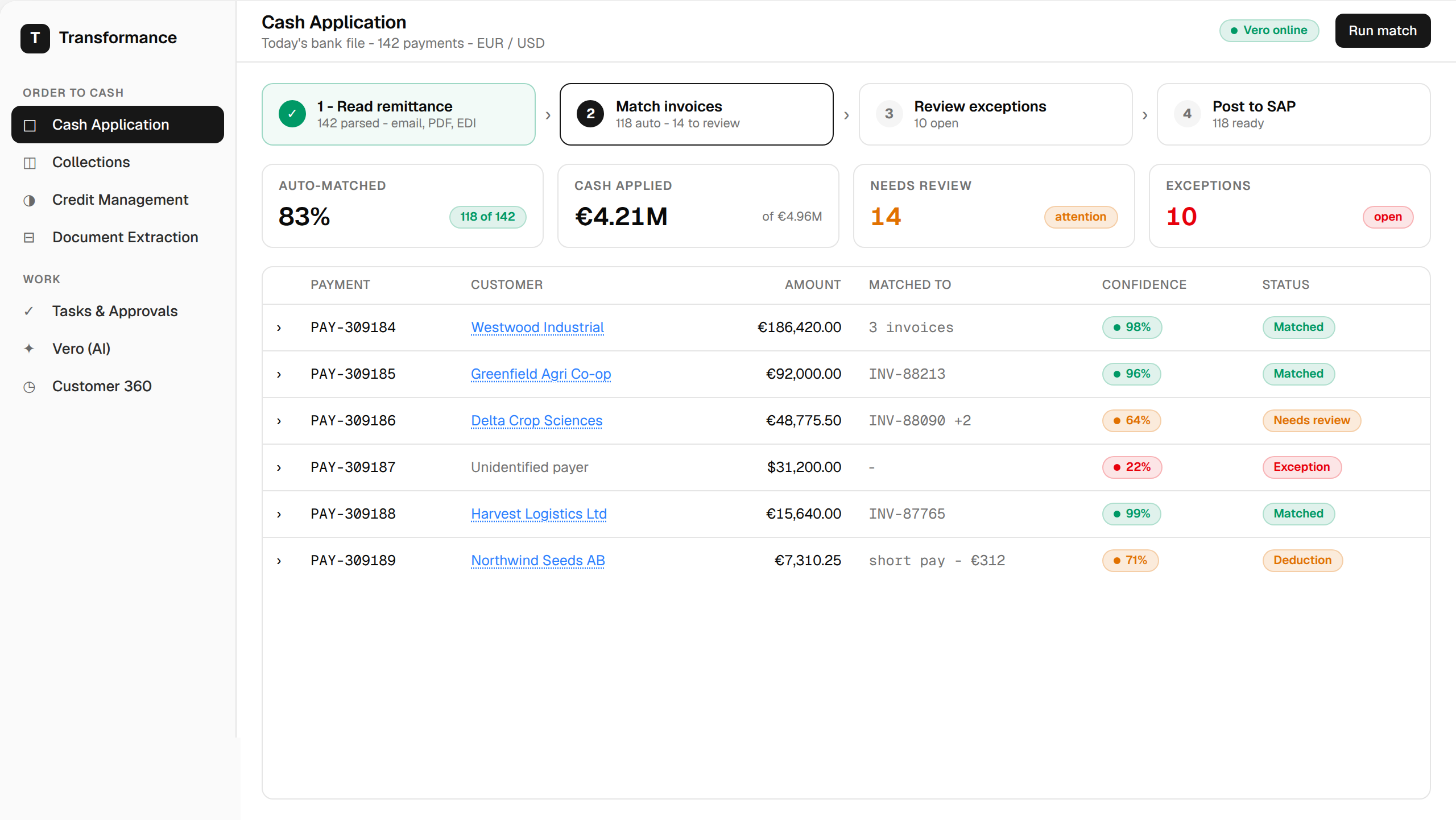
In practice, this looks like Vero running continuous cash application sweeps instead of a single overnight job, surfacing only the handful of genuinely new exceptions each morning: “38 of 41 instant payments matched automatically overnight; here are the 3 that need your input.” Teams running this model typically see high match rates at deployment that keep climbing over the following weeks, as the system accumulates resolution history for each customer’s specific payment quirks.
The upstream discipline matters too. If your team is still fielding invoices in inconsistent formats before they ever reach the payment stage, that’s worth fixing in parallel; see What is Order-to-Cash and 10 AI Use Cases for where cash application sits in the broader chain, and Why Your Month-End Close Still Breaks, And How to Fix It for how unapplied cash compounds into close delays if it isn’t resolved daily.
Frequently Asked Questions
What is real-time cash application?
Real-time cash application matches a payment to its invoice within seconds or minutes of the payment settling, instead of on a scheduled batch cycle. It’s required for rails like SEPA Instant, where payments clear continuously, 24/7, and can’t be reversed once matched incorrectly.
How is real-time cash application different from batch cash application?
Batch cash application processes all payments received in a fixed window (typically once or twice a day) in a single run. Real-time cash application processes each payment as an individual event the moment it arrives, which is the only way to keep pace with instant, irrevocable rails.
What is SEPA Instant and why does it matter for cash application?
SEPA Instant is the euro-area scheme that settles credit transfers in under 10 seconds, any time, any day. It matters for cash application because the EU’s Instant Payments Regulation is pushing adoption toward becoming the default euro payment method, which means AR teams on batch cycles will see a growing share of their cash sit unapplied between runs.
Can AI match payments in real time without human review?
Yes, for the large majority of payments, though full straight-through processing still routes genuine exceptions to a human for approval. Systems like ClearMatch resolve roughly 85% of payments automatically at deployment, rising past 95% within 90 days, while keeping a human in the loop for anything unusual or for final posting sign-off.
Does real-time cash application require ISO 20022?
No, but ISO 20022 makes it considerably easier because it carries richer, structured remittance data than legacy message formats. Even without ISO 20022, AI-based matching that reads unstructured remittance documents directly can still achieve real-time matching; it just has more raw text to interpret rather than clean structured fields.
What happens to deductions and short payments in a real-time environment?
Short payments and deductions still need investigation, but that investigation shouldn’t hold up the cash application step itself. Matching the payment to the invoice in real time and flagging the shortfall as a separate deduction workflow, rather than freezing the whole payment as an exception, keeps cash moving while the deduction gets resolved on its own track.
Do I need to replace my entire AR system to support real-time cash application?
Not necessarily. In most cases, the matching and document-ingestion layer is what needs to change, since that’s the piece running on a batch schedule; ERP posting and downstream reporting can often stay as they are, connected through existing integrations.
Conclusion
Instant payments changed the input side of cash application: money now arrives continuously, irrevocably, and often without its remittance detail attached. Matching that runs on a batch schedule was never built for that reality, and the gap shows up as unapplied cash, blocked orders, and analysts chasing remittances that should have matched themselves hours earlier.
Closing that gap takes AI that reads documents as they arrive, matches continuously instead of on a schedule, and remembers each customer’s payment patterns well enough that the same exception doesn’t need investigating twice. If your team is watching unapplied cash grow as instant payment volume climbs, it’s worth talking through what a real-time matching model would look like for your AR operation. Book a Call with Transformance to see how ClearMatch handles it.