


Key Takeaways
- German courts registered 24,064 company insolvency filings in 2025, and filings rose another 6.9% from January to July 2026 (Destatis, 2026).
- 40.5% of German Mittelstand firms in credit talks found their bank restrictive in Q2 2026, a record since the survey began in 2017 (KfW Research and ifo, 2026).
- German companies with revenue under EUR 50 million held EUR 214.7 billion in trade receivables in 2023, about 31 days of revenue by our calculation (Deutsche Bundesbank, 2025).
- CollectPulse from Transformance actions 100% of overdue invoices within 24 hours, against 30-40% for manual teams (Transformance customer data, 2026).
In This Article
- Key Takeaways
- How bad are late payments and insolvencies in Germany in 2026?
- Why does late payment hit the Mittelstand harder?
- Why do business customers pay late?
- What should Mittelstand finance teams change in 2026?
- How far has AI reached German finance teams?
- What does an AI agent like Vero change in receivables management?
- Example: three overdue customers on a Monday
How bad are late payments and insolvencies in Germany in 2026?
German company insolvency filings reached 24,064 in 2025, the most since 2014, and rose another 6.9% in the first seven months of 2026, according to Destatis.
Filings in 2025 were up 10.3%, after two years of growth above 20% each (Destatis, 2026). From January to July 2026 another 15,185 followed. Transport and warehousing was hit hardest, with 85.5 cases per 10,000 companies (Destatis, 2026). Destatis counts a filing only after the court’s first decision, often about three months after the filing, so your open items show the weakness first.
In the Atradius Payment Practices Barometer, 87% of companies in Germany report late B2B payments, against 77% across Western Europe; 52% expect insolvency risk to stay high over the next 12 months, 34% to rise further (Atradius, 2026). The 210 respondents, surveyed in spring 2026, are mostly micro businesses: a direction for the Mittelstand, not a measurement.
Why does late payment hit the Mittelstand harder?
Mittelstand suppliers finance their customers on payment terms, while 40.5% of Mittelstand firms in credit talks found banks restrictive in Q2 2026, a survey record (KfW Research and ifo).
The share rose 6.5 percentage points in one quarter; for large companies it was 32.9% (KfW Research, 2026). The survey counts only companies that negotiated with a bank in the previous three months and defines the Mittelstand as up to 500 employees and EUR 50 million in revenue.
Atradius calls supplier credit the main substitute for bank loans in Germany, so a supplier selling on trade credit terms finances part of its customers’ liquidity.
The Deutsche Bundesbank shows the amounts: companies with revenue under EUR 50 million held EUR 214.7 billion in trade receivables in 2023, on revenue of EUR 2,490.9 billion (Deutsche Bundesbank, 2025).
Our calculation divides annual revenue by 365, which gives about EUR 6.8 billion per revenue day, and expresses receivables in those days: about 31 days, against about 21 days for companies with EUR 50 million revenue or more. It is approximate, because receivables include VAT and revenue does not. Still, if their customers paid one day sooner on average, roughly EUR 6.8 billion would leave receivables; the metric is DSO.
Many family-owned companies that call themselves Mittelstand are above EUR 50 million in revenue; for them the 21-day figure applies.
Why do business customers pay late?
Companies in Germany most often name customer liquidity (50%) and internal approval delays at the customer (33%) as reasons for late payment, Atradius found in 2026.
Banking delays (28%) and a complex payment process (18%) follow, with multiple answers allowed (Atradius, 2026). For receivables, that is two different problems.
The customer cannot pay. Another reminder will not help; a credit decision will: a payment plan, a lower credit limit, shipping only against prepayment. A person who knows the whole relationship makes it.
The invoice is stuck in the customer’s process. The approval is missing, the PO number is wrong, the contact has changed, a dispute is open. What helps is the right document with the right person, the same day.
Sending both the same age-sorted reminder escalates the loyal customer and gives the one in trouble a reminder instead of a credit decision. Your payment history usually shows which case it is.
What should Mittelstand finance teams change in 2026?
Mittelstand finance teams should act on every overdue invoice on day one, record the cause of each delay and base credit decisions on their own payment history.
- Act on every overdue invoice within 24 hours, small ones included. Chase only large items and you see a change in behaviour once it is expensive. For the order of work, see how to prioritise collections with AI.
- Record the cause next to the dunning level. Approval, dispute, payment rhythm, liquidity: after a quarter you know how much overdue cash is blocked by process and how much by credit quality.
- Treat changes in behaviour as early signals. Broken promises, partial payments and new contacts show in your open items before a customer reaches the insolvency statistics; see how AI tracks promise to pay.
- Resolve disputes fast. An open dispute makes a customer who can pay look like one who cannot; see AI dispute management.
- Feed the forecast from open items. A promise for Friday or a new dispute moves expected cash, and the cash flow forecast should know the same day.
How far has AI reached German finance teams?
57% of German companies with 20 or more employees use AI in 2026, and use in controlling and accounting rose from 17% to 25%, according to Bitkom.
A year earlier the overall share was 36% (survey of 603 companies, Bitkom, 2026). Of companies that use, plan or discuss AI, 11% already run AI agents and 29% plan to. Bitkom president Ralf Wintergerst names the preconditions: reliable data, connected systems and rules on what an agent may and may not do.
In German receivables, connected systems usually means SAP. In the DSAG Investment Report 2026, 54% of 198 SAP user companies in Germany, Austria and Switzerland run SAP ECC or the older Business Suite (2024: 68%), 56% run S/4HANA on premises, and 43% have implemented AI use cases (DSAG, 2026).
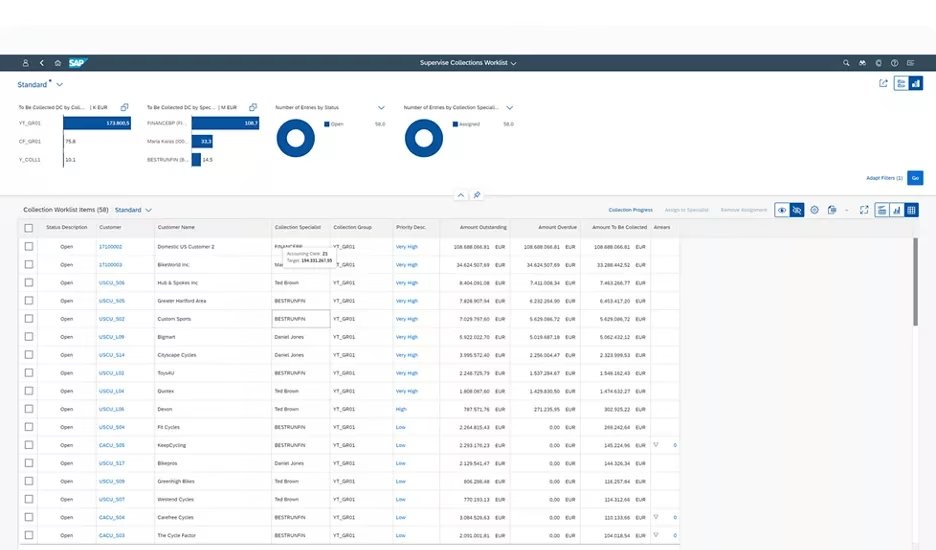
An AR agent need not wait for a migration: Transformance connects to SAP S/4HANA and ECC, Oracle, NetSuite and Dynamics (how AI agents work with SAP for accounts receivable).
What does an AI agent like Vero change in receivables management?
Vero, the AI agent from Transformance, works from each customer’s history in Customer 360, handles routine cases itself and hands credit questions to a person with the evidence.
Customer 360 is one graph per customer and Vero’s working memory: payments, promises kept or broken, disputes, contacts, replies.
- Speed: CollectPulse actions 100% of overdue invoices within 24 hours, against 30-40% for manual teams (Transformance customer data, 2026). Vero handles 60-80% of routine touches.
- Phone: the AI calling agent works in 70+ languages and makes 15-20 calls an hour, against 15-20 a day for a human collector. It identifies itself as AI at the start of every call.
- Control: Vero works within a 4-level approval model (read, recommend, execute, post). Credit decisions and ERP postings stay with you.
- Outcome: DSO down 8-12 days on average (Transformance customer data, 2026).
Transformance is headquartered in Hamburg, with customers across Europe, the United States and Australasia. Data is hosted in your region, for EU customers in the EU, or in your own cloud (VPC). A proof of value takes 4-5 weeks on one entity. See what an AI agent in accounts receivable is and CollectPulse.
Example: three overdue customers on a Monday
Three overdue receivables of similar age can need three different answers, as this example of a fictional industrial components maker shows.
- Customer A, EUR 18,400, twelve days overdue, no reply. Customer 360 shows a new accounts payable contact this month. The calling agent calls them: the invoice is waiting for approval because it has no PO number, and payment is promised for Friday. Vero drafts the email with invoice copy and PO number; you approve it.
- Customer B, three invoices totalling EUR 41,250. Two broken promises in three months, then only partial payments. Vero does not send a third dunning level; it hands the case and its history to the credit manager, who decides on a payment plan and the limit.
- Customer C, a quantity difference on one of four invoices. Vero logs the dispute and proposes holding that invoice’s reminder; the other three continue.
Before: an age-sorted dunning run sends all three the next reminder. After: A gets its PO number today, C’s dispute is logged while three invoices continue, and B sits with the credit manager.
Conclusion: treat late payment by cause, not by age
With insolvencies at their highest since 2014, Mittelstand receivables teams need to clear stuck invoices fast and see customers in trouble early.
An agent with a memory of each customer acts on every overdue invoice on day one and leaves the credit questions with you.
Frequently Asked Questions
How many companies filed for insolvency in Germany in 2025?
German courts registered 24,064 company insolvency filings in 2025, 10.3% more than in 2024 and the most since 2014 (Destatis, 2026).
Why do German business customers pay late?
Because they lack liquidity or the invoice is stuck in their process: in a 2026 Atradius survey of 210 mostly micro businesses, 50% name customer cash flow problems and 33% internal approval delays.
What can an AI agent take over in receivables management?
An AI agent such as Vero from Transformance handles 60-80% of routine touches and actions every overdue invoice within 24 hours, while a person approves credit decisions and postings.
Does an AI agent work with SAP ECC and S/4HANA?
Yes, Transformance connects to SAP S/4HANA and ECC as well as Oracle, NetSuite and Dynamics.
Where is the data stored for a German company using Transformance?
Data is hosted in your region, for EU customers in the EU, or in your own cloud (VPC).


