
Cash forecasting in SAP works best when SAP stays the system of record and an AI layer supplies live receivables signal. S/4HANA Cash Management and FSCM organise bank, AR and AP data inside the ERP. Transformance adds AI-native cash application, collections and deductions, and its CashPulse module turns that live activity into a forecast. This guide shows what SAP provides, what to add and how to integrate it.
Last updated: October 2026
Key Takeaways
- SAP provides the system of record for cash forecasting: S/4HANA Cash Management consolidates bank statements, open AR and AP items and memo records, and FSCM adds Credit, Collections and Dispute Management.
- Forecast quality follows receivables data quality, so the highest-impact step is to process payments, collections and deductions faster upstream of the forecast.
- According to the European Commission, mandatory e-invoicing and near real-time reporting for intra-EU transactions takes effect on 1 July 2030, so structured, timely transaction data becomes the norm.
- Transformance CashPulse delivers 90-95% forecast accuracy out to 90 days, with 30-, 90- and 365-day horizons, and the first 13-week forecast is ready in 2-4 weeks (Transformance platform data, 2026).
- Transformance connects to SAP S/4HANA and ECC and goes live in up to 4-8 weeks, without replacing your ERP.
In This Article
- What Is SAP Cash Forecasting?
- How S/4HANA Cash Management Supports Forecasting
- What SAP FSCM Adds for Receivables
- What Data Drives an Accurate Cash Forecast?
- How to Build an AI-Driven Cash Forecast with SAP
- How CashPulse Adds AI-Native AR Data to SAP Cash Forecasting
- How to Integrate an AI Layer with SAP
- Frequently Asked Questions
- Conclusion: Run Cash Forecasting in SAP with AI
What Is SAP Cash Forecasting?
SAP cash forecasting is the process of predicting future cash inflows and outflows using data captured in SAP's ERP and treasury modules, primarily S/4HANA Cash Management and SAP FSCM (Financial Supply Chain Management), as well as the cash and liquidity functions in SAP ECC. It combines bank statement data, open receivables and payables, memo records and planned transactions to produce a projected cash position over a defined horizon.
SAP holds the cash, receivables and payables record. Transformance connects to it and contributes AI-processed receivables signal: payments matched automatically, promise-to-pay outcomes captured from calls and emails, and deductions classified as they arrive. Read more in our guide to AR cash forecasting methods.
How S/4HANA Cash Management Supports Forecasting
S/4HANA Cash Management pulls bank statement data (via MT940, CAMT.053 or BAI2 formats), open AR and AP items and memo records into a consolidated cash position view. It supports planning levels, liquidity items and a dashboard that shows actuals against plan.
For companies running S/4HANA, it covers bank connectivity, entity consolidation and liquidity categorisation. Transformance connects to S/4HANA and contributes its own accounts receivable signals to the forecast: payment probability per customer, promise-to-pay outcomes from calls and emails, and deduction status.
What SAP FSCM Adds for Receivables
SAP FSCM adds Credit Management, Collections Management and Dispute Management alongside Cash Management. This gives treasury and AR teams a shared SAP record of credit exposure, collections worklists, dunning status and disputed items.
Many multi-entity organisations also bring in business-unit forecasts and currency consolidation from outside SAP. Integration keeps those inputs flowing into one view, and an AI layer can add payment behaviour and live collections outcomes to the same picture. For the multi-entity case, see our guide to multi-entity cash flow forecasting.
What Data Drives an Accurate Cash Forecast?
An accurate cash forecast depends on live AR signal: matched payment data, current collections activity and dispute status, in addition to posted invoices and bank balances. If cash application runs two days behind, if deductions sit unclassified for a week or if collections outcomes are logged in a spreadsheet, the forecast inherits that lag.
Three data inputs matter most:
- Matched payment status. Whether a payment has been applied to an invoice or is still unmatched changes whether that cash is confirmed or projected.
- Collections probability. A payment probability based on the customer's own payment history is a stronger predictor than static credit terms.
- Dispute and deduction status. An invoice tied to an open deduction should be forecast differently from a clean, on-terms invoice.
How to Build an AI-Driven Cash Forecast with SAP
You keep SAP in place. The work is architectural: get receivables data into the forecast faster and connect it automatically. A practical sequence:
- Measure data latency. Track the gap between when a payment or deduction happens and when it is usable in SAP.
- Automate cash application. Faster, more accurate remittance matching leaves fewer unmatched items outside the forecast.
- Score collections outcomes. Add a payment probability per customer, based on its own payment history, to each open item.
- Classify deductions early. Give every deduction a category and an owner so it enters the forecast with the right status.
- Consolidate entities through integration. Connect entity data directly instead of exporting and merging by hand.
- Model scenarios tied to actions. Show what happens to the 30-day forecast if you accelerate collections on your top 20 overdue accounts.
- Compare forecast to actuals weekly. Use the variance to recalibrate. Our 13-week cash flow template is a good starting rhythm.
How CashPulse Adds AI-Native AR Data to SAP Cash Forecasting
Transformance is built from day one on vision language models. Transformance DocSense reads remittance PDFs, emails, EDI and bank portal downloads with over 97% extraction accuracy across 100+ document types and 170+ languages, and new formats are read on the first attempt with zero template configuration.
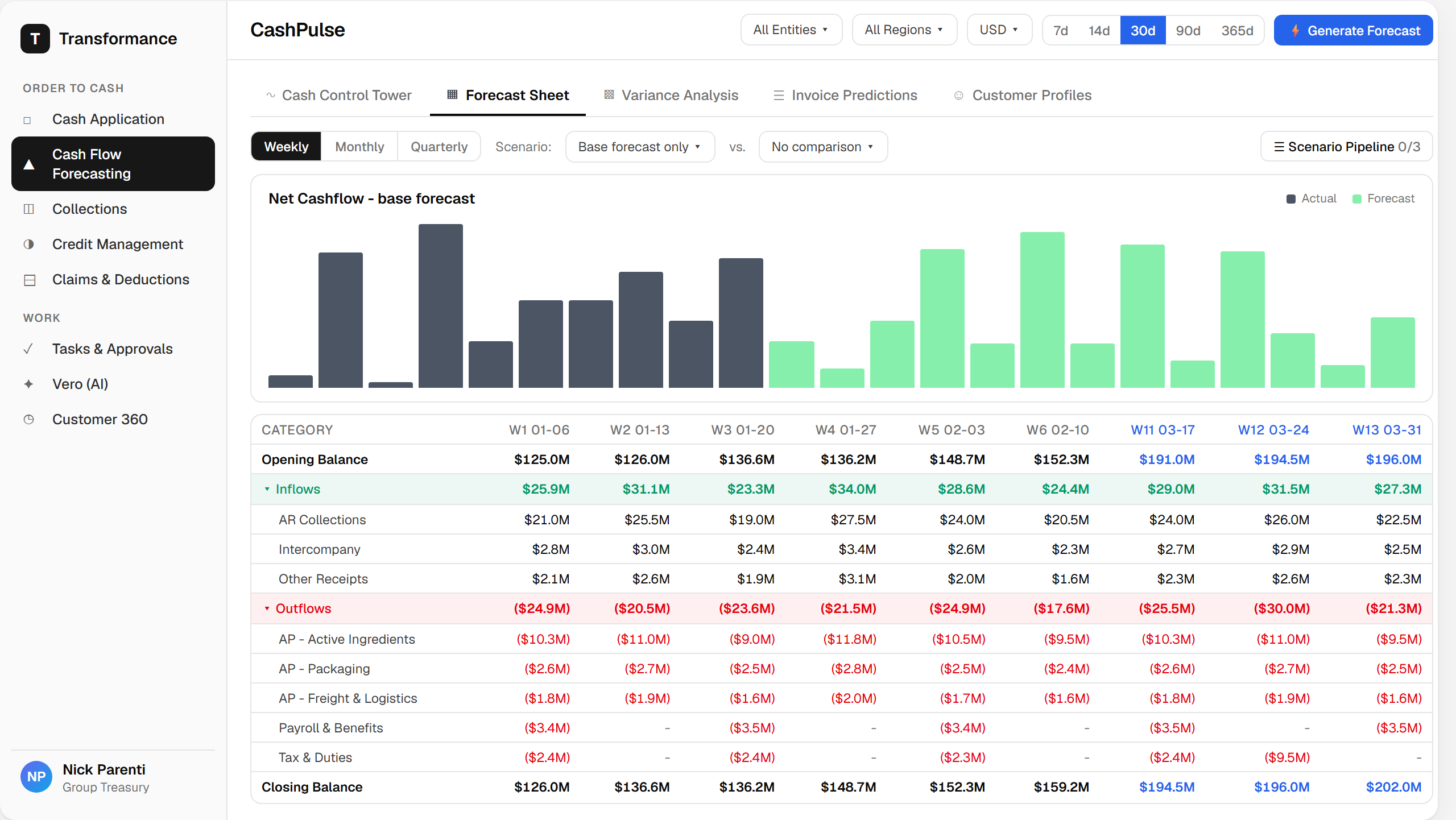
CashPulse builds its forecast on that live AR data: which invoices ClearMatch has matched (95% auto-match rate, end to end in under 8 minutes), which accounts CollectPulse is working and which promise-to-pay dates it has captured, and which deductions or disputes ClaimIQ has classified. The result is 90-95% forecast accuracy out to 90 days, with 30-, 90- and 365-day horizons, 20+ countries on one model and 100+ drivers. CashPulse also scores each customer's payment probability from its own payment history and runs action-linked scenarios, for example how the 30-day forecast changes if you accelerate collections on your top 20 overdue accounts, with each entity's forecast reflecting its own payment behaviour. The first 13-week forecast is ready in 2-4 weeks.
The collections side adds behaviour. The CollectPulse AI calling agent works overdue accounts at 15-20 calls an hour in 70+ languages and identifies itself as AI at the start of every call. 100% of overdue invoices are actioned within 24 hours, and every promise-to-pay outcome flows into the forecast. Vero, the agent, works on Customer 360, one graph per customer that serves as its working memory, so the forecast reflects payment behaviour as well as terms.
This sits within the wider order-to-cash process: a forecast is downstream of collections, cash application and deductions, which is why improving those processes improves the forecast. See the cash flow forecasting solution for the product view.
How to Integrate an AI Layer with SAP
Transformance connects to SAP S/4HANA and ECC, Oracle, NetSuite and Dynamics, and runs alongside your existing SAP environment. A typical integration plan has four parts:
- Data in: bank statements, open items and customer master data flow from SAP into Transformance.
- Processing: payments are matched, collections are worked and deductions are classified alongside the ERP.
- Controls: a 4-level approval model (read, recommend, execute, post) keeps a human in the loop for ERP postings, with 100% posting validation and a full audit trail.
- Deployment: VPC deployment keeps data in your own cloud, with SSO/SAML and role-based access control.
Full rollout takes up to 4-8 weeks, and proof of value takes 4-5 weeks on one entity. Planning an ECC migration as well? Read our SAP ECC end-of-maintenance playbook.
Frequently Asked Questions
What is SAP cash forecasting?
SAP cash forecasting is the process of projecting future cash inflows and outflows from data held in SAP's finance and treasury modules, such as S/4HANA Cash Management and FSCM. It combines bank data, open receivables and payables and planned items into a projected cash position over a chosen horizon.
Does S/4HANA include cash forecasting?
Yes, S/4HANA includes Cash Management, which brings bank statements, open AR and AP items and memo records together into a cash position and forecast view. It also handles bank connectivity and entity consolidation, and you can add AI-driven receivables signals on top of it.
What is the difference between SAP Cash Management and SAP FSCM for forecasting?
Cash Management consolidates and reports cash position data, while FSCM adds Credit Management, Collections Management and Dispute Management. Together they give treasury and AR teams a shared SAP record of cash, credit and open items.
How do you add AI to cash forecasting in SAP?
You keep SAP as the system of record and add an AI layer that processes receivables data alongside it. Transformance matches payments, scores collections outcomes and classifies deductions, then feeds that live signal into its CashPulse forecast, which connects to SAP S/4HANA and ECC.
What determines cash forecast accuracy in an SAP landscape?
Forecast accuracy depends on how current and complete the receivables data feeding the forecast is. Matched payment status, collections outcomes and dispute or deduction status are the three inputs that move accuracy the most.
Do you need to replace SAP to improve cash forecasting?
No, an AI layer connects to your existing SAP environment and leaves it in place. Transformance connects to SAP S/4HANA and ECC, Oracle, NetSuite and Dynamics, and a full rollout takes up to 4-8 weeks.
How does Transformance work with SAP for cash forecasting?
Transformance CashPulse connects to SAP and builds its forecast from live matched payments, active collections and open disputes. Postings back to the ERP follow a four-level approval model, with a human in the loop for every ERP posting.
Conclusion: Run Cash Forecasting in SAP with AI
SAP gives finance teams a reliable system of record for cash, credit and open items. The way to a sharper forecast is to improve the receivables data that feeds it: match payments faster, score collections outcomes and classify deductions early. That is what Transformance does alongside your SAP environment, with 90-95% forecast accuracy out to 90 days and a rollout in up to 4-8 weeks. Finance teams at Syngenta, Engie and PwC use Transformance.
Want to see an AR-driven forecast on top of your own SAP data? Book a call with Transformance.
SAP, S/4HANA and SAP ECC are trademarks of SAP SE. Transformance is an independent provider and is not affiliated with SAP.