
Most deduction management tools flag disputed discounts after the fact, once the revenue has already leaked out of the AR ledger. Transformance reads the original invoice, the agreed payment terms, and the actual payment date using vision language models, then builds the recovery case automatically instead of letting it sit in an aging queue. That distinction, catching unearned Skonto and cash discount deductions before they become permanent write-offs, is what separates an AI-native deduction engine from a rules-based dashboard.
Key Takeaways
- Unauthorized cash discount deductions happen when a customer pays past the discount window but still deducts the early-payment percentage, a pattern known in German-speaking markets as unberechtigt gezogenes Skonto.
- Most AR teams write off the majority of these deductions because validating them requires cross-referencing the invoice date, the payment terms, and the actual bank posting date, work that takes an analyst 15 to 20 minutes per line item.
- Cash discount abuse is rarely deliberate fraud; it is usually a byproduct of AP teams treating discount deadlines as flexible, and it compounds when nobody on the vendor side is watching.
- AI-based document extraction can match the real payment date against the discount terms automatically, which turns a manual investigation into a rules check that runs in seconds.
- Transformance’s ClaimIQ auto-classifies these deductions, drafts the dispute package, and routes it for approval instead of asking an analyst to build the case from scratch.
In This Article
- Key Takeaways
- Why Unauthorized Cash Discount Deductions Slip Through AR Teams
- What Is an Unauthorized Cash Discount Deduction?
- How Do You Detect an Unearned Discount Deduction?
- Why Manual AR Teams Write Off Most of These Deductions
- How to Validate and Recover a Cash Discount Deduction
- How AI Changes Cash Discount Deduction Recovery
- Manual Review vs. Legacy Software vs. AI-Native Recovery
- Frequently Asked Questions
- Conclusion
Why Unauthorized Cash Discount Deductions Slip Through AR Teams
A cash discount deduction is one of the easiest deductions to validate and one of the most commonly ignored. The terms are usually printed right on the invoice: 2/10 net 30, or in German business, 2% Skonto bei Zahlung innerhalb von 10 Tagen. There is no ambiguity about whether the customer qualified.
Yet deductions management teams routinely let these slide because the validation work competes with higher-value disputes: shortage claims, damaged goods, pricing discrepancies. A single unearned discount might only be worth 200 or 2,000 euros, but multiplied across thousands of invoices a year, it adds up to a meaningful and entirely preventable revenue leak.
The problem is structural, not a lack of diligence. Checking whether a discount was earned requires pulling three separate data points: the invoice date, the agreed terms, and the actual payment clearing date, then comparing them by hand. When that comparison sits behind a manual process, most teams simply do not have the bandwidth to run it on every deduction.
What Is an Unauthorized Cash Discount Deduction?
An unauthorized cash discount deduction occurs when a customer takes an early-payment discount on an invoice despite paying after the discount window closed. The customer remits the invoice amount minus the agreed discount percentage even though the payment date does not qualify under the stated terms. In German AR practice this is called unberechtigt gezogenes Skonto, or unearned discount.
The mechanics are simple. If terms are 2/10 net 30 and a customer pays on day 22 but still deducts 2%, that deduction is unauthorized. It is distinct from a legitimate cash discount, where the customer pays within the window and the discount is contractually owed, and it is also distinct from other deduction categories like shortage or pricing claims, which require investigating physical or contractual disputes rather than a date comparison.
Common Patterns Behind Skonto Abuse
Cash discount abuse tends to cluster around a handful of repeatable behaviors:
- Habitual late payers who deduct anyway. Some AP teams treat the discount date as a suggestion, not a deadline, and simply apply the percentage regardless of when the wire actually clears.
- Bank float miscalculation. A customer initiates payment within the window but the funds settle late, and nobody reconciles initiation date against clearing date.
- Deliberate cash flow management. Larger buyers sometimes stretch payment terms as a working-capital tactic while still taking every discount they can, betting the vendor will not chase a small deduction.
- System defaults. Some ERP configurations on the buyer side auto-apply the discount code regardless of the actual payment date, making the abuse unintentional but still costly.
How Do You Detect an Unearned Discount Deduction?
You detect an unearned discount deduction by comparing three data points on every discounted payment: the invoice date, the agreed discount terms, and the date the payment actually cleared. If the clearing date falls outside the discount window, the deduction is invalid and recoverable.
The detection logic itself is not complicated. What makes it hard at scale is data quality. The invoice date lives in the ERP. The payment terms might be in the customer master or in a contract PDF. The actual clearing date requires reading the remittance advice or bank statement, not just the date the customer claims they paid.
Legacy deduction tools that rely on OCR and regex extraction struggle here because remittance formats vary by customer and by bank, and a template built for one format breaks the moment a customer changes their PDF layout. That is precisely the gap Transformance closes: document extraction reads the remittance regardless of format, without a template maintenance cycle, and matches the extracted payment date against the invoice terms automatically.
Why Manual AR Teams Write Off Most of These Deductions
According to Ardent Partners (2023), AR organizations write off between 4 and 8 percent of total deductions annually without formally investigating whether the deduction was valid, primarily because the labor cost of research exceeds the expected recovery value. Cash discount deductions are disproportionately represented in that write-off pile because each one looks small in isolation.
IOFM benchmarking research puts the average manual deduction investigation at 15 to 20 minutes of analyst time when it involves cross-referencing terms, dates, and payment records across separate systems. At that rate, a team processing a few hundred discount deductions a month would need a dedicated analyst just to keep pace, and most finance organizations do not staff for that.
A 2023 Deloitte survey of finance leaders found that 62% of AR teams cite deduction backlog as one of their top three barriers to reducing days sales outstanding. Cash discount abuse contributes directly to that backlog because it competes for the same analyst hours as higher-value disputes, and it consistently loses that competition.
There is also a behavioral cost to writing these off. Customers who successfully deduct an unearned discount once tend to repeat the behavior, because nothing corrected it the first time. Left unaddressed, one habitual late payer can generate the same deduction, every invoice, every month, for years.
How to Validate and Recover a Cash Discount Deduction
Building a defensible recovery case for an unauthorized discount deduction follows a consistent sequence, whether it is done manually or by an automated system.
- Pull the original invoice terms. Confirm the exact discount percentage and the number of days from invoice date to discount deadline as stated on the invoice or master agreement.
- Identify the actual clearing date. Read the remittance advice or bank statement, not the customer’s stated payment date, to establish when funds actually settled.
- Calculate the qualifying window. Add the discount period to the invoice date to determine the last date on which the discount was legitimately available.
- Compare the clearing date against the window. If the payment cleared after the deadline, the deduction is unauthorized and recoverable.
- Check for exceptions. Some customer agreements include grace periods or bank-holiday adjustments; confirm none apply before disputing.
- Draft and file the dispute. Document the invoice date, terms, actual clearing date, and calculated shortfall, then route it through your dispute or claims reconciliation workflow for recovery.
Each step is mechanical, which is exactly why it is a good candidate for automation. None of it requires judgment calls about whether goods were damaged or a promotion was valid, the two variables that make trade deductions genuinely hard to adjudicate.
How AI Changes Cash Discount Deduction Recovery
AI changes cash discount deduction recovery by automating the date comparison and case-building work that consumes analyst time, turning a 15 to 20 minute manual investigation into a check that runs in the background on every deduction. Instead of sampling a subset of deductions for review, the system checks all of them.
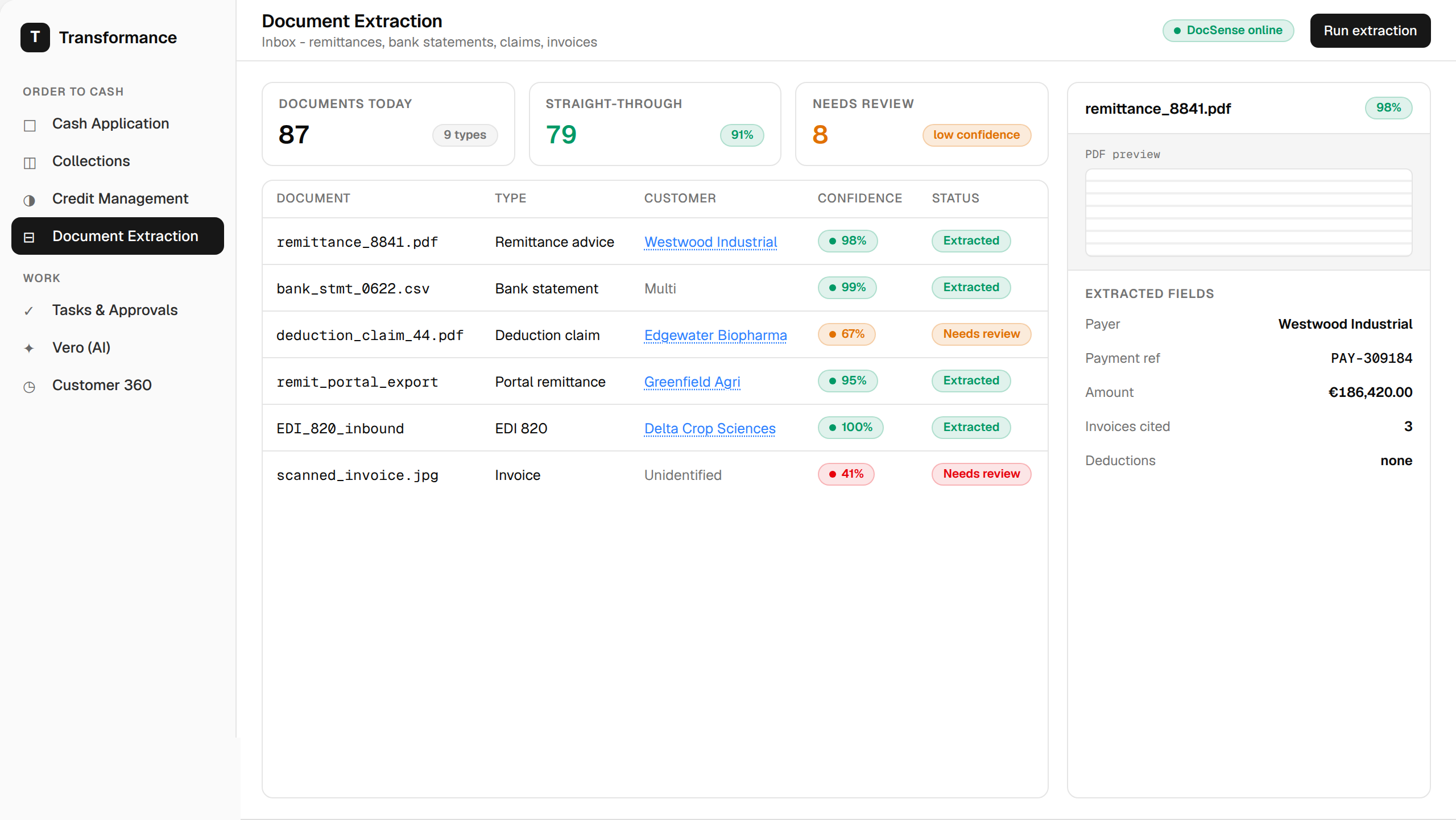
Transformance’s ClaimIQ reads deduction memos and remittance advices using the same document extraction engine that powers cash application, so it identifies the deduction, the associated invoice, and the payment date without waiting on a template built for that customer’s specific PDF layout. It then classifies the deduction against six categories, including early payment discount abuse, and calculates whether the payment date actually qualifies.
Where this matters most is at scale. A global manufacturer processing several thousand deductions a month cannot economically staff a team to manually validate every 2% Skonto deduction against payment terms. An automated check can, because the marginal cost of running the comparison on the thousandth invoice is the same as running it on the first.
When a deduction is confirmed unauthorized, the system generates the dispute package automatically: the invoice terms, the actual clearing date, the shortfall amount, and the recommended recovery action. The AR analyst reviews and sends rather than building the case from a blank spreadsheet, which is the same efficiency gain documented in The Real ROI of Claims Reconciliation.
Manual Review vs. Legacy Software vs. AI-Native Recovery
Picture a European chemicals distributor that runs its full deduction backlog through automated date matching and finds that one customer has been deducting an unearned 2% discount on nearly every invoice for eighteen months. No single deduction would be large enough to trigger manual review. Together, they would add up to a six-figure recovery opportunity, invisible because nobody was checking every invoice, only the ones that looked large enough to bother with.
Frequently Asked Questions
What is unberechtigt gezogenes Skonto?
Unberechtigt gezogenes Skonto is the German term for an unauthorized cash discount deduction, meaning a customer took an early-payment discount despite paying after the qualifying window closed. It is a specific subset of deduction abuse common in German and DACH B2B trade, where Skonto terms (typically 2 to 3% for payment within 10 to 14 days) are standard on invoices.
How do you prove a cash discount deduction was unauthorized?
You prove it by comparing the actual payment clearing date, taken from the bank statement or remittance advice, against the invoice date plus the agreed discount period. If the clearing date falls after that window, the discount was not earned and the deduction is invalid.
Is an unearned discount deduction considered fraud?
It is usually not fraud in a legal sense; it is more often a process failure on the customer’s AP side, such as a default discount code or an inconsistent payment schedule. That said, a documented pattern of repeated unearned deductions from the same customer is grounds for a formal dispute and, if unresolved, a conversation about terms enforcement.
Why do most AR teams write off unauthorized discount deductions instead of disputing them?
Most teams write them off because each individual deduction looks too small to justify the analyst time required to validate it manually. According to IOFM benchmarking, a manual investigation takes 15 to 20 minutes per deduction, which does not scale across a full invoice book.
Can AI actually detect Skonto abuse automatically?
Yes, AI can detect it automatically by extracting the invoice terms and the actual payment date from remittance documents and comparing them against the discount window without manual lookup. Transformance’s ClaimIQ runs this comparison on every deduction rather than a manually selected sample.
How much revenue do companies typically lose to unauthorized cash discount deductions?
The exact figure varies by industry and customer base, but Ardent Partners (2023) estimates that AR teams write off 4 to 8 percent of total deductions annually without investigation, and cash discount abuse is a recurring contributor because each instance appears low-value in isolation.
Conclusion
Unauthorized cash discount deductions are among the most mechanically simple deductions to validate and among the most consistently ignored, because checking terms against actual payment dates by hand does not scale past a handful of accounts. The fix is not more analyst headcount; it is running the same comparison automatically on every invoice instead of a sampled few.
Teams that stop writing off unearned Skonto and start checking every deduction against actual payment behavior tend to find the same thing: a handful of repeat offenders account for most of the leakage, and once flagged, the pattern is easy to correct through terms enforcement. That shift from manual sampling to full-coverage detection is worth a conversation before it is worth a pilot.
See how ClaimIQ checks payment terms against actual payment dates on every invoice, not a sampled few. Book a Call.