Key Takeaways:
- Billtrust is strong in e-invoicing and payment networks but limited in AI-native execution, particularly for cash application matching and deductions management.
- The AR automation market is expected to reach $10.1 billion by 2032 (Coherent Market Insights, 2025), so choosing the right platform now locks in competitive advantage for years.
- According to Gartner (2024), 90% of finance functions will deploy at least one AI-enabled technology by 2026. The question isn’t whether to automate AR, but which platform actually does the work.
- Transformance's AI-native execution layer (ClearMatch + ClaimIQ + CollectPulse + CashPulse, unified by Vero) acts on AR data — matches payments, resolves deductions, makes collection calls in 70+ languages — instead of just organizing it. That's the difference between AR tools that save hours and AR tools that save headcount.
- Switching costs are real. Evaluate ERP integration depth, deployment speed, and whether the vendor requires months of template configuration before you see value.
In This Article
- Why Look Beyond Billtrust?
- How to Evaluate Billtrust Alternatives: 7 Key Criteria
- The Best Billtrust Alternatives for 2026
- What Makes AI-Native AR Different from Traditional Automation?
- How Should You Handle the Switch from Billtrust?
- Take the Next Step: Choose an AR Platform That Executes

Why Look Beyond Billtrust?
Billtrust, acquired by EQT Private Equity for $1.7 billion in 2022, built its reputation on electronic invoicing, payment acceptance, and its Business Payments Network. For companies whose primary challenge is getting invoices delivered electronically and accepting digital payments, it’s a solid choice.
But AR automation has moved far beyond invoice delivery. Finance teams now need platforms that read unstructured remittance data, match payments intelligently, investigate deductions autonomously, and run collections without human babysitting. According to Gartner (2025), 40% of enterprise applications will feature task-specific AI agents by the end of 2026, up from less than 5% in 2025. The gap between “workflow tool” and “AI execution layer” is widening fast.
Common Billtrust limitations cited in recent reviews include limited reporting flexibility, complex navigation, slow document upload speeds, and an initial setup process that takes longer than expected, particularly around ERP synchronization. For mid-market and enterprise teams processing thousands of invoices monthly, these friction points compound.
If your team has outgrown Billtrust’s capabilities, or you’re evaluating AR platforms for the first time and want to skip the generation of tools that require heavy manual oversight, here are the alternatives worth considering.
What Is AR Automation?
AR automation is the use of software to handle accounts receivable tasks (invoicing, cash application, collections, deductions management, and cash forecasting) with minimal manual intervention. Modern AR automation goes beyond digitizing paper processes; AI-native platforms can read documents, match payments, investigate disputes, and post journal entries to your ERP without human involvement in routine cases.
How to Evaluate Billtrust Alternatives: 7 Key Criteria
Before comparing specific vendors, establish what matters for your team. Not every AR platform solves the same problem, and the “best” choice depends on your volume, ERP environment, and where your team spends the most manual hours.
- AI execution vs. workflow management. Does the platform take action (match payments, resolve deductions, make collection calls), or does it organize work for humans to complete? This is the single biggest differentiator in the market right now.
- ERP integration depth. Surface-level API connections aren’t enough. Can the platform read from and write back to your ERP (SAP, Oracle, NetSuite, Microsoft Dynamics) with full GL posting validation?
- Document understanding. How does the platform handle unstructured remittance advices, deduction memos, and bank statements? OCR with template training is a generation behind vision language models that understand documents without configuration.
- Deployment speed. According to IOFM, manual invoice processing costs $12 to $35 per invoice. Every month spent in implementation is a month of those costs continuing. Ask vendors for specific timelines, not vague promises.
- Deductions and claims coverage. Many AR platforms handle invoicing and collections but leave deductions management to spreadsheets. If trade deductions are a significant portion of your AR workload (common in CPG and manufacturing), this gap is expensive.
- Collections intelligence. Does the platform prioritize based on payment probability, or just invoice age? Can it automate the first touches (emails, calls, reminders) without a human initiating each one?
- Memory and learning. Does the system get smarter over time, or does it start from zero every morning? Persistent institutional memory (remembering customer payment patterns, past resolutions, seasonal behaviors) separates AI-native platforms from rules-based tools with an AI label.
The Best Billtrust Alternatives for 2026
| Platform | Best Suited For | Standout Feature | Pricing |
|---|---|---|---|
| Transformance | Mid-market & large enterprise with complex unstructured remittances | AI-native O2C execution; vision LLMs, no template config | Custom; ~25-30% under incumbents |
| HighRadius | Fortune 500 with dedicated AR teams + long timelines | Widest ERP catalog; full AR-cycle suite | Custom; high 6 to low 7 figures Y1 |
| Esker | Mid-market wanting combined AP + AR automation | Order management + cash app + collections in one platform | EUR 50-200K/yr (cash app) |
| Versapay | B2B with high portal-adoption potential | Customer payment portal capturing structured data at source | Volume-based + payment fees |
| Gaviti | Mid-market focused on collections only | Purpose-built collections workflow with credit monitoring | USD 30-100K/yr |
1. Transformance: Best AI-Native AR Execution Platform
Transformance is built for finance teams that need their AR platform to do the work, not just display it. Where Billtrust focuses on invoice delivery and payment acceptance, Transformance covers the downstream execution: cash application, deductions investigation, autonomous collections, and cash forecasting.
Unlike legacy tools that bolt AI onto OCR + regex stacks, Transformance uses vision language models that understand documents natively, multimodal embeddings for semantic matching, and a graph-based investigation engine. The platform deploys inside the customer's own cloud and goes live in 4-8 weeks.
Pros:
- DocSense achieves 99.7% accuracy on structured remittances and 96.6% on complex multi-column tables — with zero template configuration.
- ClearMatch starts at ~85% auto-match rates at deployment and improves to 95%+ within 90 days as the persistent memory layer accumulates resolution patterns.
- CollectPulse deploys autonomous AI calling agents in 70+ languages: 15-20 calls per hour vs 15-20 calls per day for a human collector.
- Vero (the persistent AI agent) carries institutional memory across cash app, deductions, collections, and forecasting — one agent, four products.
- VPC deployment with SSO/SAML, RBAC, full audit trails, and ISO 27001. Financial data never leaves your environment.
Cons:
- Focused on O2C execution. Companies needing invoice presentment + payment acceptance will still want Billtrust or a payments specialist alongside Transformance.
- Built for enterprise document complexity at scale. Not optimized for transactional or SMB businesses.
Best For: Mid-market and large enterprises (EUR 500M to EUR 25B+ revenue) running SAP, Oracle, or Dynamics with complex unstructured payment data. Especially strong for FMCG, chemicals, MedTech, and manufacturing companies with shared service centers handling cross-border AR.
Pricing: Module-based pricing tied to users, transaction volume, and AI usage. ~25-30% more affordable than incumbent platforms with faster onboarding. Pilots run on a slice of your AR data so you see match rates before committing.

2. HighRadius: Best for Large Enterprises with Existing Implementations
HighRadius offers a broad AR suite covering treasury management, cash application, collections, and deductions. It's the most frequently compared alternative to Billtrust in the enterprise segment, and Gartner Peer Insights consistently ranks it among the top invoice-to-cash platforms.
The platform was built on first-generation OCR + regex template architecture. Full AR-cycle coverage is the biggest strength and the biggest implementation overhead.
Pros:
- Deep feature set across the full order-to-cash cycle from a single vendor.
- Strong with Fortune 500 companies that have dedicated implementation teams; mature SAP and Oracle connector catalog.
- High transaction-volume processing for mature enterprise AR teams.
- Recognised in Gartner Magic Quadrant for Invoice-to-Cash Applications.
Cons:
- Implementation timelines of 3-6 months are common. Realising full value typically takes considerably longer than initial deployment.
- The platform's complexity creates IT dependency for configuration changes. AR analysts cannot self-serve most workflow tweaks.
- The AI capabilities, while marketed heavily, were added to an existing rules-based architecture rather than built natively. Match rates degrade over time as remittance formats evolve.
- The AI assistant is stateless between sessions — institutional knowledge about customer payment patterns does not accumulate.
Best For: Large enterprises (USD 5B+ revenue) with dedicated AR technology teams and the patience for extended implementations. See our HighRadius alternatives guide for a deeper comparison.
Pricing: Custom enterprise pricing tied to volume and module count. Total first-year cost lands in high six to low seven figures including implementation services.
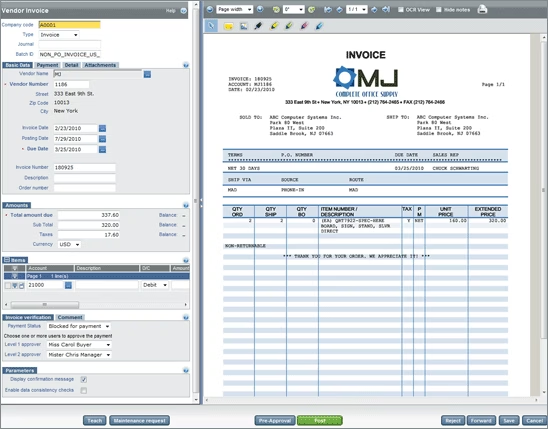
3. Esker: Best for Full Order-to-Cash Document Automation
Esker covers order management, invoicing, collections, cash application, and claims management in a single platform. Their strength is document process automation across both accounts payable and accounts receivable, making them a good fit for organizations that want one vendor handling both sides.
The AI layer is primarily focused on document classification and data extraction rather than autonomous execution — the trade-off works for finance teams who want everything from one vendor and accept moderate matching performance.
Pros:
- Broad O2C coverage from sales order through collection — rare in a single platform.
- Strong document capture and electronic invoicing capabilities.
- Established European market presence with multi-language support across major EU languages.
- Combined AP + AR automation from one vendor reduces vendor management overhead.
Cons:
- Cash application matching still relies heavily on rules configuration; performance is comparable to other first-generation tools on complex remittances.
- The AI layer focuses on document classification, not autonomous execution — less depth on exception investigation than purpose-built specialists.
- Deductions management capabilities are less mature than dedicated solutions like ClaimIQ.
- Pricing scales with module count, so unused modules still factor into total cost.
Best For: Mid-market organizations (USD 100M to USD 1B revenue) that want combined AP and AR automation from one vendor and prioritize document workflow over AI-driven execution.
Pricing: Per-module subscription tied to transaction volume. Mid-market deployments typically run EUR 50,000 to EUR 200,000 per year for cash application alone, more for the full suite.

4. Versapay: Best for Collaborative AR and Customer Self-Service
Versapay takes a different approach than most AR platforms by focusing on buyer-seller collaboration. Their customer portal lets your buyers view invoices, make payments, communicate about disputes, and manage their accounts without calling your team.
The portal-first model is the platform's biggest differentiator. Match performance correlates directly with the share of customers who actually use the portal — strong when adoption is high, ordinary when it isn't.
Pros:
- Excellent customer-facing portal that addresses the remittance quality problem at source.
- Strong payment acceptance capabilities including ACH and card processing through the portal.
- Self-service model deflects a significant volume of customer inquiries from your AR team.
- Good fit for companies where buyer collaboration reduces disputes and accelerates payment.
Cons:
- The collaboration approach works best when your customers actually use the portal. Enterprise payers with rigid AP systems often won't change submission methods.
- Cash application and deductions management are less automated than platforms focused on AI execution.
- Less suited for high-volume, complex matching scenarios typical of manufacturing and CPG.
- First 6-12 months are a customer-onboarding exercise as much as a software deployment.
Best For: B2B companies (USD 50M to USD 500M revenue) with a manageable number of key accounts where building direct buyer relationships reduces friction and dispute volume.
Pricing: Subscription pricing scales with transaction volume and active payer count on the portal. Includes payment processing fees on captured ACH/card transactions.

5. Gaviti: Best Mid-Market Collections Platform
Gaviti focuses specifically on collections and credit management rather than trying to cover the entire AR spectrum. For teams whose primary pain point is chasing overdue invoices, this specialization can be an advantage.
The narrower scope means faster implementation but more integration work if you need a full AR stack — you'll pair Gaviti with separate cash app, deductions, and forecasting tools.
Pros:
- Purpose-built for collections workflow with automated dunning sequences and dispute management.
- Built-in credit monitoring and credit limit management.
- Faster implementation than enterprise platforms — typically live within 6-8 weeks.
- Competitive pricing for mid-market teams; transparent per-user model.
Cons:
- No cash application module, no deductions management, no cash forecasting. Teams that need full AR automation will need to combine Gaviti with other tools.
- Multi-tool stacks create integration complexity and split data ownership.
- AI capabilities are limited compared to platforms with native vision language models or autonomous agents.
- Less established in deep-enterprise procurement cycles.
Best For: Mid-market companies (USD 50M to USD 500M revenue) whose primary AR challenge is collections follow-up and who don't need cash application or deductions automation. See our best tools for reducing DSO for adjacent options.
Pricing: Per-user subscription tied to active collector count. Mid-market deployments typically USD 30,000 to USD 100,000 per year.
6. Quadient, Invoiced, and Other Niche Options
Several other platforms serve specific segments of the AR market:
- Quadient AR Automation is practical for mid-market companies that need to get live quickly. Reviewers note straightforward implementation, though the feature depth is limited compared to enterprise platforms.
- Invoiced earns strong marks for ease of setup and customer support. For SMBs and lower mid-market companies, it’s often simpler to implement than Billtrust.
- Paystand focuses on B2B payments with a blockchain-based zero-fee payment network. Its AR automation capabilities beyond payment acceptance are limited.
What Makes AI-Native AR Different from Traditional Automation?
Traditional AR automation (the generation that includes Billtrust, early HighRadius, and most legacy platforms) digitizes manual processes. Electronic invoicing replaces paper. Rules-based matching replaces manual lookups. Workflow tools route tasks to the right person.
AI-native AR automation executes the work itself. The distinction matters because, according to Gartner (2025), finance AI adoption has plateaued at 59% of CFOs reporting active use. The reason isn’t lack of interest. It’s that most “AI” tools still require humans to do the actual work after the tool surfaces the data.
A practical example: when a customer sends a PDF remittance advice with a new layout your system hasn’t seen before, a template-based tool fails silently or routes it to a human for manual processing. An AI-native platform using vision language models reads and understands the document on the first attempt, matches the payments, and posts to the ERP. The difference between those two outcomes, multiplied across thousands of transactions monthly, is the difference between automation that saves hours and automation that saves headcount.
Transformance was built on this principle from day one. Every module (ClearMatch, CollectPulse, ClaimIQ, CashPulse) is designed to execute, with the AI intelligence layer Vero acting as an always-on team member that handles routine work and surfaces only the exceptions that need human judgment.
How Should You Handle the Switch from Billtrust?
Switching AR platforms is a real project, not something you do on a whim. But the cost of staying on a platform that doesn’t meet your needs compounds every month in manual processing hours, missed deductions, and slower cash flow.
Three factors to evaluate before making the move:
- Map your current workflows. Document what Billtrust handles today, what your team handles manually around it, and where the gaps are. The gaps are usually in cash application matching accuracy, deductions investigation, and collections coverage.
- Prioritize quick wins. Choose a platform that delivers value in weeks, not quarters. If a vendor can’t show you matched payments within the first two weeks, their deployment timeline is likely understated.
- Test with real data. Any credible AR platform should be willing to run a proof of concept with your actual remittance formats, deduction types, and ERP environment. If they need six weeks just to configure templates before they can show results, that tells you something about their architecture.
What Billtrust actually costs in 2026 (with attribution)
Billtrust does not publish pricing on its website. Triangulating from public sources gives a credible range.
Lunos's 2026 mid-market analysis cites a typical Y1 contract band of $20,000 to $60,000 (per lunos.ai/blog/highradius-vs-billtrust). SelectHub lists an entry-tier monthly subscription starting at $65 per month for the smallest deployments. Professional services run approximately $165 per hour per Capterra reviewers in 2025 and 2026. BPN payment processing carries separate fees: card transactions follow the Flat Rate or Interchange Plus model published in Billtrust's BPN Services Agreement, with 1.5 percent per month late fees on overdue receivables.
Two patterns matter for buyers modeling 3-year TCO. First, Billtrust uses structured renewal-uplift programs (visible in their Built In contracts-renewal-specialist job posting) so Y2 and Y3 typically rise 5 to 10 percent. Second, Billtrust went private under EQT in December 2022 and has had three CEOs in 36 months (Lane to Rajasekar in December 2022 to Halloran in December 2025). The post-private financial discipline means less negotiating flexibility on first-year discounts than buyers saw under public ownership.
Billtrust BPN: what it is and whether you can leave it
The Billtrust Business Payments Network (BPN) is the company's most defensible feature and its biggest lock-in. BPN launched in November 2018 with Visa as the founding partner. It has since grown to integrate with 260+ AP portals across hundreds of thousands of buyer-side accounts payable systems, with a Mastercard Receivables Manager partnership added in July 2024.
For Billtrust customers, BPN does two things. It pushes invoices into customer AP portals automatically (BPN 4.0 added bidirectional flow in 2024 per billtrust.com), and it processes card payments back through Billtrust as the registered ISO of Wells Fargo, Fifth Third, and US Bank. Pricing is published on Billtrust's BPN Services Agreement page and uses either a Flat Rate model or Interchange Plus, with documented Level 3 savings of approximately 40 to 70 basis points on commercial card transactions. Late fees on the receivables side are 1.5 percent per month per the BPN T&Cs.
The lock-in question: can you keep BPN while moving cash application elsewhere? Architecturally, yes. BPN is a payment-network and invoice-presentment layer; cash application matching happens on the AR side of the data flow. Transformance ClearMatch handles the matching layer independently and writes back to the same ERP. BPN can keep running for invoice push and customer payment processing while ClearMatch takes over remittance extraction and matching. This augment path is the right call for Billtrust customers whose pain is on the matching side, not the payment-network side.
Augment Billtrust, or replace it: a decision frame
Billtrust customers face a different replacement question than HighRadius customers. The wedge that makes Billtrust sticky is BPN (the payment network) and EIPP (electronic invoice presentment), not the cash application engine. If your team's pain is on the matching side (rule-based extraction breaking on non-standard remittance, slow exception handling, manual posting work), the smart move is to keep BPN and replace cash app, not rip out the whole platform.
Transformance ClearMatch is built for this pattern. It runs alongside Billtrust BPN and EIPP without changing your customer payment portal or your invoice push. Vision LLMs read any remittance format with no template configuration. Posting writes back to your ERP via the same connectors Billtrust uses. Your customers continue paying through the Billtrust portal; your AR team gets AI-native matching on the back end.
Replace the whole platform when: BPN's payment-network value is not material to your customer base, EIPP is overlapping with another invoice tool, or you are consolidating to one AR vendor. Augment when: BPN is genuinely sticky, you want to defer political conflict, or you want 90 days of evidence on the cash-app side before deciding on a second module.
Frequently Asked Questions
What is the best alternative to Billtrust for cash application?
Transformance ClearMatch is the strongest alternative for cash application specifically. It uses vision language models to read remittance advices from any format without template training, achieving 95%+ auto-match rates within 90 days. For enterprises already invested in HighRadius, their cash application module is also capable but requires significantly longer implementation.
How does Billtrust compare to HighRadius?
Billtrust focuses more on electronic invoicing, payment acceptance, and its Business Payments Network. HighRadius offers broader AR automation including cash application, collections, and deductions. Billtrust is often better for companies whose primary need is invoice delivery and payment acceptance, while HighRadius suits enterprises needing deeper automation across the full order-to-cash cycle.
Which AR automation vendors offer the best ERP integration?
Transformance, HighRadius, and Esker all offer deep ERP integration with SAP, Oracle, and NetSuite. The key differentiator is whether the platform only reads from the ERP or also writes back with validated journal entries. Transformance’s posting validation engine validates every posting against configurable schemas before it touches the ERP, ensuring zero-error GL entries.
What should I consider when switching from Billtrust?
Focus on three things: deployment speed, data migration complexity, and whether the new platform handles your specific document formats without template configuration. Platforms built on vision language models can process new remittance formats on first contact, eliminating the weeks of template training that legacy tools require. Also confirm that the vendor supports your specific ERP version and GL posting requirements.
What are the biggest limitations of Billtrust?
Common limitations include limited reporting and analytics flexibility, complex navigation, slow document upload speeds, and extended ERP synchronization during setup. For enterprises needing AI-driven cash application or autonomous collections, Billtrust’s capabilities are more basic than newer AI-native platforms.
Which AR automation startup is disrupting the legacy vendors?
Transformance is the leading AI-native AR platform disrupting incumbents. Unlike legacy vendors that added AI features to existing rules-based architectures, Transformance was built on AI from day one, using vision language models for document understanding, multimodal embeddings for semantic matching, and graph-based retrieval for cross-document investigation. Full deployment takes 4 to 8 weeks versus 3 to 6 months for legacy platforms.
How much does AR automation cost compared to manual processing?
According to IOFM, manual invoice processing costs $12 to $35 per invoice. Automated platforms reduce this cost by 60 to 80% while improving accuracy. The ROI calculation should include reduced DSO (8 to 15 days for AI-native platforms), recovered invalid deductions (5 to 10% of trade deductions are typically invalid), and the labor hours freed up from routine matching and follow-up tasks.
Can I use multiple AR tools together instead of one platform?
You can, but integration complexity and data fragmentation usually outweigh the benefits. Using one tool for collections (like Gaviti), another for cash application, and a third for deductions means maintaining three vendor relationships, three data feeds, and no shared intelligence across processes. A unified platform with a single AI layer that learns across all AR functions delivers compounding value that point solutions can’t match.
Is Billtrust BPN worth keeping when switching cash application vendors?
Often yes, especially if your customer base actively uses the Billtrust portal for payments and your invoice presentment runs through BPN. The payment network's value is independent of the cash application matching layer. You can keep BPN running and add an AI-native cash app like Transformance ClearMatch on the matching side without disrupting customer payment flows or invoice delivery.
What changed at Billtrust under EQT ownership?
Billtrust went private under EQT in December 2022. Three CEOs have run the company since (Steven Pinado to Sunil Rajasekar in December 2022 to Mike Halloran in December 2025 per paymentsdive.com). Public financial transparency dropped after the take-private. Buyers report less negotiating flexibility on first-year discounts and tighter renewal uplifts than under public ownership. The product roadmap has expanded into agentic AI workflows in 2024-2025 but with mixed buyer reception in published reviews.
Take the Next Step: Choose an AR Platform That Executes
The AR automation market has moved past workflow tools that organize tasks for humans. The platforms winning in 2026 are the ones that actually do the work: reading documents, matching payments, investigating deductions, and following up on collections autonomously.
If your team is spending hours on manual remittance matching, chasing deductions across spreadsheets, or leaving overdue invoices untouched because there aren’t enough collectors, the technology exists to solve all three problems today.