
Single-entity dunning assumes one currency, one language, and one credit policy. Group receivables do not work that way: a mid-market chemicals group might run 30 legal entities, four ERPs, and regional AR teams that don’t share a data model or a common definition of “past due.” Transformance’s CollectPulse module runs dunning logic across every entity from one policy engine, with an AI agent, Vero, that adapts language, tone, and escalation rules entity by entity without a separate configuration project for each one.
Key Takeaways
- Generic, single-entity dunning templates break down once a group runs more than a handful of legal entities, currencies, or credit policies.
- Group-level dunning needs one shared policy layer with entity-specific overrides, not a single script forced onto every subsidiary.
- Shared service centers are the operational backbone of enterprise collections, but language coverage and local escalation authority remain the biggest points of friction.
- AI-native platforms close the entity-language gap by running autonomous collection outreach in dozens of languages from a single policy engine, instead of hiring native speakers per market.
- DSO variance between subsidiaries in the same corporate group can exceed 20 days (IOFM), a signal of policy fragmentation rather than genuine differences in customer risk.
In This Article
- Key Takeaways
- Why Generic Dunning Templates Break Down at Group Scale
- What Is Enterprise Dunning Automation?
- How Does Multi-Entity Collections Differ from Single-Entity Dunning?
- Where Group-Level Dunning Policy Breaks Down
- Building an Escalation Governance Framework Across Legal Entities
- The Role of Shared Service Centers in Enterprise Collections
- How Does AI Change Enterprise Dunning at Group Scale?
- Enterprise Dunning Automation: Comparing Approaches at a Glance
- Frequently Asked Questions
- Conclusion: Group-Level Dunning Needs a Group-Level Intelligence Layer
Why Generic Dunning Templates Break Down at Group Scale
A single dunning sequence, three reminder emails, a call, then a credit hold, works fine for a single-entity company with one AR team and one currency. Add subsidiaries and the model collapses, because credit terms, legal collection limits, and customer relationships differ by entity.
A German manufacturing entity might have 30-day statutory grace periods baked into local commercial law. Its Brazilian subsidiary operates under entirely different collection remedies and currency risk. One dunning script cannot serve both without breaking compliance somewhere.
According to Deloitte’s 2024 Global Shared Services survey, fragmented process ownership across business units and entities ranks among the top three operational barriers cited by finance shared service leaders. That fragmentation shows up directly in receivables performance, not just process friction.
What Is Enterprise Dunning Automation?
Enterprise dunning automation is the use of software, and increasingly AI agents, to run structured payment reminder and escalation sequences across multiple legal entities, currencies, and languages from a centralized policy framework, while still respecting entity-specific credit terms and local collection law. It replaces a patchwork of spreadsheets, regional templates, and manual follow-up with one governed system that every entity’s AR team draws from.
This differs from standard dunning automation in one key way: standard dunning assumes a single set of rules. Enterprise dunning assumes dozens of rule sets that need to stay consistent at the policy level while flexing at the execution level.
How Does Multi-Entity Collections Differ from Single-Entity Dunning?
Multi-entity collections requires a policy hierarchy: group-level rules that set the floor (minimum touchpoints, escalation timing, documentation standards), and entity-level rules that adjust for local law, currency, and customer relationships. Single-entity dunning skips that hierarchy entirely because there’s nothing to reconcile.
The practical difference shows up in three places. First, currency: a group with receivables in euros, dollars, and Brazilian real needs FX-aware aging, or “30 days past due” calculates differently depending on which entity is booking the invoice. Second, language: a shared service center covering five countries either hires native speakers for each market or loses response rates on outreach that reads as translated. Third, authority: who can approve a credit hold on a strategic account differs by entity, and a global template that ignores local sign-off chains creates compliance exposure.
A useful reference point for how these processes connect: our guide to what order-to-cash means and where AI fits across the cycle covers how collections sits downstream of invoicing and cash application, which matters because entity fragmentation upstream compounds fragmentation in dunning.
Where Group-Level Dunning Policy Breaks Down
Currency and Payment Term Fragmentation
Groups operating across currencies often discover their DSO reporting is inconsistent before it’s even inaccurate. Entity A calculates DSO on invoice date, Entity B on delivery date, and consolidated group DSO becomes a rough average that hides real problems.
IOFM (2024) reports that DSO variance between subsidiaries within the same corporate group can exceed 20 days even when underlying customer risk profiles are comparable, a sign that the gap is procedural, not economic.
Escalation Authority and Legal Entity Boundaries
Credit holds, legal referral, and write-off authority typically sit with different people at the entity level, not the group level. A centralized dunning tool that ignores this either bottlenecks on the wrong approver or bypasses local controls that finance leadership needs for audit purposes.
Language and Local Market Expectations
A collections email translated by machine translation, sent from a shared service center that doesn’t speak the customer’s language, reads as impersonal at best. At worst, it damages a commercial relationship a sales team spent months building.
Shared Service Center Bandwidth
Ardent Partners (2023) found that best-in-class AR teams spend under 5% of collections capacity resolving cross-entity exceptions, while typical teams spend closer to 20%. That gap is capacity a shared service center could otherwise put toward negotiation and dispute resolution instead of manual reconciliation between entity ledgers.
Building an Escalation Governance Framework Across Legal Entities
A governance framework is what keeps enterprise dunning consistent without forcing every entity into an identical process. Five components determine whether that framework holds up at scale:
- A group-level baseline policy: minimum contact cadence, documentation requirements, and escalation triggers that apply everywhere, regardless of entity.
- Entity-specific overrides: local payment terms, statutory grace periods, and currency handling that adjust the baseline without breaking it.
- A defined escalation chain per entity: who approves a credit hold, who signs off on legal referral, and how quickly those approvals need to happen.
- Consolidated, currency-normalized reporting: one DSO calculation method applied consistently across entities so leadership sees real performance, not an averaged artifact.
- An audit trail that survives entity boundaries: every reminder, call, and promise-to-pay logged in a format that holds up in both local and group-level audits.
Miss any one of these and the framework degrades into the same entity-by-entity patchwork it was supposed to replace. Our piece on what controllers actually want from AI automation covers a related pattern: controllers consistently ask for governance and audit trails before they’ll trust automation with anything customer-facing, and enterprise dunning is no exception.
The Role of Shared Service Centers in Enterprise Collections
Shared service centers exist to centralize transactional finance work, and collections is usually one of the first processes moved into them. The problem is that centralization without language and policy flexibility just relocates the fragmentation instead of solving it.
A three-person team in a Warsaw shared service center covering Italian, French, and Spanish accounts either needs three native speakers on staff, or it needs a system that can execute in those languages without adding headcount. AI-native collections makes the second possible.
Accenture (2023) notes that finance shared service centers pursuing AI-augmented processes report meaningfully higher productivity per FTE than centers running manual or rules-only workflows, with the gap widening as transaction volume grows. Multi-entity collections is precisely the kind of high-volume, rules-heavy process where that gap shows up fastest.
How Does AI Change Enterprise Dunning at Group Scale?
AI changes enterprise dunning by replacing static templates with an agent that adjusts language, escalation timing, and tone per entity while operating from one governed policy layer. That’s the structural shift: not faster emails, but execution that scales across entities without multiplying manual configuration work.
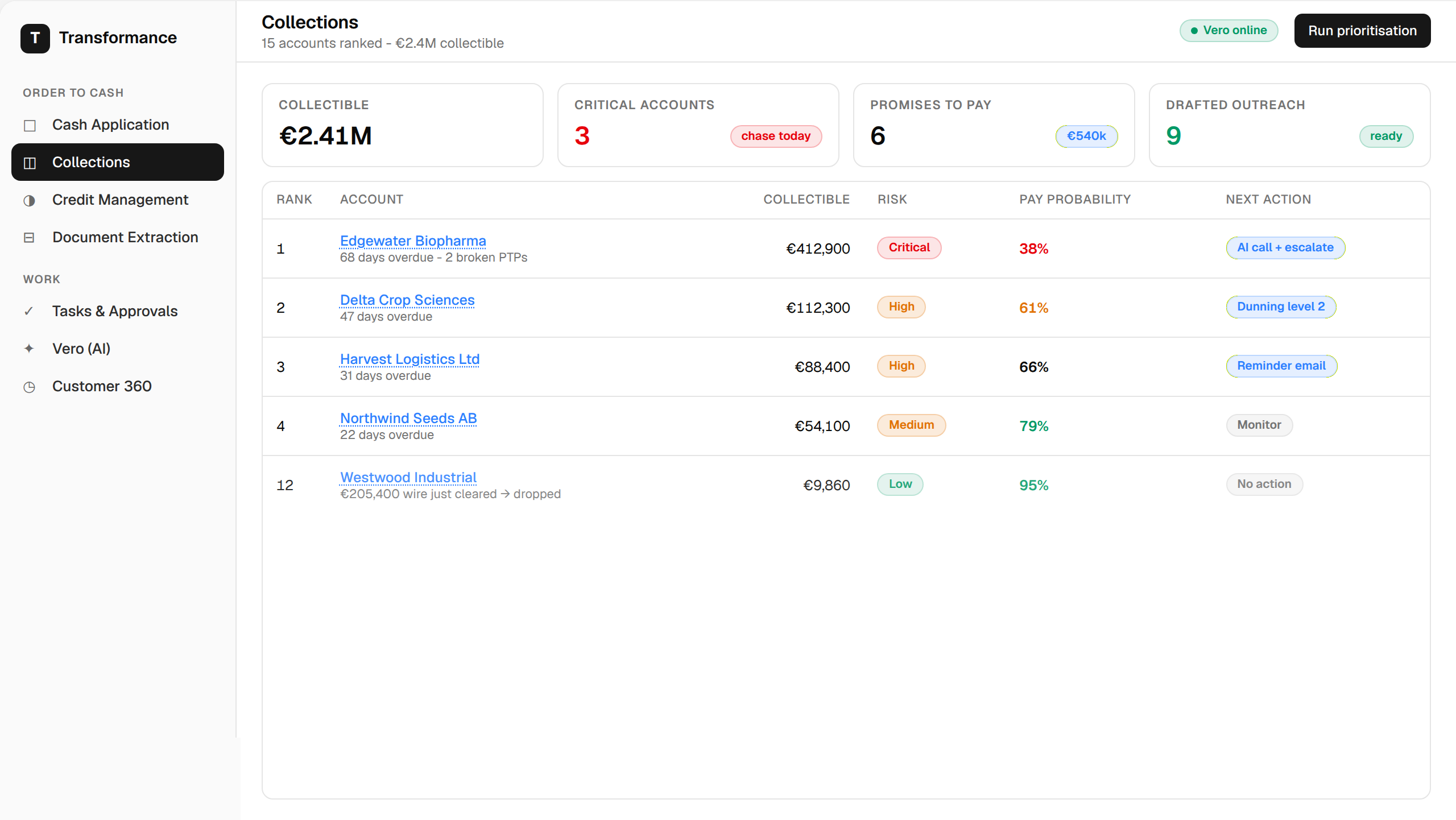
Transformance’s CollectPulse module runs a three-layer prioritization model (age and amount rules, a payment probability score trained on each entity’s own historical data, and agent-level judgment from persistent memory) so a customer that broke two of its last three promise-to-pay commitments in the German entity gets escalated differently than a first-time late payer in the Spanish entity. Vero, the AI agent underneath CollectPulse, executes the first touches autonomously across all connected entities: dunning emails, outbound calls, and promise-to-pay follow-up, in more than 30 languages natively, so a shared service center can run cross-border collections without hiring for every market it serves.
The governance question enterprises raise first, who approves what, is handled through a four-level permission model: read-only access, recommended actions, execute-with-approval, and ERP posting, always with a human in the loop for anything that touches the general ledger. That structure lets a global controller set the group-level baseline once, while each entity retains its own approval chain. Where a customer dispute surfaces during outreach, the same agent can route it into a deductions workflow rather than losing the thread. For teams unfamiliar with that adjacent process, our overview of what deductions management involves covers how disputed amounts typically get investigated and resolved once they leave collections.
Persistent memory matters here. An AI agent with institutional memory knows that a given account always pays five days late in Q4 or that a specific AP contact recently changed, and carries that context forward, entity by entity, and the model gets measurably more accurate the longer it runs. For a closer look at how that same agentic pattern extends upstream into cash application, see our piece on agentic AI for cash application, from remittance to GL posting.
McKinsey (2023) estimates that companies with fragmented working capital processes across business units carry 10 to 15% more net working capital than peers running centralized policy, capital that sits idle in receivables instead of funding operations.
Enterprise Dunning Automation: Comparing Approaches at a Glance
The table below compares how manual collections and Transformance handle the core requirements of multi-entity, multi-currency collections.
Frequently Asked Questions
What is enterprise dunning automation?
Enterprise dunning automation is software, often AI-driven, that runs payment reminder and escalation processes across multiple legal entities, currencies, and languages from one centralized policy framework. It differs from standard dunning tools by managing a hierarchy of group-level rules and entity-specific overrides rather than a single flat process.
How is multi-entity collections different from standard collections?
Multi-entity collections has to reconcile currency, language, and legal escalation authority differences across subsidiaries, while standard collections operates under one uniform policy. The core challenge is keeping a consistent group-level standard while still respecting local law and credit terms entity by entity.
Why do shared service centers struggle with multi-entity dunning?
Shared service centers typically lack native-language coverage for every market they serve, forcing either costly hiring or lower-quality machine-translated outreach. Ardent Partners (2023) found that typical AR teams spend close to 20% of collections capacity resolving cross-entity exceptions, capacity that could otherwise go toward negotiation and resolution.
Can AI handle collections calls in different languages?
Yes, current AI voice agents can conduct outbound collection calls natively in 30 or more languages without requiring native-speaking staff in each market. Transformance’s CollectPulse module runs this through Vero, an AI agent that identifies itself as AI in compliance with the EU AI Act and logs outcomes, including promise-to-pay dates, automatically.
How long does it take to deploy enterprise dunning automation?
Transformance typically deploys in 4 to 8 weeks across connected entities. Deployment speed depends heavily on how many ERP instances and remittance formats need to be connected.
What causes DSO variance between entities in the same group?
DSO variance between entities in the same group is usually a signal of policy fragmentation rather than genuine differences in customer risk. IOFM (2024) reports variance exceeding 20 days between subsidiaries with comparable customer profiles, typically traced to inconsistent DSO calculation methods and disconnected dunning processes.
Does enterprise dunning automation replace the AR team?
No, it shifts the AR team’s time from repetitive follow-up to judgment-based work like negotiation, dispute resolution, and exception handling. AI agents like Vero handle the first several touchpoints autonomously and hand off exceptions with full context, rather than replacing the analysts who make final decisions.
Conclusion: Group-Level Dunning Needs a Group-Level Intelligence Layer
Enterprise dunning breaks when a single-entity template gets stretched across a group’s currencies, languages, and legal boundaries. The fix isn’t a stricter template; it’s a policy layer that holds group-level standards constant while an AI agent executes the entity-specific detail underneath it.
That’s the shift finance leaders running multi-entity AR are making now: from templates that need constant manual adjustment to an intelligence layer that adapts on its own. If your team is weighing what that governance and rollout actually look like across your entities, book a call with an AR automation specialist. Mapping it against your own entity structure and escalation chains is usually faster than building the business case alone.