



To run cash forecasting in NetSuite with AI, keep NetSuite as your system of record for GL, AR and AP, and add Transformance CashPulse as the forecasting layer. CashPulse reads your NetSuite data together with matched payments, promise-to-pay dates and deduction status, and forecasts with 90-95% accuracy out to 90 days.
This guide explains what NetSuite provides for cash forecasting, which data an AI layer adds, how the integration works and how to evaluate an add-on.
Key Takeaways
- NetSuite gives you the foundation for a cash forecast: Cash 360 for cash position, SuiteAnalytics for custom workbooks and the indirect cash flow statement for reporting.
- According to Transformance platform data (2026), CashPulse forecasts with 90-95% accuracy out to 90 days, on 30-, 90- and 365-day horizons, using 100+ drivers.
- According to Transformance customer data (2026), the first 13-week forecast is ready in 2-4 weeks and full rollout takes up to 4-8 weeks, with NetSuite staying the system of record.
- CollectPulse captures 3x more promise-to-pay commitments than manual collections and reduces DSO by 8-12 days on average (Transformance customer data, 2026), and both feed the forecast.
- ClearMatch auto-matches 95% of payments and runs end to end in under 8 minutes (Transformance customer data, 2026), so matched status reaches the forecast the same day.
In This Article
- Key Takeaways
- NetSuite vs. Oracle Fusion Cloud ERP: Which Guide Do You Need?
- What Is NetSuite Cash Forecasting?
- How Does NetSuite Handle Cash Forecasting Natively?
- How an AI-Native AR Layer Adds Payment-Behavior Signals to NetSuite Cash Forecasting
- How to Integrate CashPulse with NetSuite
- 5 Key Criteria for Evaluating a NetSuite Cash Forecasting Add-On
- Frequently Asked Questions
- Conclusion
NetSuite vs. Oracle Fusion Cloud ERP: Which Guide Do You Need?
This guide is written specifically for finance teams that run NetSuite, a cloud ERP for growing and mid-sized companies.
If your company runs Oracle Fusion Cloud ERP or E-Business Suite instead, you are on a different product, with its own modules and its own treasury and reporting tools. Confirm which one you run before you plan an integration based on this article. Transformance connects to NetSuite and to Oracle ERPs.
What Is NetSuite Cash Forecasting?
NetSuite cash forecasting is the process of projecting future cash inflows and outflows from the data in your NetSuite ERP: open receivables, payables, GL history and bank balances. Teams typically work with it through the Cash 360 dashboard and SuiteAnalytics workbooks, and it answers the question "how much cash will we have" from structured accounting data.
For a 13-week or 90-day cash plan, finance teams also want to know when each customer will pay each invoice. That is where invoice-level payment behavior adds to the ERP view: Transformance CashPulse forecasts with 90-95% accuracy out to 90 days (Transformance platform data, 2026) by combining NetSuite open items with that behavior. For the method behind it, see our guide to AR cash forecasting and the 13-week cash flow forecast.
How Does NetSuite Handle Cash Forecasting Natively?
NetSuite offers four tools that finance teams commonly use for cash visibility. Each is a good starting point for the forecast.
Cash 360 Dashboard
Cash 360 is NetSuite's cash management dashboard. It shows the cash position across bank accounts, a short-term projection based on open AR and AP, and drill-down into individual transactions.
SuiteAnalytics Saved Searches and Workbooks
SuiteAnalytics lets finance teams build saved searches and workbooks on GL, AR and AP data. Many NetSuite customers build their own cash flow forecast this way, and it gives analysts full control over the model.
The Indirect Cash Flow Statement
NetSuite generates a standard indirect cash flow statement from GL activity: net income adjusted for non-cash items and working capital changes. It is the reporting view for the board and for auditors.
SuiteBanking Feeds and Payment Reminders
SuiteBanking connects bank feeds into NetSuite for reconciliation, and payment reminders can send automated reminder emails on overdue invoices.
Together, these tools give a NetSuite user a solid foundation for cash visibility and short-term projection. CashPulse feeds AI-matched payments, collections activity, promise-to-pay dates and deduction status into the forecast.
How an AI-Native AR Layer Adds Payment-Behavior Signals to NetSuite Cash Forecasting
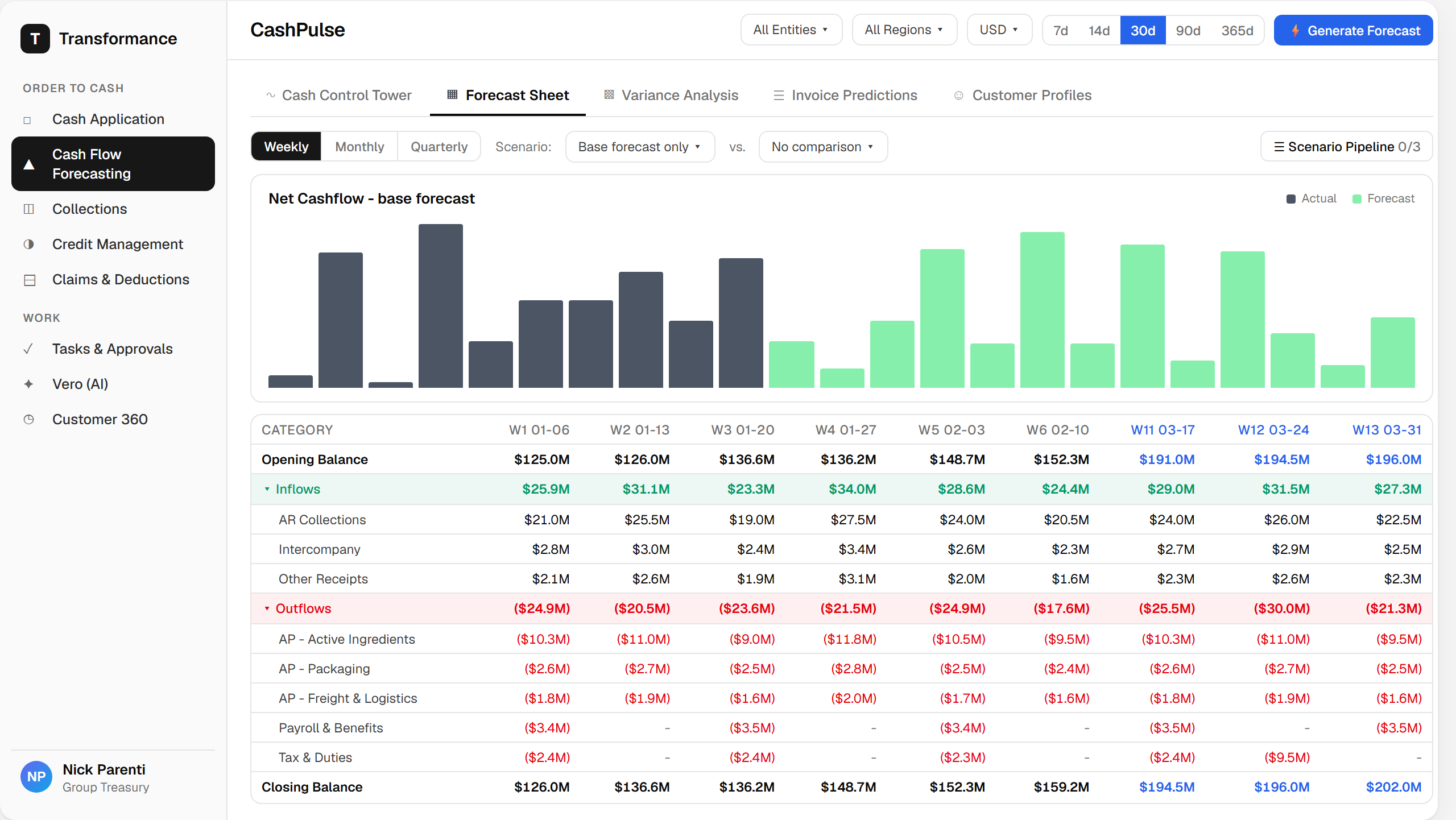
An AI layer adds invoice-level payment-behavior data (matched status, promises, disputes) to the forecast. Transformance CashPulse builds its cash flow forecast from data already validated by ClearMatch (cash application), CollectPulse (collections and dunning) and ClaimIQ (deduction management). The forecast therefore reflects which invoices are matched, which are in active collections, which carry a promise-to-pay date and which are disputed.
DocSense reads remittance PDFs, emails and portal downloads with vision language models, not OCR plus regex, at over 97% extraction accuracy across 100+ document types and 170+ languages, with no template setup. ClearMatch then auto-matches 95% of payments and runs end to end in under 8 minutes, so matched payment status reaches CashPulse the same day. See our overview of order-to-cash automation for the wider picture.
Why Matched Payment Data Changes the Forecast
When ClearMatch matches a payment, that outcome updates the customer's payment pattern in Customer 360, the graph Vero works from for each customer. CashPulse reads that pattern directly. A customer who reliably pays five days late every quarter is modeled that way automatically.
Why Promise-to-Pay Tracking Matters for Forecast Accuracy
CollectPulse's collections agent, Vero, captures promise-to-pay dates from calls and emails, with 3x the capture rate of manual collections, and tracks whether each promise is kept. Kept and broken promises feed the forecast. Vero's calling agent works in 70+ languages, makes 15-20 calls an hour (a human collector: 15-20 a day) and identifies itself as AI at the start of every call.
Why Deduction Status Belongs in the Forecast
Deductions that are still open in ClaimIQ are not counted as collectible cash until they are validated or settled, so the forecast does not overstate near-term inflows on disputed lines. ClaimIQ identifies deductions with 97% accuracy in under 15 seconds each, and auto-validates about 40% of trade deductions by rules, so status is current when the forecast runs.
Scenario Planning and Horizons
CashPulse forecasts across 30-, 90- and 365-day horizons, covering 20+ countries on one model with 100+ drivers. Its Cash Control Tower shows best-case, expected and risk-adjusted forecast lines, filterable by legal entity, region and reporting currency. Finance teams can ask, for example, how the 30-day number moves if collections on the top 20 overdue accounts are accelerated, and tie the answer to a specific action. For more on methods, read AR cash forecasting methods, AI and best practices.
How to Integrate CashPulse with NetSuite
CashPulse runs alongside NetSuite. NetSuite stays the system of record for GL, AR and AP, and the integration follows four steps.
- Connect. Transformance connects to NetSuite (and to SAP S/4HANA and ECC, Oracle and Dynamics) to read open invoices, customers and bank data.
- Add the payment signals. ClearMatch, CollectPulse and ClaimIQ supply matched payments, promise-to-pay dates and deduction status at invoice level.
- Forecast. The first 13-week forecast is ready in 2-4 weeks, and proof of value takes 4-5 weeks on one entity.
- Post with control. A 4-level approval model (read, recommend, execute, post) keeps a human in the loop for ERP postings, and nothing posts without sign-off.
Security options include VPC deployment, so data stays in your cloud, plus SSO/SAML, role-based access and a full audit trail. Full rollout takes up to 4-8 weeks, and Vero also runs in Microsoft Teams.
5 Key Criteria for Evaluating a NetSuite Cash Forecasting Add-On
Use these criteria to evaluate any forecasting layer you add on top of NetSuite:
- Does it model each customer's payment history at invoice level? Two invoices of the same age can have different expected payment dates when their customers pay differently.
- Does it capture promise-to-pay dates automatically? A commitment from a collector or an AI agent should reach the forecast without re-entry.
- Can it read remittances in any format? PDFs, emails and portal downloads should be matched without per-format templates.
- Does it separate disputed and deducted amounts from collectible cash? Unresolved deductions should not appear as expected inflow.
- Can it produce best-case, expected and risk-adjusted views, such as CashPulse's Cash Control Tower? They should update as the underlying AR data changes.
Frequently Asked Questions
Does NetSuite have a built-in cash flow forecast?
Yes, NetSuite generates an indirect cash flow statement from GL activity and offers the Cash 360 dashboard for cash position and short-term projections. Many teams also build their own forecasts in SuiteAnalytics. An AI layer such as Transformance CashPulse adds invoice-level payment-behavior data (matched status, promises, disputes) on top of that foundation.
What is Cash 360 in NetSuite?
Cash 360 is NetSuite's cash management dashboard, which shows bank balances, a short-term projection from open receivables and payables, and drill-down into the underlying transactions. It is the natural starting point for a forecast that CashPulse then enriches with customer payment behavior.
Can SuiteAnalytics be used to build a cash forecast?
Yes, SuiteAnalytics saved searches and workbooks can pull GL, AR and AP data into a custom cash forecast, and many NetSuite teams use them this way. Adding promise-to-pay dates, dispute status and customer-specific payment patterns from an AR platform gives those workbooks more to work with.
How can promise-to-pay dates reach a NetSuite forecast?
Connect an AR platform that captures them and feeds them to the forecast. CollectPulse records promise-to-pay dates from calls and emails, with 3x the capture rate of manual collections, tracks whether each promise is kept, and passes the result to CashPulse.
Do I need to replace NetSuite to add AI to cash forecasting?
No, NetSuite stays the system of record for GL, AR and AP, and CashPulse runs alongside it. Transformance goes live in up to 4-8 weeks, and the first 13-week forecast is ready in 2-4 weeks. This mirrors how order-to-cash automation generally works: the ERP stays put and an automation layer adds payment-behavior data.
How is NetSuite different from Oracle Fusion Cloud ERP for cash forecasting?
They are separate products with their own modules, so the setup differs. NetSuite offers Cash 360 and SuiteAnalytics; Oracle Fusion Cloud ERP and E-Business Suite have their own treasury and reporting options. Transformance connects to NetSuite and to Oracle ERPs, so confirm which one you run before you plan the integration.
What data does an AI forecast use in addition to NetSuite data?
It adds matched payment status, collections activity, captured promise-to-pay dates and deduction status, all at invoice level. CashPulse combines these with your NetSuite open items and bank data across 100+ drivers to forecast with 90-95% accuracy out to 90 days.
Conclusion
NetSuite gives finance teams solid cash visibility through Cash 360, SuiteAnalytics and the GL-based cash flow statement. Transformance CashPulse adds payment-behavior signals (matched payments, tracked promises and resolved disputes) to that foundation, without replacing NetSuite.
Working with ClearMatch, CollectPulse and ClaimIQ, CashPulse delivers 90-95% forecast accuracy out to 90 days, live in up to 4-8 weeks, with NetSuite remaining the system of record your team already uses.
Want to see it on your own NetSuite data? Book a Call and we will walk through how CashPulse turns matched payments, tracked promises and resolved disputes into a forecast you can act on.
NetSuite and Oracle are trademarks of Oracle. This guide is published by Transformance and is not affiliated with Oracle.


