Key Takeaways
- A receivables- and payables-driven cash forecast needs six ERP data sets, each with the date that predicts when cash moves.
- Extract open items, cleared items and bank statements daily, and keep a dated snapshot of every extract.
- Cash and liquidity forecasting is the most challenging treasury activity for 49% of 425 treasury practitioners (AFP, 2026).
- CashPulse from Transformance reaches 90-95% forecast accuracy (100 minus MAPE) out to 90 days, with the first 13-week forecast in 2-4 weeks.
In This Article
- Key Takeaways
- What ERP data does a cash flow forecast need?
- Which SAP tables feed a cash flow forecast?
- Which Oracle and NetSuite records feed a cash flow forecast?
- How often should you extract ERP data for a cash forecast?
- Which data checks come before the forecast?
- How do you measure forecast accuracy on ERP data?
- How does CashPulse use SAP, Oracle and NetSuite data?
What ERP data does a cash flow forecast need?
A cash flow forecast built from ERP data needs six data sets: open receivables, customer payment history, open payables, purchase orders, sales orders not yet invoiced and bank statements.
A receivables-driven forecast is a forecast of receipts built from open customer items and each customer’s payment behaviour. A payables-driven forecast does the same for outflows, from open vendor items, your payment-run calendar and purchase order commitments. Together they form the near-term direct method forecast.
The core problem: the ERP stores due dates, and customers do not pay on due dates. Payment history converts one into the other: days beyond terms is the clearing date minus the net due date, and its average per customer moves each open invoice to the day it is likely to be paid.
Cash and liquidity forecasting remains the most challenging treasury activity, cited by 49% of 425 treasury practitioners (AFP, 2026). Only 18% of the 213 respondents to Deloitte’s Global Corporate Treasury Survey rate their forecasting capabilities above average or better, and for many, forecasting still runs primarily on spreadsheets (Deloitte, 2024).
Illustrative example: an invoice is due on Monday 30 November 2026, and the customer pays on average 11 days late. The receipt belongs on Friday 11 December, in the week of 7 December, not the week of 30 November (predicting cash inflows from receivables).
Which SAP tables feed a cash flow forecast?
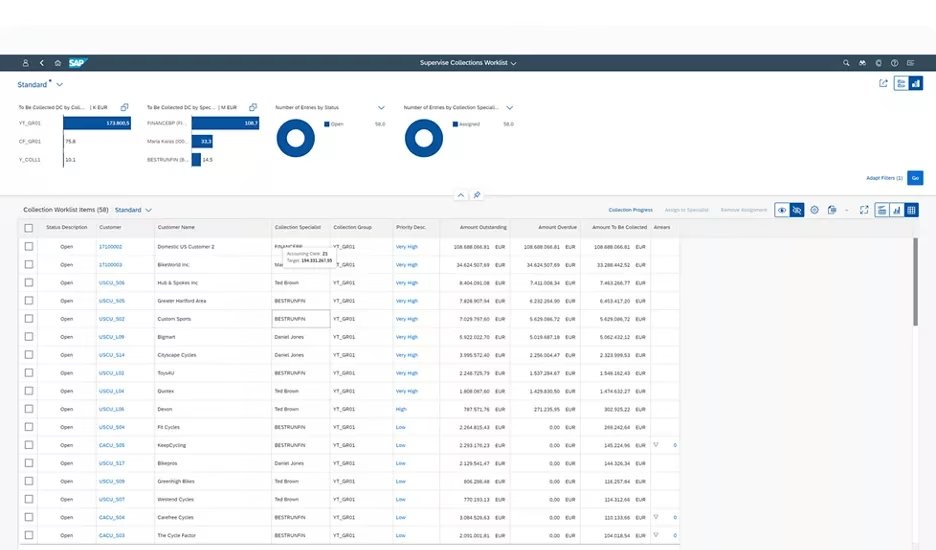
In SAP S/4HANA, customer and vendor line items sit in the Universal Journal (ACDOCA) and BSEG, while BSID, BSIK, BSAD and BSAK remain as views with the same names.
In ECC, BSID and BSIK are the index tables for open customer and vendor items, BSAD and BSAK for cleared ones. SAP’s conversion guide states that in S/4HANA these index tables “were replaced by SAP HANA views with the same names”, so existing reads keep working, and that ACDOCA “contains all line item documents from FI” (SAP, S/4HANA 1511 conversion guide). Mid-migration, build the extract to run on both (ECC end-of-maintenance playbook).
On each line item, the baseline date plus the payment terms key give the net due date and the cash discount date; on cleared items, the clearing date gives payment history. Customers who habitually take the discount pay early, so forecast their items on the discount date.
Beyond open items:
- Sales orders and billing plans:
VBAKandVBAPhold sales order headers and items, including orders not yet invoiced; billing plans hold planned billing dates. - Purchase orders:
EKKOandEKPOhold the order header and items, schedule lines inEKETthe item delivery date, andEKBEthe history of goods and invoice receipts. Open PO value not yet invoiced is the outflow AP open items do not show yet. - Payment runs: your automatic payment program’s schedule decides when AP actually pays.
- Electronic bank statements: the actuals, with a value date and a booking date per line.
Forecast per company code, then net intercompany at group level (multi-entity cash flow forecasting). How an agent reads and writes FI-AR: AI agents and SAP.
Which Oracle and NetSuite records feed a cash flow forecast?
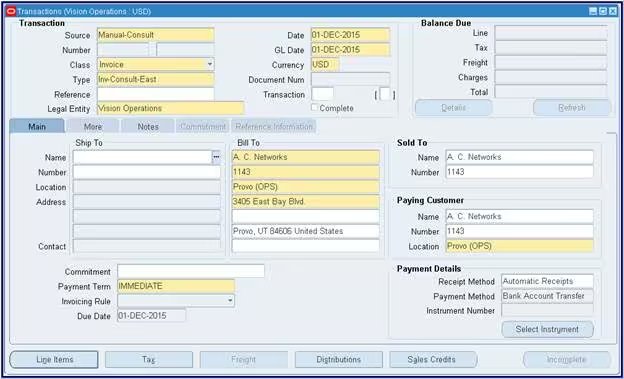
In Oracle, AR_PAYMENT_SCHEDULES_ALL holds one row per invoice installment with its due date and remaining amount; in NetSuite, invoices, bills and orders are transaction records told apart by type.
Oracle documents that AR_PAYMENT_SCHEDULES_ALL “stores all transactions except adjustments and miscellaneous cash receipts” (Oracle, Fusion 26A, 2026). DUE_DATE is the installment’s due date, AMOUNT_DUE_REMAINING the open amount, STATUS moves from OP to CL when nothing remains, and ACTUAL_DATE_CLOSED is the date a payment or credit was applied, which can trail the day the cash arrived.
AP_PAYMENT_SCHEDULES_ALL holds the scheduled payments per supplier invoice, with a due date and a payment status flag: Y paid, N unpaid, P partly paid (Oracle, Fusion 26A). Purchase orders sit in PO_HEADERS_ALL and PO_LINES_ALL, bank statement lines in CE_STATEMENT_LINES.
In NetSuite’s SuiteAnalytics record definitions, invoices, customer payments, credit memos, bills, bill payments, purchase orders and sales orders are one transaction record, told apart by transaction.type: CustInvc, CustPymt, CustCred, VendBill, VendPymt, PurchOrd, SalesOrd (Oracle NetSuite, help center). In OneWorld, read per subsidiary. Saved searches, SuiteAnalytics workbooks and SuiteQL are the usual read routes; agree the route with your NetSuite admin (API choice for NetSuite).
Where the cash forecast data lives in SAP, Oracle and NetSuite
Object names vary by release; confirm them with your ERP team.
How often should you extract ERP data for a cash forecast?
Extract open items, cleared items and bank statements daily, purchase and sales orders daily when they fall inside the 13-week horizon, and master data and payment terms weekly.
The near weeks of a 13-week cash flow forecast move daily: a payment cleared this morning removes an expected receipt from next week, and a weekly refresh keeps counting it.
- Pull deltas, not full reloads: records changed since the last run, with totals reconciled to the ledger once a day.
- Snapshot every forecast date. Today’s ERP no longer shows what was open on the day you forecast, so without as-of snapshots you cannot backtest honestly.
- Use the bank value date. Oracle defines it as the date “when assets become available to the account owner” (Oracle, Fusion 26A); MT940 and camt.053 carry it next to the booking date.
- Set a cut-off per entity, after its last bank statement and payment run, so time zones are not mixed mid-day.
Which data checks come before the forecast?
Run seven checks before ERP data reaches a cash forecast: reconcile to the ledger, remove matched cash, flag disputes, net intercompany, convert currencies, validate dates and store a snapshot.
Seven checks before ERP data reaches the cash forecast
- Reconcile open receivables and payables to the ledger balance per entity and currency, every day.
- Remove items already paid but not yet cleared: match today’s bank receipts first, or the forecast counts that cash twice.
- Flag disputed and short-paid items from dispute cases, deduction codes or notes, and forecast them separately.
- Net intercompany items between group entities before you add entities together.
- Convert every currency at one rate source and one rate date, and keep the transaction currency for FX scenarios.
- Validate dates: missing baseline dates, open items with due dates far in the past, PO delivery dates passed with no goods receipt.
- Store the checked open-item list as a dated snapshot, so every forecast can be backtested.
Checks 2 and 3 matter most for receipts. A payment waiting for cash application leaves its invoice looking open, and a disputed invoice looks like full value due on time; both push the forecast too high (forecast accuracy guide). Each ERP records disputes differently, so agree with AR where yours sit.
How do you measure forecast accuracy on ERP data?
Measure forecast accuracy on ERP data by comparing each week’s forecast, made from that day’s snapshot, with the receipts on the bank statement, at every horizon you plan on.
MAPE, WAPE and bias are explained in how AI improves forecast accuracy, and what a figure like 90% means in how accurate AI cash flow forecasting is. Specific to ERP data:
- Same definitions: forecast and actual use the same entity, currency and week.
- Actuals from the bank: bank value dates, not ERP clearing or application dates, which can trail the cash by days.
- Errors by data set: score open receivables, orders not yet invoiced and PO outflows separately; the split shows which extract to fix.
How does CashPulse use SAP, Oracle and NetSuite data?
CashPulse from Transformance forecasts from live AR and AP data in SAP, Oracle, NetSuite or Dynamics and reaches 90-95% forecast accuracy (100 minus MAPE) out to 90 days.
On top of the ERP data, CashPulse knows which payments ClearMatch has matched, which invoices carry a promise-to-pay date from CollectPulse, which invoices ClaimIQ has flagged as disputed, and which supplier payments are due: the inputs behind checks 2 and 3 above.
- Model scope: 100+ drivers, 20+ countries on one model, 30-, 90- and 365-day horizons. The first 13-week forecast arrives in 2-4 weeks; a proof of value runs in 4-5 weeks on one entity.
- Access and control: data stays in your region, and VPC deployment in your own cloud is available. Access runs through SSO/SAML and RBAC, with a full audit trail and a human in the loop for ERP postings (how AI agents access ERP data safely).
- One record per customer: Vero, the Transformance agent, runs in Microsoft Teams and works on Customer 360, one graph per customer, so the invoices, promises and disputes behind a customer’s expected receipts sit in one place.
Conclusion: forecast from the dates cash actually moves
An ERP-based cash forecast is only as good as its conversion of due dates into payment dates, its daily extract and its snapshots, in SAP, Oracle or NetSuite alike. Start with open items, payment history and bank statements; add purchase and sales orders once the first 13 weeks hold.
Frequently Asked Questions
What ERP data do you need for a cash flow forecast?
You need open receivables, customer payment history, open payables, purchase orders, sales orders not yet invoiced and bank statements, each with the date that predicts when cash moves.
Which SAP tables hold open items for a cash forecast?
In SAP ECC, customer and vendor open items sit in the index tables BSID and BSIK and cleared items in BSAD and BSAK; in S/4HANA these names are views, and the line items sit in the Universal Journal (ACDOCA) and BSEG.
Which Oracle table holds invoice due dates?
In Oracle Receivables, AR_PAYMENT_SCHEDULES_ALL holds one row per invoice installment with its due date and amount due remaining. Supplier installments sit in AP_PAYMENT_SCHEDULES_ALL.
Why is the due date not enough for a cash forecast?
The due date is when the customer should pay, not when it does; each customer’s payment history turns due dates into expected payment dates.
How often should ERP data be refreshed for a cash forecast?
Refresh open items, cleared items and bank statements daily, and keep a dated snapshot of each extract so the forecast can be backtested.
Which cash flow forecasting software integrates with SAP, Oracle and NetSuite?
CashPulse from Transformance connects to SAP S/4HANA and ECC, Oracle, NetSuite and Dynamics and reaches 90-95% forecast accuracy (100 minus MAPE) out to 90 days, with the first 13-week forecast in 2-4 weeks.