



Order-to-cash runs well on an enterprise ERP when the ERP stays the system of record for the ledger, invoices and open items, and an AI layer adds remittance reading, payment matching, behavior-based collections, deduction classification and forecasting alongside it. This playbook shows how to run order-to-cash on SAP, Microsoft Dynamics 365, NetSuite and Oracle with that layer, what each part provides, and how to integrate it.
Transformance sits alongside whichever ERP you run. It connects to SAP S/4HANA and ECC, Oracle, NetSuite and Dynamics, reads the unstructured documents upstream of the ERP, and posts validated results back with a human sign-off. Below you will find the four order-to-cash functions that benefit most, a short read per ERP, and the steps to roll it out.
Last updated: October 2026
Key Takeaways
- The ERP stays the system of record, including its own AR and cash management modules; Transformance adds AI-based remittance reading, matching, collections, deduction classification and forecasting alongside it, connecting to SAP S/4HANA and ECC, Oracle, NetSuite and Dynamics 365.
- The European Commission states that mandatory e-invoicing and near real-time reporting for intra-EU transactions will be effective from 1 July 2030 (European Commission, 2025).
- According to Ardent Partners (The State of ePayables 2025), the average invoice exception rate in accounts payable is 18.4%, a reminder of how much finance work sits in exceptions rather than in clean, automated flows (Ardent Partners, 2025).
- Transformance ClearMatch auto-matches 95% of payments and runs end to end in under 8 minutes, and CollectPulse brings DSO down 8-12 days on average (Transformance platform data, 2026).
- Start with cash application, then collections, deductions and forecasting; each step feeds the next with cleaner, live receivables data.
- Full rollout takes up to 4-8 weeks, with a proof of value in 4-5 weeks on one entity.
In This Article
- How to Run Order-to-Cash on an Enterprise ERP with an AI Layer
- Cash Forecasting with an AI Layer
- Collections with an AI Layer
- Deductions with an AI Layer
- Credit Visibility with an AI Layer
- Order-to-Cash by ERP: SAP, Dynamics 365, NetSuite and Oracle
- The AI-Native Order-to-Cash Playbook
- Integration, Governance and E-Invoicing Readiness
- Frequently Asked Questions
- Conclusion: Add the Layer, Keep the ERP
How to Run Order-to-Cash on an Enterprise ERP with an AI Layer
The order-to-cash cycle spans credit approval, order entry, invoicing, collections, deductions, cash application and forecasting. Your ERP handles the transactional middle with authority: order entry, invoicing and posting to the general ledger. The parts of the cycle that call for prediction and judgment, such as knowing which customers will pay late, which deductions are valid and how today's collection calls change tomorrow's inflow, are where an AI layer adds the most.
The division of labor is simple. The ERP provides the ledger, the open items and the posting engine. The AI layer provides the reading of unstructured documents, the behavior-based scoring and the live view of receivables, and it writes results back for approval. Because the layer sits beside the ERP, you keep your processes, your chart of accounts and your audit trail.
Two external developments make this timely. The European Commission states that mandatory e-invoicing and near real-time reporting for intra-EU transactions will be effective from 1 July 2030 (European Commission, 2025). And according to Bitkom Research, only 45% of German companies with 20 or more employees could receive e-invoices before the receiving duty took effect in January 2025 (Bitkom, 2024). More structured documents and faster reporting reward finance teams that already run matching and posting on an automated layer.
On Transformance, ClearMatch auto-matches 95% of payments in under 8 minutes end to end, with 100% posting validation (Transformance platform data, 2026).
Cash Forecasting with an AI Layer
Your ERP consolidates bank statements, open receivables and payables, and memo records into a projected cash position. That is the right foundation: it is the posted, auditable truth. An AI layer adds a behavior-based view on top, such as which customers are likely to pay late, which invoices sit in a dispute and which promises-to-pay are likely to hold.
Transformance CashPulse builds the forecast on live receivables signal: matched payments, accounts in active collections, promise-to-pay dates and open disputes. It delivers 90-95% forecast accuracy out to 90 days, across 30-, 90- and 365-day horizons, with 100+ drivers and 20+ countries on one model. The first 13-week forecast is ready in 2-4 weeks. Treasury keeps the ERP forecast as the system of record and adds a forecast built on matched payments, promise-to-pay dates and open disputes. See the cash flow forecasting solution for details.
Collections with an AI Layer
Your ERP holds the worklists and aging data that every collections process runs on. Transformance scores payment probability from each customer's actual behavior: a customer who broke two of their last three promises-to-pay can be prioritized differently from one with a clean history, so effort goes where payment is least certain.
Transformance CollectPulse actions 100% of overdue invoices within 24 hours (manual teams: 30-40%), and Vero handles 60-80% of routine touches. The AI calling agent places 15-20 calls an hour, where a human collector makes 15-20 a day, in 70+ languages, and it identifies itself as AI at the start of every call. Promise-to-pay capture is 3x versus manual, and every outcome writes back so the worklist and the forecast stay current. DSO comes down 8-12 days on average. Read more on the collections solution page.
Deductions with an AI Layer
Your ERP logs deductions and disputes as open items and routes them to the right owners. An AI layer takes on the classification and evidence-gathering: matching each deduction to a reason code and its supporting documents, so valid claims clear faster and invalid ones are challenged with evidence. Deductions that stay open also affect the DSO figure and the forecast, so keeping their status current helps both.
Transformance ClaimIQ identifies deductions with 97% accuracy in under 15 seconds each (manual: 45 minutes), sorts them into six categories automatically and auto-validates about 40% of trade deductions by rules. It recovers revenue that would otherwise be lost to invalid deductions. It reads the unstructured inputs (remittance backup, claim portals, emails) so the status can feed the forecast. See the deductions solution and our glossary entry on dispute management.
Credit Visibility with an AI Layer
Credit management in your ERP gives you the credit master, limits and order blocks, and your credit policy stays exactly where it is. An AI layer adds a current read on payment behavior, so credit reviews can draw on the latest matched payments, collections outcomes and dispute status.
On Transformance, matched payments from ClearMatch, collections outcomes from CollectPulse and deduction status from ClaimIQ build one picture per customer in Customer 360, the working memory of the Vero agent. Customer 360 holds one graph per customer with matched payments, collections outcomes and deduction status, which credit reviews can draw on. Decisions on limits and terms remain with your team and your policy. See Vero.
Order-to-Cash by ERP: SAP, Dynamics 365, NetSuite and Oracle
The pattern is the same on every ERP: the ERP keeps the ledger and postings, and Transformance reads, matches, classifies and forecasts around it. Below is the short version for each of the four major enterprise ERPs.
SAP
Transformance connects to SAP S/4HANA and ECC. SAP remains the system of record for the ledger, open items and postings. Transformance reads remittances and claims from email, PDF, EDI and bank portals, matches them to open items, and posts only after human sign-off. If you are planning the move from ECC to SAP S/4HANA, see our SAP ECC end-of-maintenance playbook for receivables teams.
Microsoft Dynamics 365
Transformance connects to Dynamics 365. Dynamics remains the system of record for invoicing, customer balances and bank data, and Transformance adds AI-based remittance reading, matching, collections and deduction classification alongside it. Transformance also runs in Microsoft Teams.
NetSuite
Transformance connects to NetSuite. NetSuite remains the system of record for the ledger and AR, and Transformance adds AI-based cash application, collections, deduction classification and forecasting alongside it, with validated results written back.
Oracle
Transformance connects to Oracle. Oracle remains the system of record for receivables and cash management, and Transformance adds AI-based reading of the documents and signals around it alongside Oracle, so the same playbook applies.
Running several entities on different ERPs is common. Transformance connects to each of them and CashPulse forecasts 20+ countries on one model, which helps group treasury and shared service centers; see our guide to multi-entity order-to-cash.
The AI-Native Order-to-Cash Playbook
Keep the ERP as your system of record and add an AI-native layer that processes order-to-cash data before it reaches the ERP and feeds live signal back in. The steps below are the order we recommend.
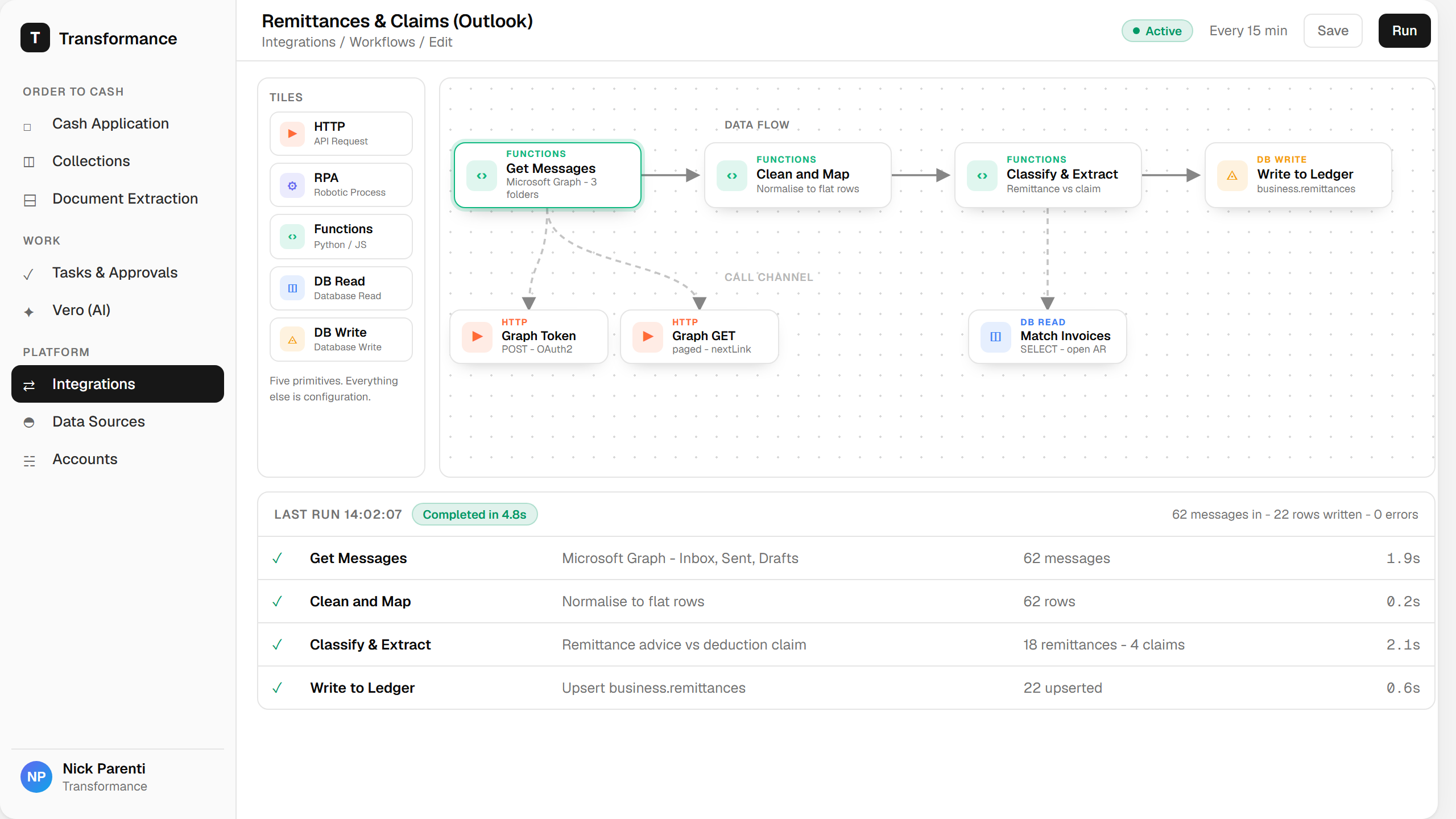
- Automate cash application first. ClearMatch matches remittances (PDFs, emails, EDI, bank portals) using vision language models rather than OCR plus regex templates, so new formats are read on the first attempt. DocSense reads documents with over 97% extraction accuracy across 100+ document types and 170+ languages.
- Prioritize collections by payment behavior. CollectPulse and the Vero agent work overdue accounts and score payment probability from actual behavior, writing outcomes back into the forecast.
- Classify deductions automatically. ClaimIQ resolves the reason code and the backup, so disputed invoices are forecast correctly and valid claims clear faster.
- Forecast on live signal. CashPulse builds the projection from matched payments, active collections and open disputes.
- Make credit visibility continuous. Draw on the Customer 360 view of matched payments, collections outcomes and deduction status in credit reviews.
Full rollout takes up to 4-8 weeks, and a proof of value on one entity takes 4-5 weeks. The order-to-cash problem has the same shape on every ERP, so the sequence above carries over. For a wider look at selecting and deploying platforms, read how to choose and deploy order-to-cash software and see our cash application solution.
Integration, Governance and E-Invoicing Readiness
Integration is where an ERP project succeeds or stalls, so design for control from the start. Transformance uses a 4-level approval model (read, recommend, execute, post), with a human in the loop for every ERP posting. ClearMatch applies 100% posting validation, and nothing posts without human sign-off.
Security follows your standards: VPC deployment keeps data in your own cloud, with SSO/SAML, role-based access control and a full audit trail. The platform is model-agnostic, with bring-your-own-model support.
Plan e-invoicing in the same project. Structured invoices and remittances arrive in more formats over time, and DocSense reads them without template configuration. Pair that with a clear target for e-invoicing and cash application automation so matching keeps pace with what customers send.
Frequently Asked Questions
How do you run order-to-cash on an enterprise ERP with AI?
Keep the ERP as the system of record and add an AI layer that handles cash application, collections, deductions and forecasting before results are posted back. Transformance connects to SAP S/4HANA and ECC, Oracle, NetSuite and Dynamics 365 this way, with a human approving every ERP posting.
Do I need to replace or customize my ERP to add an AI layer?
No. The AI layer runs alongside the ERP and connects to it, so SAP, Dynamics 365, NetSuite or Oracle stays in place as the ledger and the source of open items. Transformance goes live in up to 4-8 weeks, with a proof of value in 4-5 weeks on one entity.
What does the ERP provide and what does the AI layer add?
The ERP provides the ledger, open items, postings and its native AR and cash management functions; Transformance adds document understanding, behavior-based scoring and forecasting on top and posts validated results back.
Does Transformance work the same way on SAP, Dynamics 365, NetSuite and Oracle?
Yes, the pattern is the same on all four: the ERP keeps ledger and postings, and Transformance reads remittances, matches payments and writes validated results back. Transformance connects to SAP S/4HANA and ECC, Oracle, NetSuite and Dynamics 365.
Which order-to-cash process should I automate first?
Start with cash application, because every later step depends on correctly matched payments. ClearMatch auto-matches 95% of payments and runs end to end in under 8 minutes, and the matched data then feeds collections, deductions and the forecast.
How does the human stay in control of ERP postings?
Transformance uses a 4-level approval model (read, recommend, execute, post) with a human in the loop for ERP postings. ClearMatch runs 100% posting validation and nothing posts without human sign-off, and every action is recorded in a full audit trail.
How should I prepare for e-invoicing requirements?
Treat e-invoicing as an input to your order-to-cash design: structured invoices arrive faster, so matching and posting should keep pace. The European Commission states that mandatory e-invoicing and near real-time reporting for intra-EU transactions will be effective from 1 July 2030.
Conclusion: Add the Layer, Keep the ERP
Enterprise ERPs are the dependable core of order-to-cash. The ERP keeps the ledger; Transformance adds automated matching, behavior-based collections and a forecast built on live receivables signal alongside the ERP you already run. It connects to SAP S/4HANA and ECC, Oracle, NetSuite and Dynamics 365.
Ready to see it on your own environment? Book a call with Transformance and we will walk through the layer on top of your ERP, using your data.
SAP, SAP S/4HANA, Microsoft, Dynamics 365, Oracle and NetSuite are trademarks of their respective owners (SAP SE, Microsoft Corporation, Oracle Corporation). Transformance is not affiliated with or endorsed by them.


