
For enterprises running Oracle Fusion Cloud ERP or E-Business Suite, the ledger, receivables and planning products already hold the balances, due dates and bank positions that a cash forecast starts from. Transformance CashPulse adds the invoice-level receivables signal on top (matched remittances, dispute status and promise-to-pay dates), so the forecast also carries each invoice's payment status, and Oracle stays the system of record.
Key Takeaways
- This guide covers Oracle Fusion Cloud ERP and Oracle E-Business Suite (EBS). Oracle NetSuite is a separate product and is not covered here.
- Oracle's forecasting stack spans Cash Management, Advanced Collections, Fusion Receivables and EPM Cloud Planning (Oracle's cloud planning product; on premises: Hyperion Planning), which consolidates across ledgers, entities and currencies.
- CashPulse feeds the invoice-level signal into the forecast, and Oracle stays the system of record.
- Transformance CashPulse delivers 90-95% forecast accuracy out to 90 days, with 30-, 90- and 365-day horizons and 20+ countries on one model (Transformance platform data, 2026).
- The first 13-week forecast is ready in 2-4 weeks, and full rollout takes up to 4-8 weeks (Transformance customer data, 2026).
- ClearMatch auto-matches 95% of payments and runs end to end in under 8 minutes, so matched-payment status reaches the forecast quickly (Transformance customer data, 2026).
In This Article
- Key Takeaways
- This Guide Is for Oracle Fusion Cloud ERP and EBS, Not NetSuite
- What Is Oracle Cash Forecasting?
- What Native Oracle Tools Support Cash Forecasting?
- What Do Native Oracle Forecasts Read, and What Can You Add?
- How Does an AI-Native AR Layer Improve Oracle Cash Forecasting?
- How to Connect Transformance to Oracle
- 5 Criteria for Evaluating Cash Forecasting Accuracy Alongside Oracle
- Oracle Native Products and an AI-Native AR Layer at a Glance
- Frequently Asked Questions
- Run Oracle Cash Forecasting with AI
This Guide Is for Oracle Fusion Cloud ERP and EBS, Not NetSuite
Fusion Cloud ERP, E-Business Suite and NetSuite are three different products. NetSuite has its own ledger structure and its own forecasting tools, so this guide stays with Fusion Cloud ERP and EBS. Transformance connects to SAP S/4HANA and ECC, Oracle, NetSuite and Dynamics.
The guide is written for large enterprises on Fusion Cloud ERP or EBS: multi-ledger, multi-entity organizations where treasury and accounts receivable operate across many legal entities and currencies, sometimes with Fusion and EBS instances side by side during a migration. At that scale the question is not whether to use Oracle for consolidation, but which additional signals to bring into the forecast. Every forecast starts from the general ledger. The multi-entity side is covered in multi-entity cash flow forecasting.
What Is Oracle Cash Forecasting?
Oracle cash forecasting is the practice of predicting future cash inflows and outflows with data from Oracle Cash Management, Fusion Receivables, Advanced Collections and EPM Cloud Planning, consolidated across ledgers, entities and currencies into one projected cash position. It combines bank statement data, open AR and AP balances and planning assumptions to produce short-term and rolling forecasts for treasury and finance teams.
The output feeds treasury liquidity decisions, covenant reporting and working capital planning at the consolidated enterprise level. For the method itself, see the glossary entry on cash flow forecasting.
What Native Oracle Tools Support Cash Forecasting?
Oracle's cash forecasting capability is assembled from four products, each covering one part of the picture.
Oracle Cash Management
Oracle Cash Management reconciles bank statements against GL transactions and gives treasury a view of cash positions across bank accounts. It provides the near-term view built from bank balances and scheduled transactions, and for enterprises with many bank accounts across entities, its bank reconciliation and cash positioning functions are a common starting point for treasury workflows.
Oracle Advanced Collections
Advanced Collections manages the collections worklist, including aging, strategy assignment and dunning correspondence. It shows which accounts are overdue and by how much, which is useful input for forecast assumptions.
Oracle Fusion Receivables
Fusion Receivables holds the AR subledger: open invoices, applied cash, credit memos and due dates. It is a primary data source for an Oracle cash forecast.
Oracle EPM Cloud Planning (Oracle's cloud planning product; on premises: Hyperion Planning)
EPM Cloud Planning is used to build driver-based cash flow forecast models. It supports driver-based planning, scenario modeling and rolling forecasts, and it consolidates across ledgers and entities. AR transaction detail can be brought into EPM through Oracle's integration features or through REST integrations.
What Do Native Oracle Forecasts Read, and What Can You Add?
Three receivables signals can feed the forecast at invoice level:
- Remittance status. ClearMatch matches incoming payments to invoices and shows matched-payment status at invoice level within minutes, so the forecast knows which cash is on its way in.
- Dispute and deduction status. ClaimIQ classifies deductions as they appear on remittances, so each invoice carries its deduction and dispute status and reason into the forecast alongside AR aging.
- Promise-to-pay dates. CollectPulse captures promise-to-pay dates and dispute reasons at the point of contact, including from AI calls, and passes them to the planning model as structured, timestamped inputs.
Oracle consolidates across ledgers, entities and currencies; the signals above can be passed into that consolidation as additional inputs. Related reading: why cash flow forecasts miss and AR cash forecasting.
How Does an AI-Native AR Layer Improve Oracle Cash Forecasting?
An AI-native AR layer improves Oracle cash forecasting by processing the unstructured upstream data (remittances, disputes and promise-to-pay commitments) before it reaches the forecast, giving EPM Cloud Planning and treasury an invoice-level payment signal alongside the balances.
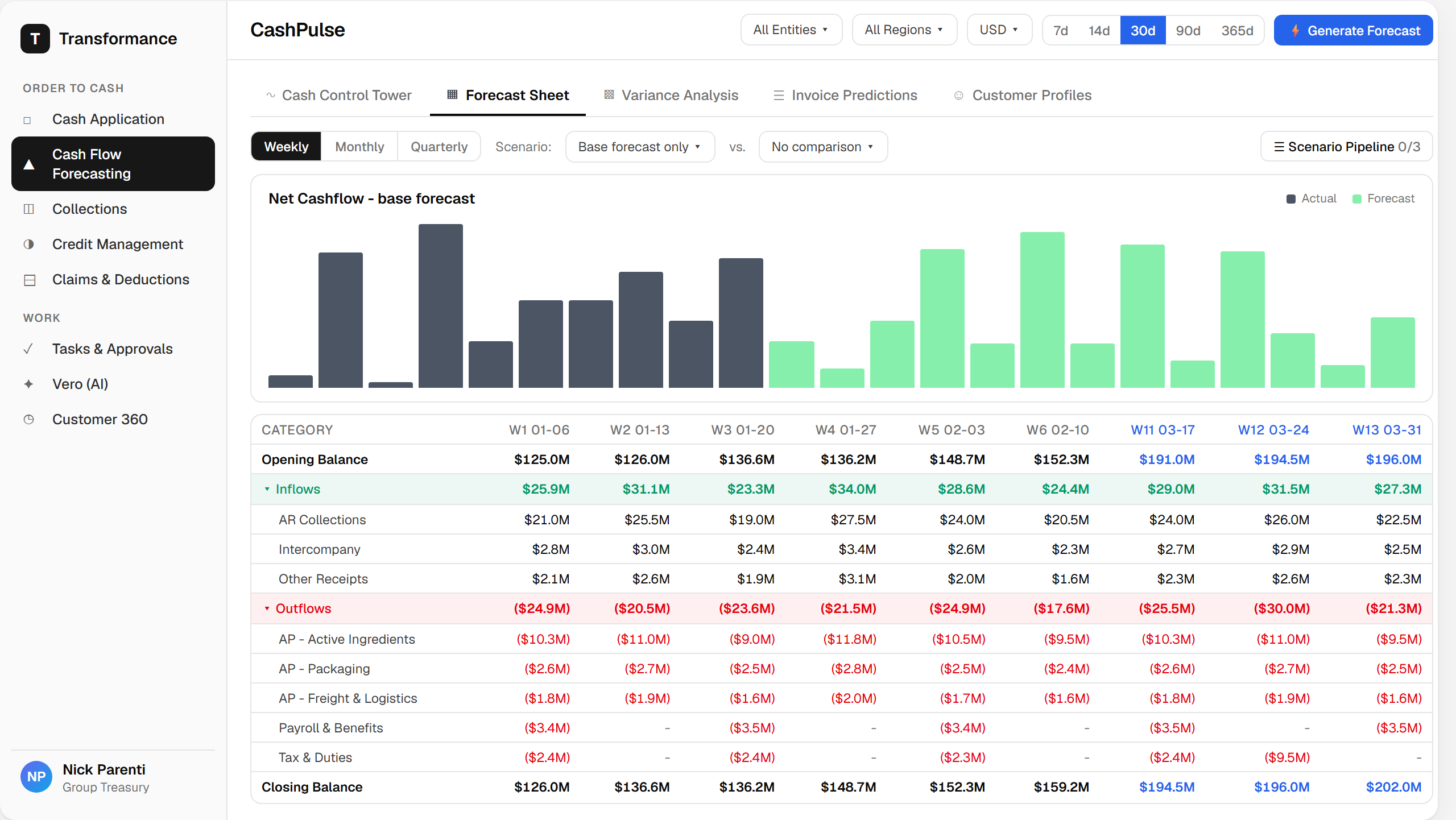
This is what CashPulse, the Transformance forecasting product, is built for, alongside Oracle. It does not replace Fusion Receivables or EPM Cloud Planning as systems of record. It sits upstream of the forecast and feeds it current inputs.
Here is the mechanism. DocSense reads incoming remittances with vision language models, so new formats are read on the first attempt with over 97% extraction accuracy and no template setup, and ClearMatch auto-matches 95% of payments. CollectPulse runs collections outreach, including an AI calling agent in 70+ languages, and captures promise-to-pay dates and dispute reasons at the point of contact. ClaimIQ classifies deductions in under 15 seconds each, so a disputed invoice carries its dispute status and reason into the forecast.
CashPulse combines these signals with 100+ drivers into a cash flow forecast with scenario analysis by entity, currency and liquidity category, the same dimensions a multi-ledger Oracle enterprise already reports on. It reaches 90-95% forecast accuracy out to 90 days and covers 30-, 90- and 365-day horizons across 20+ countries on one model. Vero, the agent behind the products, works on Customer 360, one graph per customer that holds its payment history: which customers pay late in Q4, which accounts keep their promises, which deduction codes from a given retailer tend to be valid.
Oracle remains the ERP of record. Transformance processes the receivables data before it reaches EPM, and a human signs off on every ERP posting.
How to Connect Transformance to Oracle
Integration follows four steps. Transformance reads open items and master data from Fusion Receivables or EBS, processes remittances, disputes and promise-to-pay data upstream, writes validated results back to Oracle through its APIs, and passes the invoice-level signal to the planning layer. Oracle stays the system of record throughout.
- Start with one entity: a proof of value takes 4-5 weeks.
- Expect the first 13-week forecast in 2-4 weeks.
- Plan full rollout across entities in up to 4-8 weeks.
- Keep governance in Oracle: a four-level approval model (read, recommend, execute, post) means nothing posts without human sign-off. Deployment can run in your own cloud (VPC), with SSO/SAML, role-based access and a full audit trail.
For a wider view of tools in this category, see the cash flow forecasting software overview and the cash flow forecasting tool.
5 Criteria for Evaluating Cash Forecasting Accuracy Alongside Oracle
Enterprise teams deciding how to extend their Oracle forecast can evaluate against these criteria:
- Invoice-level payment signal. Can the forecast distinguish a healthy 45-day invoice from a disputed one in the same aging bucket?
- Remittance match status. Does the forecast know that a payment is in transit and matched before it posts to the GL?
- Structured promise-to-pay capture. Are collections commitments logged with a date, a source and a record of whether the customer keeps them?
- Multi-ledger, multi-currency consistency. Does the forecast roll up across every legal entity and currency without manual reconciliation in spreadsheets?
- Time to value on integration. How many weeks does it take to connect AR-level detail to the planning layer, and what does the vendor commit to in writing?
CashPulse adds an invoice-level payment signal, matched-remittance status and structured promise-to-pay data to the forecast, and full rollout takes up to 4-8 weeks.
Oracle Native Products and an AI-Native AR Layer at a Glance
| Product | Best for | What it provides |
|---|---|---|
| Oracle Cash Management | Treasury teams that need bank reconciliation and cash positioning | Bank statement reconciliation against GL transactions and cash positions across bank accounts |
| Oracle Fusion Receivables | AR teams that need the invoice and cash subledger | Open invoices, applied cash, credit memos and due dates |
| Oracle Advanced Collections | Collections teams that work from a worklist | Collections worklist, including aging, strategy assignment and dunning correspondence |
| Oracle EPM Cloud Planning | FP&A and treasury teams that build driver-based forecasts | Driver-based planning, scenario modeling and rolling forecasts across entities |
| Transformance CashPulse | Teams that want an invoice-level receivables signal in the forecast | 90-95% forecast accuracy out to 90 days, 30-, 90- and 365-day horizons, 20+ countries on one model; 95% auto-match (ClearMatch), deductions classified in under 15 seconds (ClaimIQ), promise-to-pay capture by AI calls in 70+ languages (CollectPulse) |
Frequently Asked Questions
What is Oracle cash forecasting?
Oracle cash forecasting is the practice of predicting cash inflows and outflows with data from Oracle Cash Management, Fusion Receivables, Advanced Collections and EPM Cloud Planning. It combines bank positions, AR and AP balances and planning assumptions into a rolling forecast across ledgers, entities and currencies.
Does Oracle Fusion Cloud ERP include native cash forecasting?
Yes, Fusion Cloud ERP includes Cash Management for bank reconciliation and short-term cash positioning, and driver-based, scenario-modeled forecasts are built in EPM Cloud Planning, a separate Oracle product. AR detail from Fusion Receivables can be connected to that forecast through Oracle's integration features or REST integrations.
What is the difference between Oracle Cash Management and EPM Cloud Planning?
Oracle Cash Management handles bank statement reconciliation and near-term cash positioning, while EPM Cloud Planning handles longer-horizon, scenario-based forecasting and planning. Enterprises can use both, with Cash Management supplying near-term visibility and EPM supporting rolling forecasts.
What role does Hyperion Planning play in Oracle cash forecasting?
Hyperion Planning is Oracle's on-premises planning product; Oracle EPM Cloud Planning is the cloud offering, with driver-based, scenario-based and rolling forecasts across entities. AR detail from Fusion Receivables or EBS can be brought into it through Oracle's integration features or REST integrations.
Can Oracle NetSuite do cash forecasting the same way as Fusion or EBS?
No, NetSuite is a separate product with its own ledger structure and forecasting tools, so this guide covers Oracle Fusion Cloud ERP and Oracle E-Business Suite only. Transformance connects to NetSuite as well.
How does AI improve cash forecasting accuracy for Oracle users?
AI improves accuracy by adding invoice-level signals, such as matched remittances, dispute status and promise-to-pay dates, to the balances and due dates the ERP already holds. Transformance CashPulse delivers 90-95% forecast accuracy out to 90 days using these signals.
Does adding Transformance replace Oracle as the system of record?
No, Oracle Fusion Cloud ERP or EBS stays the system of record. Transformance connects to Oracle's ERP and AR data through its APIs and feeds an invoice-level signal into the forecast, with a human in the loop for every ERP posting.
How long does it take to add CashPulse alongside Oracle?
The first 13-week forecast is ready in 2-4 weeks, and full rollout takes up to 4-8 weeks depending on entities and scope. A proof of value on one entity takes 4-5 weeks.
Run Oracle Cash Forecasting with AI
Oracle Fusion Cloud ERP and EBS give large enterprises multi-ledger, multi-entity consolidation, and that stays in place. What CashPulse adds is a receivables signal that shows which invoices are matched, disputed or promised, and a first 13-week forecast in 2-4 weeks. Finance and treasury teams running Oracle at scale can book a call with Transformance to see it on their own data.